TLDR;
This video explores the Hebrew word "Adam," often translated as "human," and its deeper significance in Biblical Hebrew. It explains that "Adam" represents a composition of male and female, not in a biological sense, but as the union of soul and body. The video further connects the numerical value of "Adam" to the filled name of God, suggesting an equivalence between humanity and the divine.
- "Adam" signifies the union of male (soul) and female (body).
- The numerical value of "Adam" (45) matches the filled name of God, symbolising a connection between humanity and divinity.
- Understanding Hebrew letters and their numerical values provides insights into the deeper meanings of biblical concepts.
Introduction to Adam in Biblical Hebrew [0:03]
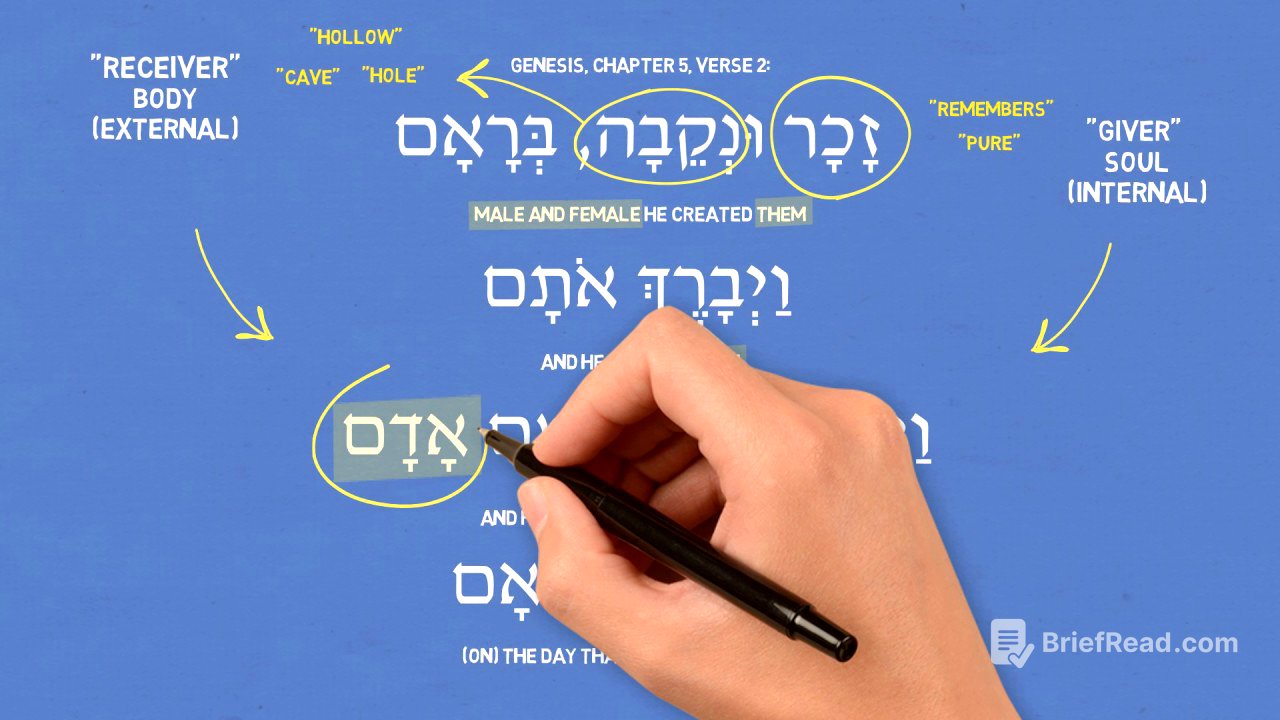
The video begins by introducing the Hebrew word "Adam," which is commonly translated as "human" in English. It poses the question of what it truly means to be "Adam" according to the Hebrew Bible. Genesis chapter 5, verse 2 is referenced, setting the stage for an exploration of the word's deeper meaning and significance.
The Composition of Adam: Male and Female [0:20]
The video analyses Genesis 5:2, highlighting that "Adam" is not solely a biological male or physical female, but a composition of both. It explains that only the union of male and female can be named "Adam." The terms "Zahar" (male) and "Nekevah" (female) are examined, with "Zahar" representing the one who remembers and is pure, and "Nekevah" symbolising a hole or deficiency. Together, they form "Adam."
Soul and Body: The True Essence of Adam [3:52]
The explanation moves beyond the literal interpretation of male and female, presenting "Zahar" as the soul that remembers its heavenly origins and "Nekevah" as the human body. It asserts that only the soul and body together constitute "Adam," emphasising that neither the soul alone nor the body alone can be considered human. The union of both is essential to being "Adam."
The Numerical Value of Adam [5:12]
The video breaks down the Hebrew word "Adam" into its constituent letters: Aleph, Dalet, and Mem (final form). Each letter is assigned a numerical value: Aleph (1), Dalet (4), and Mem (40). The sum of these values is 45. This numerical value of "Adam" becomes significant as it is later compared to the numerical value of the name of God.
The Name of God and its Numerical Value [6:22]
The video revisits the name of God (Hashem) written as Yod, Heh, Vav, Heh, which represents mercy and love. The numerical values of these letters (10, 5, 6, 5) add up to 26. It then introduces an alternative way of writing the name of God, using the filled letters (Yod-Aleph-Dalet, Heh-Aleph, Vav-Aleph-Vav, Heh-Aleph).
Equivalence of Form: Adam and the Name of God [9:11]
The numerical value of the filled name of God is calculated, revealing a total of 45. This matches the numerical value of "Adam." The video concludes that this equivalence signifies a correlation of form between the human being (soul and body) and the name of God, suggesting a deep connection between humanity and the divine.