TLDR;
This video presents important chemistry questions for board exams, focusing on solid-state topics. It covers packing efficiency calculations, HCP structures, numerical problems involving BCC lattices and density, explanations of magnetic substances, relationships between edge length and radius in unit cells, definitions of magnetic solids, non-stoichiometric defects, and Bravais lattices. The presenter encourages viewers to like, share, and subscribe for more videos.
- Packing efficiency calculations for BCC lattices.
- Explanation of HCP structures and atomic arrangements.
- Numerical problems related to density and radius of atoms in BCC structures.
- Explanation of diamagnetic, paramagnetic, and ferromagnetic substances.
- Relationship between edge length (a) and radius (r) for different unit cells.
- Definitions of diamagnetic, paramagnetic, and ferromagnetic solids.
- Discussion of non-stoichiometric point defects and F-centres.
- Definition of Bravais lattices and related numerical problems.
Introduction [0:00]
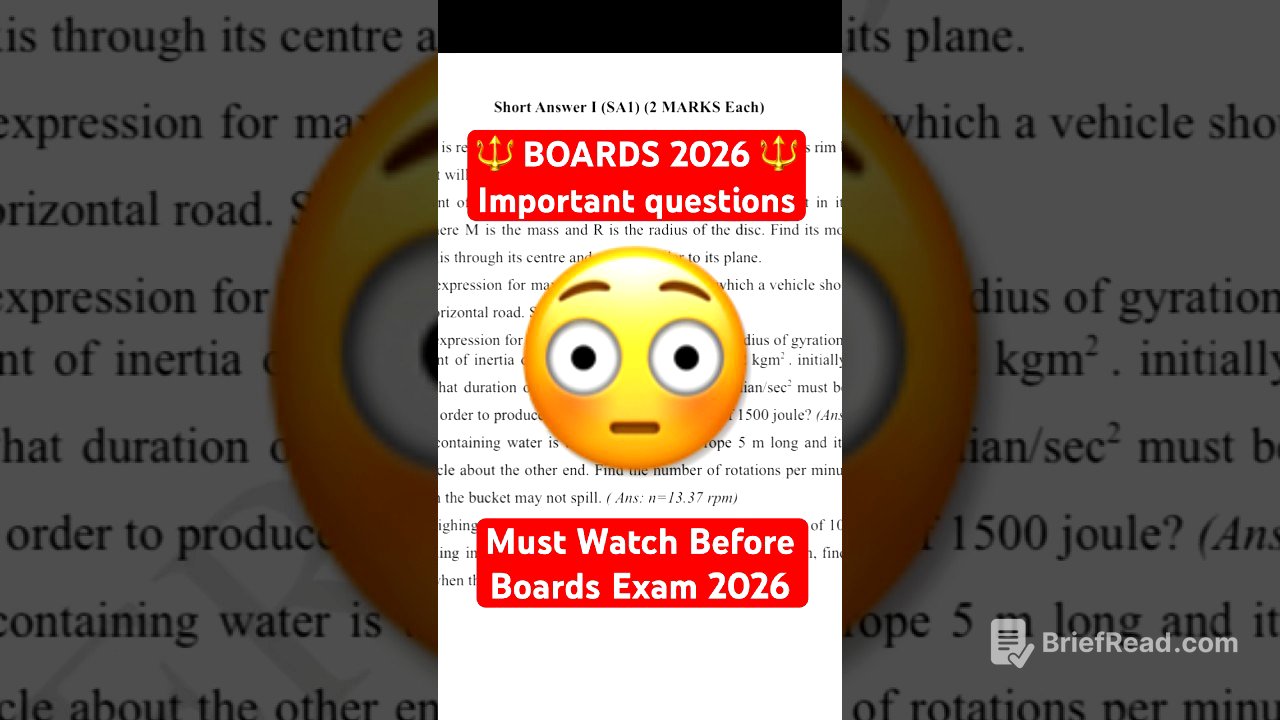
The presenter introduces a set of important chemistry questions for board exams, specifically focusing on solid-state chemistry. He urges students to note down the questions as they are presented.
Short Answer Questions [0:08]
The video outlines several short answer questions. First, calculate the packing efficiency for a Body-Centred Cubic (BCC) lattice. Second, describe the arrangement of atoms in the first, second, and third layers of a Hexagonal Close-Packed (HCP) structure. Finally, a numerical problem is presented: given the density of sodium in a BCC structure (0.97 g/cm³) and its molar mass (23 g/mol), calculate the radius of a sodium atom.
Explanation of Magnetic Properties and Unit Cells [0:57]
The presenter asks to explain with examples the differences between diamagnetic, paramagnetic, and ferromagnetic substances. Also, describe the relationship between edge length (a) and radius (r) for Simple Cubic (SC), Body-Centred Cubic (BCC), and Face-Centred Cubic (FCC) unit cells. Finally, define diamagnetic, paramagnetic, and ferromagnetic solids.
Non-Stoichiometric Defects and Bravais Lattices [1:17]
The video transitions to four-mark questions, starting with an explanation of non-stoichiometric point defects, including a diagram of F-centres. It then asks for a definition of Bravais lattices. A numerical problem is included, involving niobium forming a BCC structure with a given density (8.55 g/cm³) and edge length (330 pm). The task is to determine how many atoms are present in 0.5 grams of niobium.
Call to Action [1:47]
The presenter encourages viewers to save the video, like it, and share it with other students. He mentions that he intends to continue the series and asks viewers to subscribe to the channel to support him.


![★[걸리버 여행기] 설민석 강독 풀버전★ 동화? NO! 발간 직후 금서로 지정된 문제적 풍자문학 | 요즘책방 : 책 읽어드립니다 The Page-Turners EP.30](https://wm-img.halpindev.com/p-briefread_c-10_b-10/urlb/aHR0cDovL2ltZy55b3V0dWJlLmNvbS92aS82bmxvUThyUGdrYy9ocWRlZmF1bHQuanBn.jpg)