TLDR;
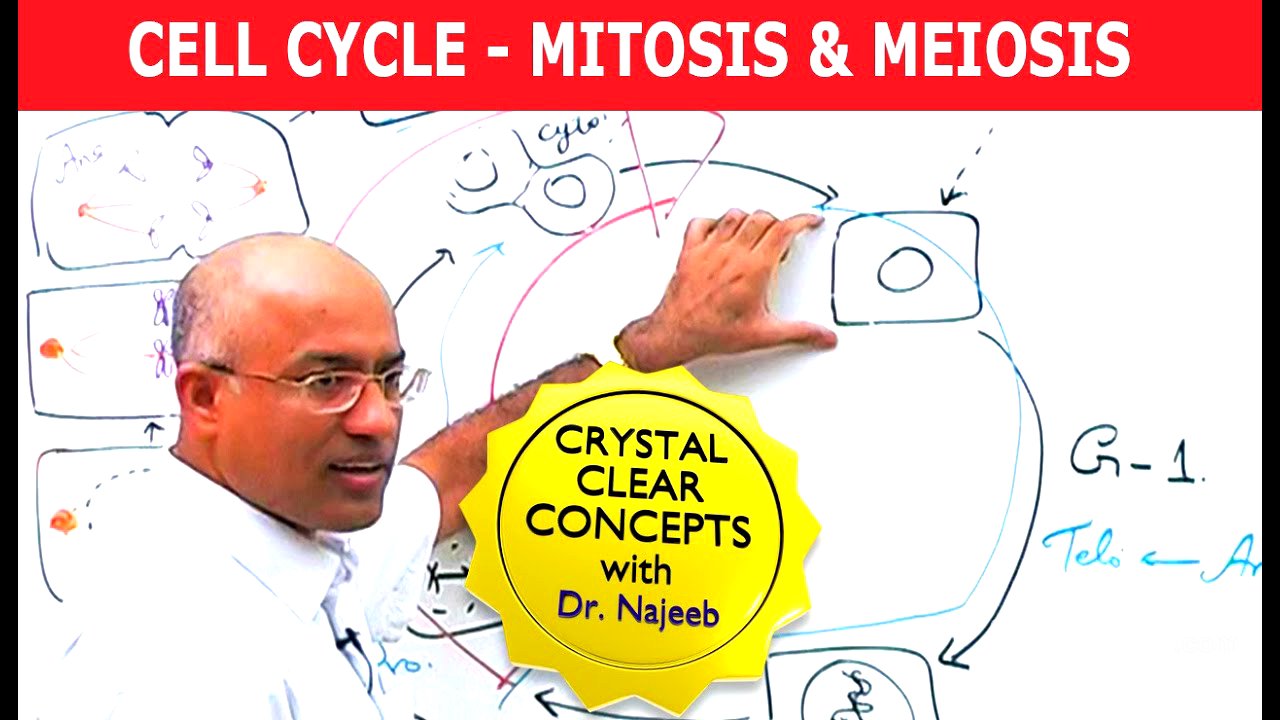
This lecture by Dr. Najeeb explains the cell cycle, mitosis, and the genes that regulate these processes, including their role in cancer development. It covers the different phases of the cell cycle (G1, S, G2, M, and G0), the stages of mitosis (prophase, metaphase, anaphase, and telophase), and the checkpoints that ensure the integrity of DNA before cell division. The lecture also discusses the molecular mechanisms that control cell cycle progression, including growth factors, receptors, signal transducers, responder genes, cyclins, and cyclin-dependent kinases (CDKs).
- Cell cycle consists of interphase (G1, S, G2) and mitosis (M phase).
- Mitosis involves prophase, metaphase, anaphase, and telophase.
- Checkpoints (G1/S and G2/M) ensure DNA integrity before replication and division.
- Cell cycle progression is controlled by growth factors, receptors, signal transducers, responder genes, cyclins, and cyclin-dependent kinases (CDKs).
Introduction to Cell Cycle [0:01]
The lecture introduces the concept of the cell cycle, which is the process by which a cell divides into two daughter cells. The cell cycle consists of different phases through which a mature cell passes to eventually divide. The lecture will cover the phases, mitosis, and the genes regulating the cell cycle, including their role in cancer development.
Interphase: G1, S, and G2 Phases [0:49]
The cell cycle has two main parts: interphase and mitosis. Interphase includes the G1 (pre-synthetic or growth phase 1), S (DNA synthesis phase), and G2 (post-synthetic or growth phase 2) phases. During G1, the cell prepares for DNA synthesis by producing proteins and enzymes, increasing its cytoplasm and organelles. In the S phase, DNA replication occurs, doubling the genetic material (2n becomes 4n). After DNA replication, the cell enters the G2 phase, preparing to divide the duplicated genetic material equally into two daughter nuclei. Some cells may exit the cycle into the G0 phase, a resting phase, while others continue to proliferate.
Cell Types: Labile, Stable, and Permanent [8:00]
Cells are categorised into labile, stable, and permanent types based on their proliferative activity. Labile cells, such as those in the skin, gastrointestinal tract, and bone marrow, continuously multiply and do not enter the G0 phase. Stable cells, like hepatocytes and kidney cells, are typically in the G0 phase but can re-enter the cell cycle with appropriate stimulus. Permanent cells, including neurons and myocardial cells, once differentiated, remain in the G0 phase and cannot re-enter the cell cycle.
Mitosis vs. Interphase [13:33]
Interphase includes the G1, S, and G2 phases, during which the cell prepares for division by synthesising proteins and replicating DNA. Mitosis is the process of dividing the replicated genetic material in one nucleus into two daughter nuclei. Cytokinesis is the division of the cytoplasm and organelles into two separate cells. Mitosis focuses on nuclear division, while cytokinesis completes the cell division process.
Stages of Mitosis: Prophase [18:26]
Mitosis is divided into four phases: prophase, metaphase, anaphase, and telophase. During prophase, chromatin condenses into visible chromosomes, each consisting of two identical chromatids. The nuclear membrane starts to dissolve, and the centrioles move to opposite poles of the cell. Phosphorylation of histone proteins causes chromatin condensation, while phosphorylation of laminin proteins leads to the dissolution of the nuclear membrane.
Stages of Mitosis: Metaphase, Anaphase, and Telophase [24:25]
In metaphase, the nuclear membrane disappears, and microtubules form the mitotic spindle. The double-structured chromosomes align on the equatorial plane, with microtubules attaching to the kinetochores of each chromatid. During anaphase, each double-structured chromosome breaks at the centromere, and the identical chromatids move to opposite poles. In telophase, the cell starts dividing its cytoplasm, nuclear membranes reappear around the separated chromatids, and the chromatin becomes less condensed. Cytokinesis completes the process, resulting in two daughter cells.
Cell Cycle Checkpoints: G1/S and G2/M [30:42]
The cell cycle is tightly regulated to ensure proper DNA replication and cell division. Checkpoints exist to monitor DNA integrity and halt the cycle if errors are detected. The G1/S checkpoint ensures that DNA is healthy before replication, while the G2/M checkpoint verifies that DNA replication was completed without errors. If DNA damage is detected, the cell cycle is arrested until the damage is repaired.
Molecular Control of Cell Cycle Progression [39:10]
Cell cycle progression is controlled by various molecular mechanisms. In the G1 phase, genes that promote cell multiplication must be activated, while genes that inhibit cell replication must be suppressed. Growth factors, receptors, signal transducers, and responder genes play crucial roles in this process. Growth factors bind to receptors on the cell membrane, activating signal transducer proteins that relay the signal to the nucleus. Responder genes then produce transcription factors that activate genes necessary for DNA replication.
Cyclins and Cyclin-Dependent Kinases (CDKs) [49:19]
Cyclins and cyclin-dependent kinases (CDKs) are key regulators of the cell cycle. CDKs are enzymes that phosphorylate target molecules, but they are only active when bound to cyclins. Different cyclins are produced at specific phases of the cell cycle. Once a cyclin binds to a CDK, the complex becomes active and phosphorylates target proteins, such as transcription factors, which then activate genes required for DNA replication, allowing the cell to progress from the G1 phase to the S phase.