TLDR;
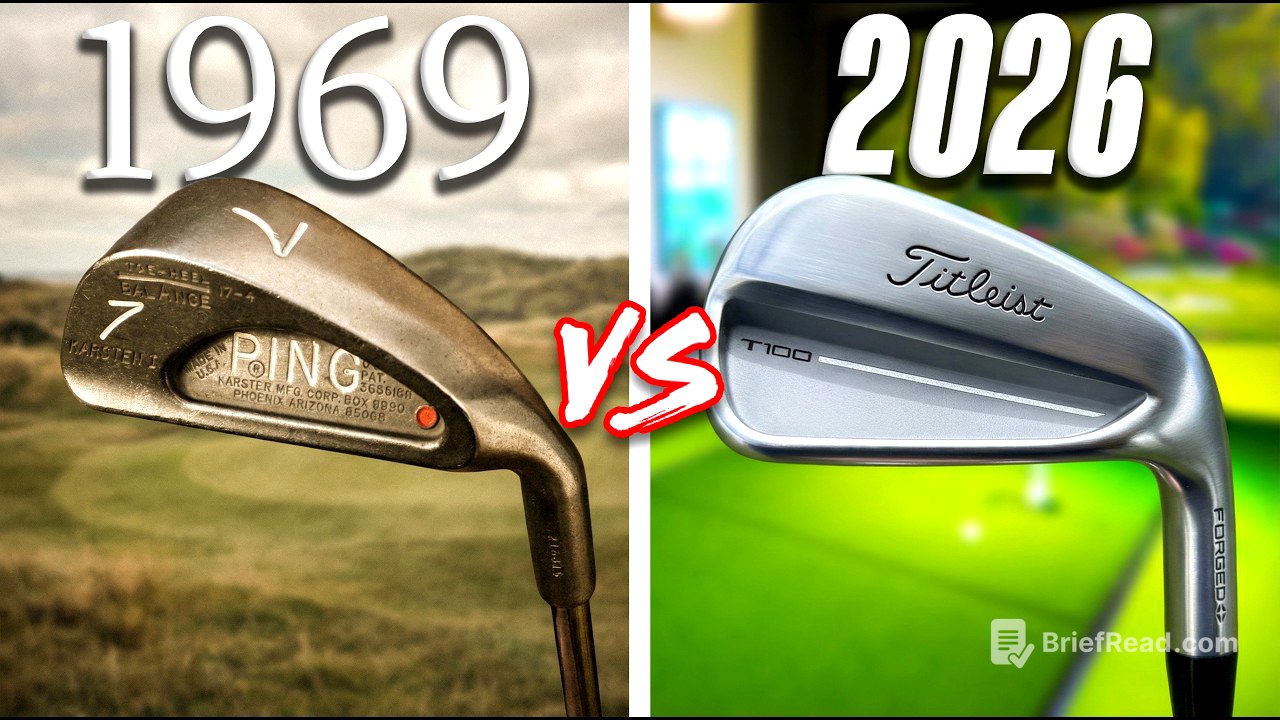
This video compares iconic 1969 Ping Castm One irons against modern Titleist T100 irons to assess the advancements in golf club technology over the past 55 years. The test focuses on the 5-iron, 7-iron, and wedge, analysing distance, accuracy, and forgiveness using a GC quad launch monitor.
- The 1969 Ping irons, known for their revolutionary perimeter weighting and custom fitting options, hold up surprisingly well against modern clubs.
- The performance gap is minimal, particularly in the 7-iron, with the older clubs exhibiting impressive distance control and forgiveness.
- The video highlights the importance of playing with clubs you enjoy and trust, regardless of their age, challenging the notion that newer always equals better.
Introduction [0:00]
The presenter introduces a set of iconic Ping Castm One irons from 1969 and explains that he, an average golfer, will compare them against modern Titleist T100 irons. The aim is to determine how much golf club technology has improved over the last 55 years.
The Iconic Ping Castm One Irons [0:29]
The Ping Castm One irons, released in 1969, are described as revolutionary due to their toe and heel weighting, a concept borrowed from Ping's successful Answer putter. This perimeter weighting aimed to increase forgiveness and stability. Ping was also the first to offer custom fitting, allowing golfers to tailor the lie angle of their irons. Despite their age, the irons don't look drastically different from modern clubs. The presenter plans to test the 5-iron (28° loft), 7-iron (36° loft), and pitching wedge (50° loft) against his Titleist T100 irons, which have similar lofts.
Initial Thoughts and Comparison [4:13]
The presenter compares the Ping Castm One irons to his Titleist T100s, noting the difference in appearance. He shares his average carry distances with the Titleist irons: 169 yards for the 7-iron, 195 yards for the 5-iron, and 134 yards for the pitching wedge. He also discusses standard deviation, which indicates the consistency of his shots. The presenter questions whether the older Ping irons will show significant drop-offs in performance compared to the modern clubs, challenging the marketing hype around new golf equipment.
Testing the 7-Iron [5:44]
The presenter begins testing the 7-iron, noting the original slippery grips and the unusual placement of the patent number on the toe. Despite a stone rattling in the shaft, his first shot goes 158 yards. His second shot, however, hits the flag at 170 yards with a club head speed of 94 mph and a ball speed of 123 mph. Subsequent shots reveal that while the feel isn't as powerful as modern irons, the distance is still respectable, and the forgiveness is impressive, even on thin shots.
Testing the Wedge [9:46]
Moving on to the 50° wedge, the presenter expresses confidence due to its higher loft, which is ideal for chip shots. He appreciates the squared face and the ability to open it up for creative shots. Full shots with the wedge feel amazing, further increasing his excitement.
Testing the 5-Iron [11:27]
The presenter anticipates the 5-iron being more challenging to hit. He admits his first shot is a bit thin and loses some distance compared to his modern iron. He notes that the grips are slippery and worn, making it harder to get used to them. While some shots are mishits, he eventually hits one "absolutely flushed," praising the feel and ball flight.
Testing the 3-Iron [13:31]
For fun, the presenter tries the daunting 3-iron, treating it like a fairway finder. His first shot feels amazing and travels 238 yards. Subsequent shots are less successful, highlighting the club's unforgiving nature on mishits.
Data Analysis and Final Thoughts [14:57]
The presenter analyses the data, acknowledging the inherent unfairness of comparing such old clubs to the latest models. The Ping wedge went 122 yards compared to 134 yards with his Titleist, a difference that aligns with the 4-degree loft difference. The Ping 7-iron went 163 yards compared to 169 yards with his Titleist, again consistent with the 2-degree loft difference. The standard deviation for the Ping 7-iron was only four yards, indicating excellent distance control. The Ping 5-iron averaged 191 yards compared to 195 yards with his Titleist. Overall, the presenter is incredibly impressed with the Ping irons, praising Karsten Solheim for revolutionising golf club design. He concludes that golfers should not be afraid to play with older clubs if they enjoy them and see no compelling reason to upgrade.