TLDR;
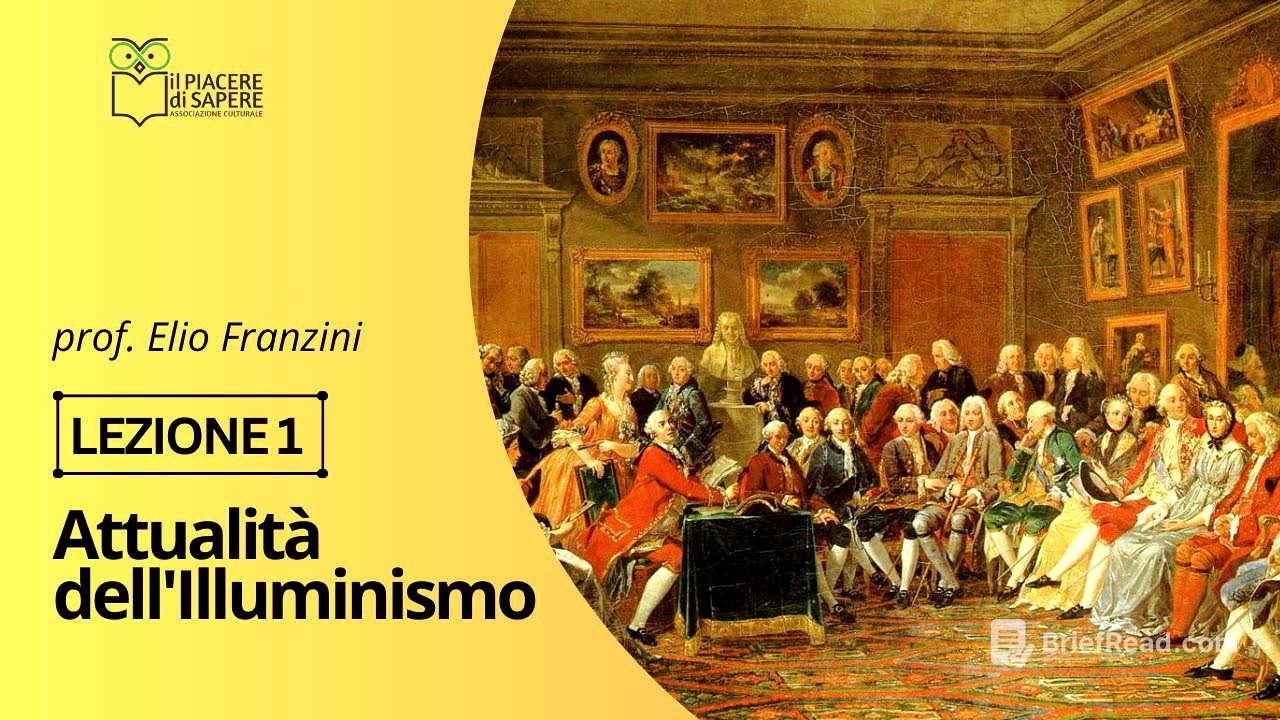
Professor Elio Franzini delivers a lecture on the relevance of the Enlightenment, exploring its complexities and challenging common understandings. The lecture addresses whether the Enlightenment can become a shared understanding or remain confined to specialists. It examines the multiple facets of the Enlightenment, including its perennial, thematic, and geographical dimensions, and questions its origins and end.
- The Enlightenment is not always a shared understanding.
- There are multiple facets of the Enlightenment.
- The Enlightenment's origins and end are complex.
Introduction to the Enlightenment [0:01]
Professor Elio Franzini is introduced as an expert in aesthetics and former Rector of the University of Milan. The lecture series, titled "Grandeur and Limits of the Enlightenment," will explore the Enlightenment's influence on aesthetics, philosophy, and politics. The aim is to determine if the Enlightenment can evolve into a common understanding or remain a topic reserved for specialists. Professor Bruschi highlights the importance of disseminating philosophical and mathematical knowledge and encourages viewers to share information about the association's initiatives.
Defining the Enlightenment [4:33]
Professor Franzini connects the Enlightenment to the association's name, "Pleasure of Knowing," referencing Kant's definition of Enlightenment as "Dare to know" ("Sapere Aude"). He introduces the lecture's theme: the relevance of the Enlightenment, within a course titled "Grandeur and Limits of the Enlightenment," focusing on aesthetics, philosophy, and politics. He questions whether a common understanding of the Enlightenment exists, given the prevalence of tribalism and intolerance in contemporary society. The lecture aims to explore whether the Enlightenment can become a shared value or remain confined to academic discourse, requiring tolerance and shared understanding, which seem lacking in today's culture.
Multiple Enlightenments [8:20]
Professor Franzini poses the question: are there many enlightenments, each with distinct characteristics, or a single unified Enlightenment? He suggests that the answer is multifaceted, aligning with the Enlightenment's own non-monolithic nature. He outlines three directions to explore: a perennial Enlightenment transcending historical periods, a thematic Enlightenment focusing on key Enlightenment themes, and a geographical Enlightenment acknowledging the diverse national and regional expressions of the Enlightenment across Europe. Despite their differences, these traditions share the concept of "light," symbolising illumination and knowledge.
The Enlightenment as Light [10:35]
The concept of the Enlightenment as "light" implies dispelling darkness, though this isn't necessarily historically accurate. The term "Enlightenment" emerged later, with Diderot's 1753-54 writings on interpreting nature highlighting the multiplication of "points of light" (points de lumière) as philosophy's task. The lecture will explore these geographical enlightenments to define the themes and the "metaphysics of the Enlightenment," a term used within the Enlightenment culture.
Perennial Enlightenment: Radical Thought [12:03]
Professor Franzini introduces the concept of a "perennial Enlightenment," offering two contrasting definitions. The first, from Jonathan Israel, describes "radical Enlightenment" as a trans-historical radicalism. Israel's book, "A Revolution of the Mind," characterises the Enlightenment as a continuous revolution of the mind. However, this definition is criticised for anachronistically applying modern concepts like democracy, racial and sexual equality, and individual lifestyles to the 18th century, where they were largely absent. Israel argues that the Enlightenment consists of basic principles such as democracy, equality (racial, sexual), individual freedom, freedom of thought, expression and press, separation of religious authority from the legislative process and education, and separation of church and state.
Perennial Enlightenment: A Failed Project [15:50]
The second example contrasts sharply, portraying the Enlightenment as a historical failure. Adorno and Horkheimer's "Dialectic of Enlightenment" argues that reason, instead of liberating humanity, led to the horrors of the Holocaust. Adorno questions the value of reason when it resulted in such barbarity, arguing that the Enlightenment's emphasis on formal principles lacked concrete application and dialectical depth. The Enlightenment failed to incorporate negativity, resulting in a static reason unable to grasp the complexities of the contemporary world. Adorno and Horkheimer criticise the Enlightenment for not citing or engaging with Enlightenment authors, dismissing Voltaire as a banal figure.
Periodising the Enlightenment [21:47]
To move beyond these totalising views, Professor Franzini suggests examining the Enlightenment within its historical context, something both Israel and Adorno fail to do. He poses the question: when did the Enlightenment begin? While unable to provide a definitive answer, he offers two perspectives. The first is 1688, with Locke's "Essay Concerning Human Understanding," marking the restoration of liberal governance after Cromwell. This view suggests the true Enlightenment was English, originating with Locke and strengthened by Hume, whom Franzini identifies as the central figure uniting all Enlightenment thinkers.
The Birth of the Enlightenment [24:57]
Professor Franzini suggests that the Enlightenment began in England, with a re-evaluation of sensible thought and the rise of the liberal state. This involved limiting religious dominance and emphasising individual rights. He notes that England was the only truly liberal state in Europe, with a sovereign power limited and attributed to individuals. The execution of Charles I in 1688 symbolised a transfer of sovereignty from the monarch to the people.
Libertine Thought and the Critique of Religion [27:10]
The second perspective locates the Enlightenment's origins in French libertine thought, which critiqued rational theology. Key figures include Joseph Addison, Fontenelle, and Pierre Bayle, considered the "father" of the Enlightenment. Bayle aimed to demystify religious narratives, initiating the Enlightenment as a critique of rational theology. This critique, found in Bayle's writings and later in clandestine texts like "Letter to Sophia," emphasised liberation from religious prejudice. Bayle's concept of the "virtuous atheist" disconnected morality from religion, arguing that virtue stems from inner ethical principles, not religious belief.
Three Origins of the Enlightenment [32:16]
Professor Franzini identifies three origins of the Enlightenment: the transfer of sovereignty symbolised by the execution of a king, the rise of liberal thought and individual autonomy, and the critique of religious authority and prejudice. These developments occurred between the late 17th and early 18th centuries. He contrasts this with the Crocean tradition, which traces the Enlightenment back to Descartes' "Cogito" and the mid-17th century in France.
The End of the Enlightenment [33:30]
Professor Franzini proposes specific end dates for the Enlightenment: between 29 March 1794, when Condorcet was indicted, and 27-28 July 1794, the Thermidorian Reaction. These dates coincide with the French Revolution's decline, when it distanced itself from its Enlightenment roots. Condorcet, considered the last of the Enlightenment thinkers, was indicted by the Jacobins, with Robespierre criticising Enlightenment figures as "political charlatans" and preferring Rousseau. Condorcet's subsequent suicide symbolised the Enlightenment's failure. The Thermidorian Reaction, marked by Robespierre's execution, ended the French Revolution and its ideals.
The Enlightenment as Myth [42:16]
After Thermidor, the Enlightenment transformed into a myth, with "Liberté, égalité, fraternité" becoming a slogan promoted by figures like Napoleon Bonaparte. The Enlightenment became a religion, ceasing as a political and cultural movement. Its principles were reinterpreted by corrupt politicians, who had been part of the Jacobin party.
Three Currents of the Enlightenment [44:29]
Professor Franzini identifies three currents within the Enlightenment: a theological Enlightenment focused on religion, a political and social Enlightenment concerned with individual power and the polis, and a philosophical Enlightenment. The theological Enlightenment wasn't atheist but sought to replace revealed religions with deistic philosophies. Robespierre accused Enlightenment thinkers of atheism, while Condorcet criticised Robespierre for remaining a "priest" unable to grasp true freedom of thought.
The Philosophical Enlightenment: Hume and Diderot [48:57]
The philosophical Enlightenment is exemplified by David Hume, who sought to ground knowledge in human nature rather than metaphysics, focusing on "how" we reason rather than "why." The other key work is Diderot and D'Alembert's "Encyclopédie," aiming to represent the world and multiply "points of light." Despite its ambition, Diderot realised that a book alone couldn't transform humanity. The lecture concludes by noting that the Enlightenment remains a point of contention, with the Catholic Church maintaining its opposition, though Pope Francis has acknowledged its importance, stating that "the Enlightenment is not enough."
Internal Periodisation of the Enlightenment [56:14]
Professor Franzini offers an internal periodisation of the Enlightenment, dividing it into three phases. The first, from the late 17th century to the early writings of Hume (1740), was a nascent phase without a unified European identity. The second, from the 1740s with the "Encyclopédie" to the 1770s, saw the rise of major Enlightenment figures who developed and disseminated Enlightenment thought. The third, from the 1770s to Condorcet's death and the French Revolution, was a terminal phase. The central phase, marked by figures from Hume to Diderot, represents the most influential period, culminating in Kant's "Critique of Pure Reason" and the escape from "dogmatic slumber." The next lecture will explore the metaphysics of the Enlightenment and its development in various countries.