TLDR;
This video explains the concept of levers, their mechanical advantage, and their classification into three classes, highlighting their presence and function within the human body. It covers the components of a lever, how to calculate mechanical advantage, and provides examples of each class of lever in both everyday objects and biomechanical movements.
- Levers amplify or diminish force using a rigid rod pivoting on a fulcrum.
- Mechanical advantage determines a lever's effectiveness based on the ratio of motive arm to resistive arm.
- Three classes of levers exist, each with a different arrangement of fulcrum, load, and effort.
- All three classes of levers can be observed in the human body.
Introduction to Levers [0:00]
The video introduces the concept of levers as tools for amplifying or diminishing forces, referencing Archimedes' famous quote about moving the world with a long enough lever and a fulcrum. It explains that leverage, in its purest form, is a physics concept involving a rigid rod or plank that pivots on a fulcrum. A load acts on the lever, and a motive force (effort) is applied to move the load. The goal is to determine if a lever can help move a heavy object, even with a limited applied force.
Lever Terminology and Seesaw Example [2:26]
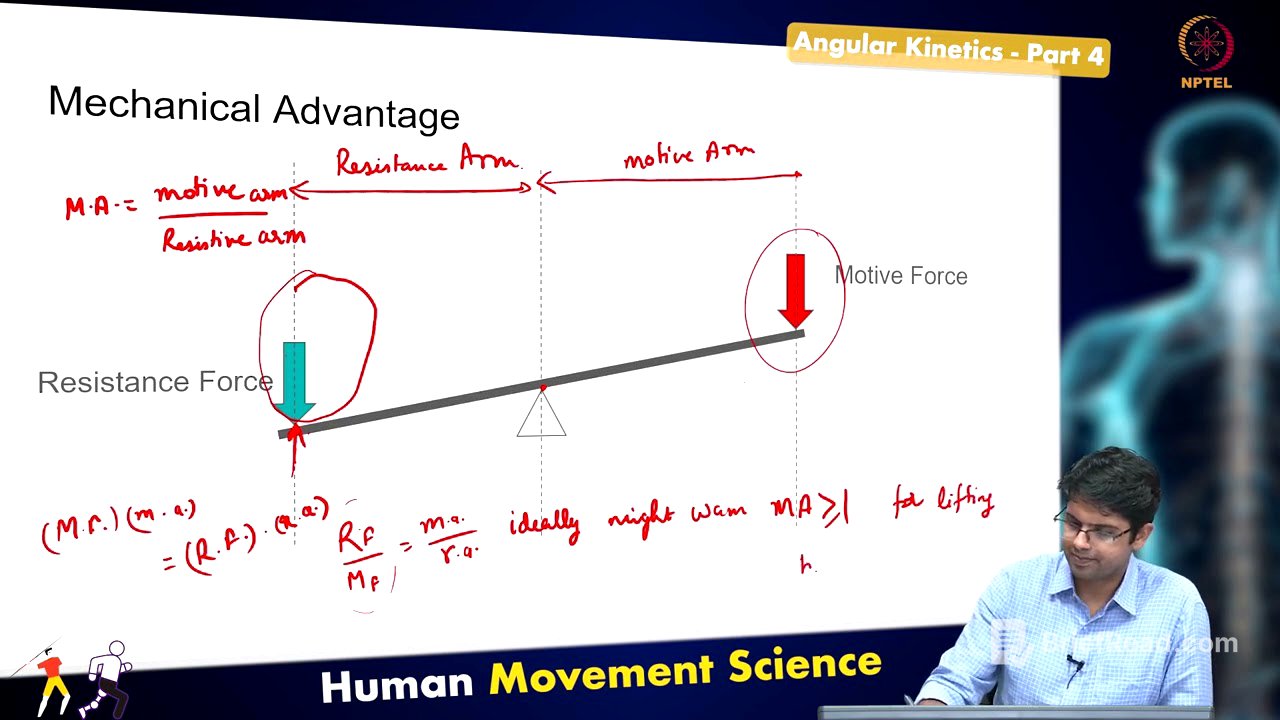
The discussion moves to defining key terms: the motive arm (perpendicular distance between the pivot point and the direction of force application) and the resistance arm (perpendicular distance between the pivot point and the direction of the load). A seesaw example illustrates how a lever works. When two people of equal weight sit at equal distances from the fulcrum, the seesaw remains horizontal due to balanced moments. If one person is heavier, the lighter person can compensate by moving further from the fulcrum to maintain balance.
Mechanical Advantage Explained [6:54]
The concept of mechanical advantage is introduced as a way to determine if a lever can move a particular object. Mechanical advantage is defined as the ratio of the motive arm to the resistive arm. The video explains that a mechanical advantage greater than or equal to 1 is desirable for lifting heavy loads. If someone can only produce 100 Newtons of force and the mechanical advantage is 2, they can lift a weight of 200 kgs. A mechanical advantage of 1 simply changes the direction of the applied force.
Classes of Levers: FLE [12:38]
The video introduces the three classes of levers, using the mnemonic "FLE" (Fulcrum, Load, Effort) to remember their configurations. In Class 1 levers, the fulcrum is in the middle, between the motive force and the resistive force. In Class 2 levers, the load is in the centre. In Class 3 levers, the effort is in the centre. Examples of each class are provided.
Examples of Levers [14:29]
Examples of each class of lever are given. Class 1: pliers, where the fulcrum is in the centre. Class 2: a hammer used to pry out nails, where the point of contact acts as the fulcrum. Class 3 levers are often found in biomechanical systems.
Levers in the Human Body [15:49]
The discussion shifts to levers in the human body, noting that all three classes of levers can be found. An example of a Class 1 lever is the attachment of the head to the vertebral column. Class 2 levers are observed in the foot during walking or running, with the toe acting as the fulcrum. A push-up is also an example of a Class 2 lever. Class 3 levers are common in musculoskeletal arrangements, such as a bicep curl, where the elbow is the fulcrum and the bicep muscle provides the effort.
Conclusion [21:22]
The video concludes by summarising that levers are used to increase, decrease, or redirect applied effort. Mechanical advantage quantifies the lever's efficacy in lifting a load. The principle of FLE helps classify the three types of levers, all of which are found in the human body, with Class 3 levers being particularly prevalent in musculoskeletal arrangements.