TLDR;
This video provides a detailed overview of Sir M. Visvesvaraya's life and exemplary character, as portrayed in V.S. Narayana Rao's essay "Adarsha Vyakti Sir M. Visvesvaraya". It covers Visvesvaraya's achievements, his commitment to public service, and his personal values, highlighting his significant contributions to India's progress and his unwavering dedication to duty and integrity. The summary includes key moments and anecdotes that illustrate his principles and impact on society.
- Highlights Visvesvaraya's dedication to public service and national development.
- Illustrates his commitment to integrity and ethical conduct in both personal and professional life.
- Showcases his visionary thinking and practical approach to problem-solving.
Introduction to V.S. Narayana Rao [1:06]
V.S. Narayana Rao is a well-known figure in literature and theatre. Born to B.V. Subbaraya and Lakshmamma, he obtained a Kannada Vidwan degree from Madras University. He worked as a teacher in schools in Kushalnagar and Madikeri, and also at the Rashtrabandhu newspaper in Mangalore. Narayana Rao was involved in the 1930s civil disobedience movement and was even imprisoned for his participation. He authored "Mokshagundam Visvesvaraya: His Life and Work" in English, later translated into Kannada, and wrote other notable works such as "Vishwaratna Netaji Bose," "Gandhi Vada," and "Bharata Samvidhana". Additionally, he was an actor and director in the Vilasi theatre, performing in Kailasam's plays.
The Essence of an Ideal Person [3:23]
The essay "Adarsha Vyakti Sir M. Visvesvaraya" is extracted from V.S. Narayana Rao's biography of Visvesvaraya. It explores Visvesvaraya's life principles, his ideal personality, and the values one can adopt from his life. The essay discusses the challenges he faced while upholding his principles. Visvesvaraya, when asked if he would wish to be born again, responded, echoing the French philosopher Rino, that having lived a fulfilling life, he would gladly accept another life on Earth.
Honours and Achievements [4:57]
Visvesvaraya's life was marked by unparalleled fame and numerous accolades, including titles and awards that came to him without solicitation. These included several medals during his student days, the CIPE and KCIE titles from the British government, honorary degrees from various universities such as Calcutta, Patna, Allahabad, and Mysore, and honours from numerous organisations. The Bharat Ratna, India's highest civilian award, was also conferred upon him. Visvesvaraya believed that all his desires were fulfilled, supported by the recognition and honours he received.
Centenary Celebrations and Nehru's Tribute [6:30]
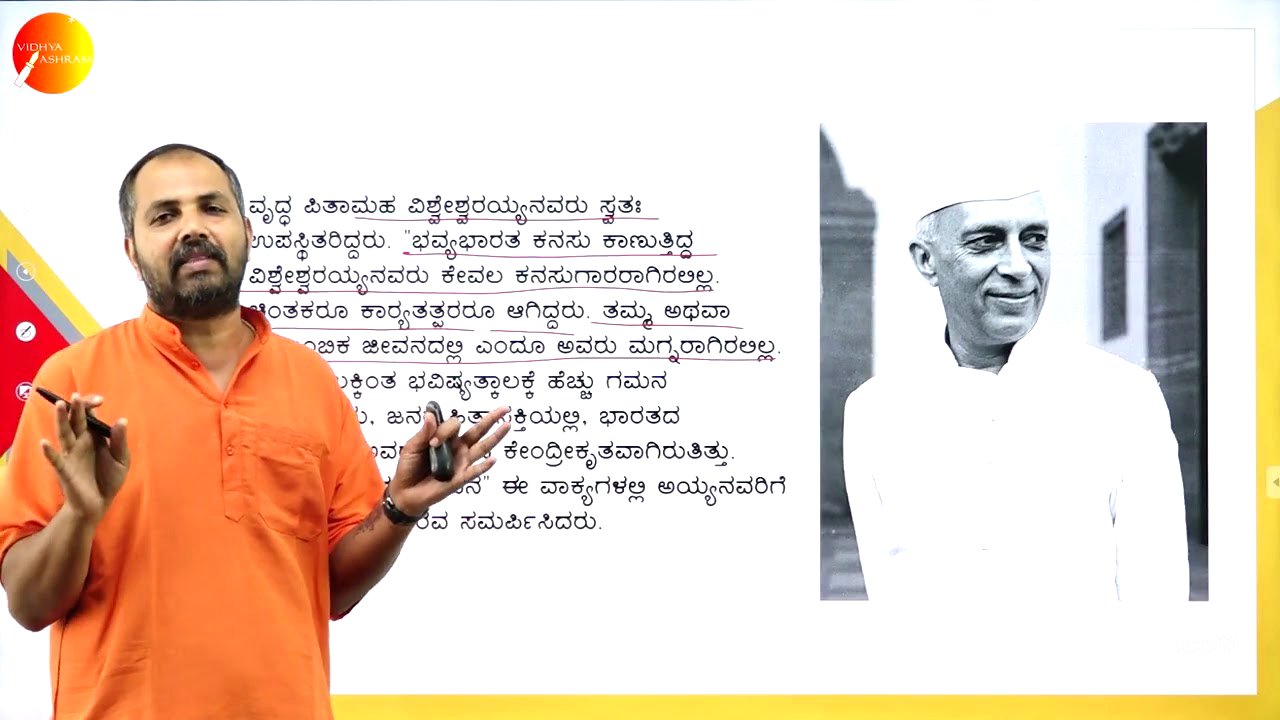
Visvesvaraya lived a fulfilling life for over a century, passing away at the age of 102. His birth centenary was celebrated on 15 September 1960. A special honour ceremony was held in Bangalore's Lal Bagh. Despite the recent death of his son-in-law, Feroze Gandhi, Prime Minister Jawaharlal Nehru made a special trip to pay his respects to Visvesvaraya, demonstrating his sense of duty. Nehru remarked that Visvesvaraya focused more on the future than the past, with his thoughts centred on the welfare of the people and the future of India, describing his life as an ideal one.
Jayachamaraja Wodeyar's Commemoration [9:18]
The event was presided over by Rajapramukh Jayachamaraja Wodeyar, who praised Visvesvaraya for achieving immense fame, respect, and popularity during his lifetime. Wodeyar noted that few fields had not benefited from Visvesvaraya's contributions to state development and technical progress. He highlighted Visvesvaraya's involvement in engineering, irrigation, reservoirs, drinking water projects, electricity generation, bridge construction, university education (including the establishment of Mysore University in 1916), industrial education, urban development, industries, and banking. Wodeyar emphasised that Visvesvaraya's vision was the primary reason these areas developed and flourished.
Visvesvaraya's Vision and Qualities [12:07]
Wodeyar spoke of Visvesvaraya's foresight, efficiency, expertise, experience, intelligence, and wisdom, stating that the structures and developments resulting from these qualities would remain as lasting monuments to his extraordinary skill, competence, efficiency, and patriotism. He noted that Visvesvaraya always thought with a long-term perspective, considering the benefits and drawbacks for future generations. Wodeyar highlighted Visvesvaraya's dedication to completing tasks, his special knowledge, and his effective use of experience, intelligence, and wisdom, particularly in his service to the state of Mysore.
Daily Life and Habits [14:30]
Visvesvaraya maintained his health by walking three to four miles daily and travelling by car to escape the city's polluted environment. He valued orderliness in everything, keeping his desk organised with sharpened pencils of various colours, rubber, glue, scissors, knives, and pins. He preferred pencils with erasers attached for convenience. Visvesvaraya would meticulously draft letters, often revising them multiple times for precision. He always carried a small pencil and paper to jot down important notes, which he would later record in a notebook.
Diet, Discipline and Principles [17:35]
Visvesvaraya lived a healthy and long life due to his disciplined diet, recreation, sleep, exercise, and moderation. He was a moderate eater, consuming only what was necessary, and maintained a strict routine of sleeping at 10 PM and waking up at 6 AM. His diet included light breakfast and coffee, two slices of bread or small chapatis, a few spoons of rice, some yoghurt, a baked apple, and Nanjanagudu bananas. Before accepting the position of Diwan, he gathered his relatives and made them promise not to ask him for favours or jobs once he assumed office. He even wrote to his brother-in-law, H. Ramaiya, about this condition.
Integrity and Frugality [20:51]
Visvesvaraya was known for his strict and impartial nature. Despite his relatives being qualified, he did not help them secure jobs in the Mysore government, directing them to seek opportunities elsewhere. He regularly sent money orders to poor relatives from his salary. After retirement, he distributed most of his pension to his relatives, keeping only what he needed. In his will, he made provisions for his long-serving staff. He did not allow relatives to live with him, encouraging them to be self-reliant. After his wife's death, he lived alone, eventually allowing his brother's son, M.R. Krishnamurthy, and his family to live with him.
Humility and Public Service [23:19]
Visvesvaraya associated only with virtuous people and never gave recommendation letters. He treated government employees with great respect, viewing government service as service to the people. Once, when an officer claimed to have been his servant, Visvesvaraya corrected him, saying the officer was his assistant. He disliked self-praise, stating that he was merely a planner and the officers were the achievers, attributing any success to the government and its officials. He asked not to be excessively praised and hoped that the people of Mysore would not blame him for things he did not do, expressing that this would bring him complete satisfaction.
Simplicity and Principles in Practice [25:49]
Visvesvaraya always sought permission from the Maharaja before travelling in a government car with his brother and his children. He did not have a retinue of staff or police escorts. Despite the lack of electricity, telephone facilities, and proper roads in his village, he remained fond of it. He would spend a night in the village and return to Bangalore the next evening. On one occasion, his mother, Akkachamma, travelled from the village to his bungalow in a government car. When she found it difficult to get out of the car due to her age, Visvesvaraya suggested that the driver take her back to Chamarajpet in the same car. However, his mother refused, knowing his strict adherence to rules, and instead rested before travelling in his private car. She told him that while she was proud that he had become a Diwan, she was even more pleased by his conduct.