TLDR;
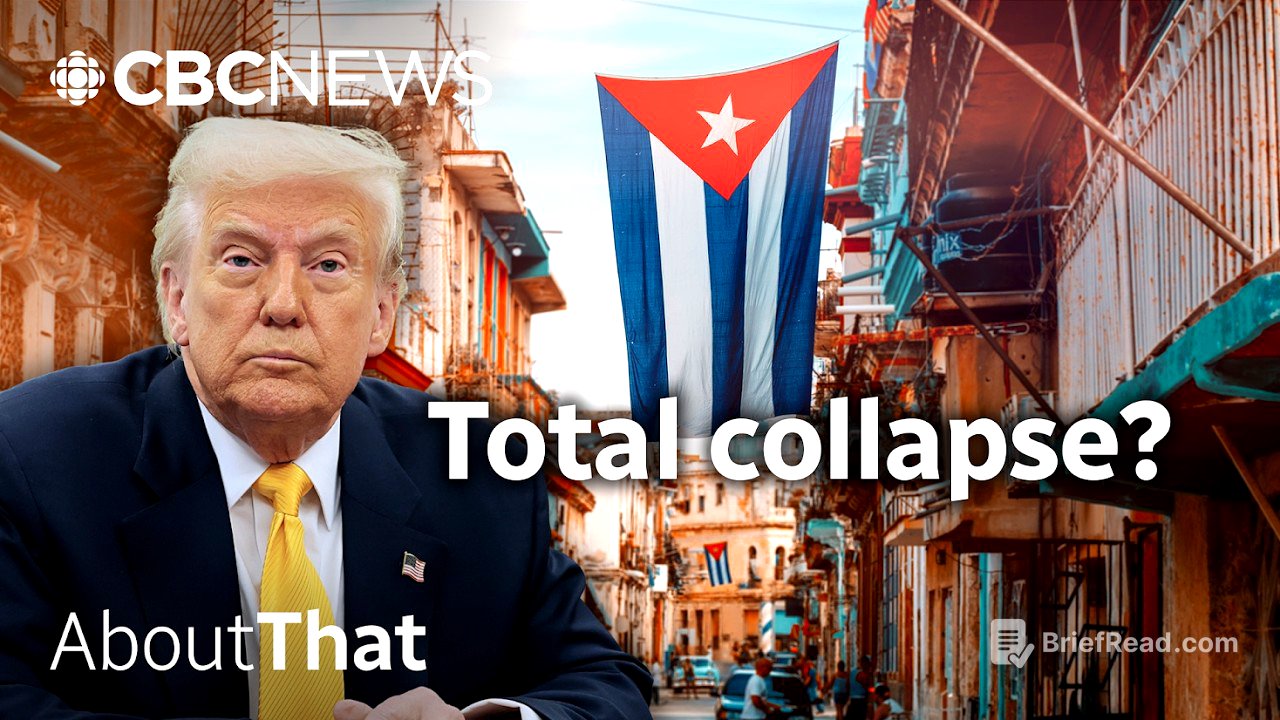
This video explores the escalating tensions between the United States, under the Trump administration, and Cuba. It examines the historical context of US-Cuban relations, the current economic crisis in Cuba exacerbated by US sanctions, and potential motivations behind Trump's aggressive stance, including business interests, political considerations related to the Cuban-American population in Florida, and the desire to achieve a foreign policy legacy by dismantling the communist regime.
- US sanctions and the collapse of Venezuelan oil supply have pushed Cuba to the brink of economic collapse.
- Trump's policy towards Cuba is influenced by business interests, political considerations related to the Cuban-American population in Florida, and the desire to achieve a foreign policy legacy.
- The historical context of US-Cuban relations, including the Cold War and the Cuban Missile Crisis, shapes the current dynamics.
Introduction [0:00]
The video begins by highlighting the worsening conditions in Cuba due to the US cutting off critical supplies. The Trump administration accuses the Cuban government of persecution, torture, and being corrupt and inhumane, while the Cuban government describes Trump's actions as "economic genocide." Cuba faces a multitude of challenges, including corruption, aging infrastructure, hurricanes, a struggling economy, and international isolation, pushing it towards a humanitarian crisis. US sanctions on oil have severely impacted the country, leading to warnings about potential disruptions to air travel due to oil shortages. The video raises the question of why Cuba, a country in dire straits, is attracting such aggressive attention from the United States and why now.
Cuba's Economic Crisis [1:25]
The Trump administration views Cuba as a failing nation, seeing an opportunity in its weakness. Cuba is experiencing widespread blackouts, forcing the shutdown of schools and businesses, and impacting access to running water. The tourism industry, a crucial part of the Cuban economy, has collapsed. Many Cubans rely on foreign money sent from family and friends abroad to survive. The core of Cuba's problems lies in its oil supply, as many power plants rely on oil to generate electricity. Decades of US sanctions have limited Cuba's access to financial markets, insurance, foreign currency, and willing sellers, making it difficult to purchase oil. Cuba relies on a small number of countries for its oil supply, with Venezuela being the primary source. However, oil shipments from Venezuela have almost entirely stopped due to US pressure on the Maduro regime.
Trump's Interest in Cuba [4:45]
The video explores Trump's interest in Cuba, noting that he once saw Cuba as a business opportunity when he was the chair of Trump Hotels and Casino Resorts. However, US embargoes have closed the Cuban market to most American companies since the 1960s. Consultants for Trump's hotel business sought reimbursement for a business trip to Havana, attempting to make it legal by framing it as being on behalf of a charity. Trump may see a development future in Cuba, similar to his views on the Middle East. He also considers the Cuban-American population in the United States, particularly in Florida, and their strong feelings about Cuba.
The Influence of Marco Rubio [6:49]
Marco Rubio, the son of Cuban immigrants, is a key figure in shaping Trump's Cuba policy. Rubio's political career is based on hostility toward the Cuban government, and his views resonate with Cuban-Americans, especially in Florida. Trump values Rubio's input on Cuba policy, and his stance aligns with the sentiments of many Cuban-Americans who harbor resentment towards the Castro regime.
Legacy and Historical Context [8:48]
The video emphasizes that Trump is not the first American president to be hostile towards Cuba. The United States has been trying to destabilize the Cuban government since 1959, following the rise of Fidel Castro and the Cold War. Cuba's communist existence near the US has been a source of tension for decades. Trump may see an opportunity to achieve a lasting legacy by dismantling the communist regime in Cuba, something that no other US president has been able to do since 1959. Overthrowing the Cuban revolutionary government would be a significant achievement for Trump, especially compared to other geopolitical hotspots.