TLDR;
This video investigates intriguing questions about biology, scaling laws, and how various metrics, like heartbeats and metabolic rates, relate to the sizes and behaviors of different species, particularly elephants.
- The video starts with a shocking historical experiment involving LSD and an elephant, illustrating the misconception of dosing scales.
- Key findings elucidate the generality of the "one billion heartbeats" rule for mammals, Kleiber's Law for metabolic scaling, and the efficiencies of larger body sizes.
- The exploration extends to urban life, discussing the benefits and efficiencies of living in cities versus smaller towns and establishing parallels to biological scaling.
How much LSD should you give an elephant? [0:00]
The video begins with the question of how much LSD to administer to an elephant for scientific purposes. A historical reference is made to a CIA project in the 1960s, decades before researchers found out that elephants' behavior might be influenced by a naturally occurring LSD-like substance. An Indian elephant named Tusko was given 300 milligrams of LSD based on a mistaken assumption that dosage scales linearly with mass. Tragically, this assumption led to Tusko's death shortly after administration, as the researchers had drastically underestimated the impact of LSD on such a large animal.
Metabolic Rate In Animals [3:09]
The video explains that metabolic rate, or calorie usage over time, doesn’t scale with mass linearly. Instead, it depends on metabolic rate itself, influenced by how an organism's energy is radiated through its surface area. The host discusses the metabolic energy consumption for a cat versus an elephant, highlighting the misconception that larger mass equals proportionately higher energy needs. Through an example with an elephant and a cat, the complexities and misconceptions of mass scaling are detailed.
The Surface Law [5:27]
The surface law proposed in 1838 suggested that metabolic rate scales with surface area instead of mass. Simplifying the problem mathematically shows that while mass increases as volume grows cubed (R³), the surface area grows squared (R²). This leads to the conclusion that metabolic rate should scale to the two-thirds power of mass. An analogy is drawn to cooking, describing how the time required to cook meat scales differently based on thickness, illustrating the principle of efficiency through surface area.
What is Kleiber’s Law? [8:04]
Kleiber's Law, derived from Max Kleiber's 1932 research, states metabolic rate scales as the mass to the three-quarters power rather than the previously accepted two-thirds. This change is crucial since it suggests larger animals like elephants have higher energy needs than previously thought—about 178 times more calories than smaller animals like cats. The historical basis for the exploration of metabolic rates among animals is discussed, along with the implications of this scaling in various taxonomic groups.
Why is ¼ everywhere in biology? [10:49]
The video turns to the recurring theme of quarter-power scaling laws in biology, where various biological metrics like lifespan, blood circulation time, and breathing rates are compared. The host highlights that while metabolic rate increases with size, aspects like lifespan and circulation time behave differently and approximately scale with mass to the one-quarter power. The discovery of these patterns leads to questions regarding their underlying biological significance.
WBE Theory [13:33]
The video introduces West, Brown, and Enquist's (WBE) Theory, which posits that the energy distribution networks—like blood vessels—function similarly in organisms of varying sizes. This theory explains the quarter-power scaling observed in biological properties through principles of efficiency in resource distribution. With established premises about network design and fractal structures, they mathematically correlate metabolic rates to mass scaling.
Every animal has 1,000,000,000 heartbeats [19:53]
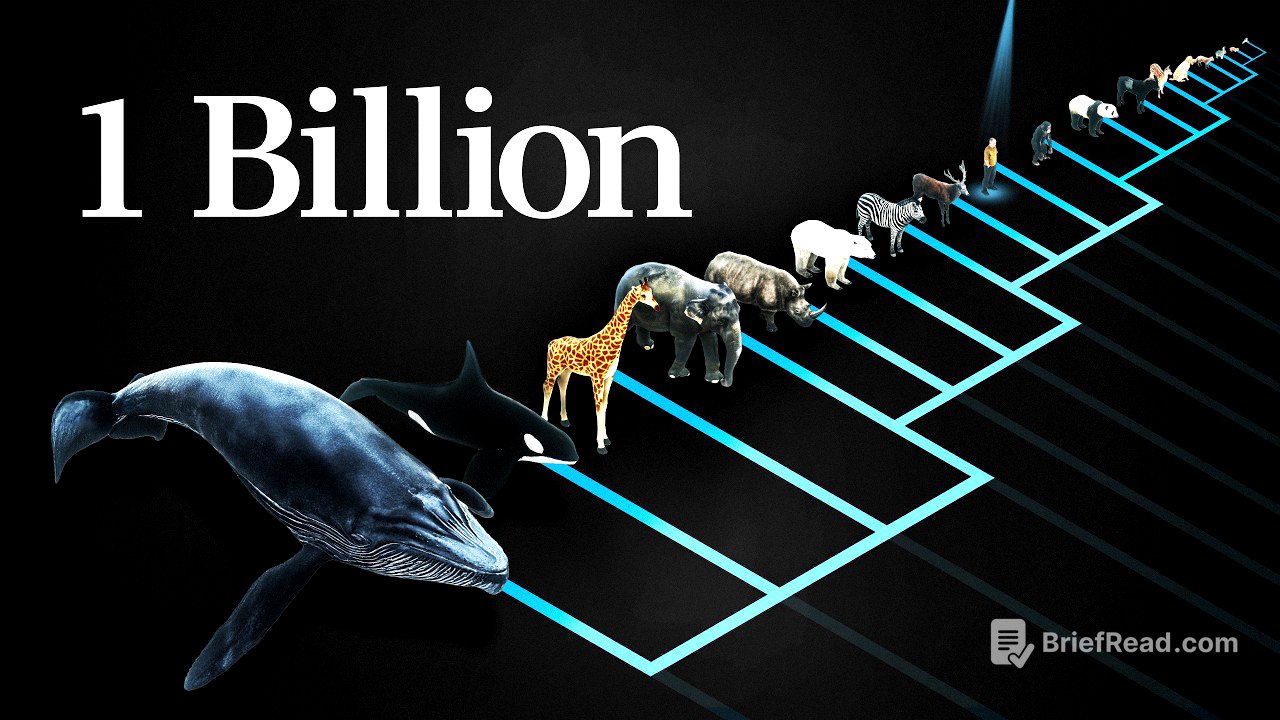
The video discusses the striking observation that nearly all mammals experience around one billion heartbeats in their lifetime, regardless of size. This curious trend prompts exploration as to why this specific count appears consistent across species. The analysis showcases how heart rate and lifespan are inversely related, leading larger animals to have slower heart rates and longer lives. The pattern aligns with the general life history strategies of animals.
Why Humans Live Longer [23:11]
Humans are identified as an outlier in the heartbeat analysis, as contemporary lifestyles have extended the average lifespan, effectively bringing the average number of heartbeats over a lifetime closer to three billion. Advancements in health standards and medical practices have played pivotal roles in increasing life expectancy and overall heart rate averages among humans in modern times compared to historical data.
Is it better to live in a city or a small town? [24:31]
The video contrasts the perceived downsides of urban living with evident advantages regarding health and longevity. While larger cities are often associated with higher crime and pollution rates, there is quantitative evidence suggesting that cities might lead to longer lifespans due to factors like improved economic opportunities and shared resources.
Is there really a universal scaling exponent for life? [30:12]
Lastly, the discussion raises questions about universal constants in scaling laws across all of life, acknowledging ongoing debates within the scientific community about metabolic scaling exponents. While Kleiber's Law serves as a prominent example of biological scaling, it’s suggested that various scaling laws might operate differently in distinct groups of organisms, prompting future research for a clearer understanding of these relationships.