TLDR;
This video explores the story of Prophet Musa's journey to meet Al-Khidr at the junction of two seas (Majma al-Bahrayn) as described in Surah Al-Kahf, blending classical Islamic interpretations with modern scientific concepts like spacetime, wormholes, and time reversal. It suggests that Majma al-Bahrayn could be a metaphor for a wormhole, the revival of the dead fish an indication of time reversal, and the spring of life a manifestation of exotic matter needed to stabilize a wormhole. The video concludes by emphasizing the importance of understanding Surah Al-Kahf both theologically and scientifically to prepare against deception, particularly during the trials of the end times.
- The journey of Prophet Musa to meet Al-Khidr at Majma al-Bahrayn.
- Interpretation of Majma al-Bahrayn as a potential wormhole.
- The revival of the dead fish as an indicator of time reversal.
- The spring of life as a manifestation of exotic matter.
- The importance of understanding Surah Al-Kahf both theologically and scientifically.
Surah Al-Kahf & Science [0:00]
The video begins by addressing a debate about the identity of Musa in Surah Al-Kahf, confirming it is indeed the Musa of Bani Israel. It recounts the story of Musa being informed by Allah about a more knowledgeable servant at the junction of two seas and his subsequent journey to find him. The video highlights the dual approach of understanding existence through revelation (Quran and Hadith) and physics, setting the stage for exploring the meeting of Musa and Al-Khidr at Majma al-Bahrayn. Allah instructed Musa to take a dead fish and that the place where he loses the fish is where he will find his servant. Musa then sets out with Yusha bin Nun.
The Beginning of the Journey: Yusha bin Nun & the Dead Fish Sign [1:30]
Yusha bin Nun's role in the journey is highlighted as the one entrusted with carrying the dead fish and witnessing the miraculous event of its revival. Yusha's unique position as a witness becomes critical later in the narrative. Musa tells his servant that he will never give up until he reaches the junction of the two seas even if he has to travel for ages.
What Is Majmaʿ al-Bahrayn (The Junction of Two Seas)? [3:10]
The video explains the meaning of Majma al-Bahrayn, both literally as the junction of two seas and metaphorically as the junction of two vast domains or cosmic realities. The Arabic word "Bahar" encompasses not just saltwater seas but any vast, deep expanse or domain. This opens the door to a scientific reading of the event, suggesting Majma al-Bahrayn could represent the intersection of two different regions of existence or knowledge.
At the Mysterious Junction: The Resurrection of the Fish at Majmaʿ al-Bahrayn [5:10]
Upon arriving at Majma al-Bahrayn, Musa falls asleep, and the dead fish carried by Yusha miraculously comes back to life. The Quran describes the fish taking its course into the sea "amazingly," creating a tunnel-like passage. Yusha witnesses this extraordinary event, including the tunnel remaining open, yet forgets to inform Musa at the moment. After Musa wakes up and they have traveled a considerable distance, Yusha remembers and tells Musa about the fish. Musa responds, "That is exactly what we were seeking."
The Spring of Life [8:41]
The video transitions to exploring the cause of the anomalies at Majma al-Bahrayn, particularly the revival of the dead fish. Classical interpretations suggest the presence of the "Ain al-Hayat," the spring of life, at the junction, which restores life to any dead creature that comes into contact with its waters. The video then proposes a modern scientific perspective on this event.
Spacetime in the Quran [9:53]
To understand the meeting between Musa and Al-Khidr, the video establishes the concept of spacetime as a four-dimensional continuum, as defined by Einstein's theory of relativity. The Quran anticipates this by using water-related metaphors to describe the cosmos, implying that spacetime behaves as a fluidic medium. Celestial mechanics are described using terminology associated with fluid dynamics, such as celestial bodies "swimming" or "floating" in an orbit.
Spacetime in the Journey of Dhul-Qarnayn [12:45]
The application of fluidic metaphors to spacetime is further evidenced in the narrative of Dhul-Qarnayn, who reaches the setting of the sun and finds it as if setting in a spring of dark murky water. This is interpreted as a metaphorical descriptor for a black hole or gravitational singularity, where light is irrevocably pulled into a dark, impenetrable gravitational well.
Majma al Bahryan: A Quranic Wormhole? [15:15]
The video proposes that Majma al-Bahrayn can be interpreted as the junction connecting two distinct regions of spacetime, akin to a wormhole or Einstein-Rosen bridge. This junction serves as a threshold between Musa's three-dimensional temporal reality and the higher-dimensional reality inhabited by Al-Khidr, who can perceive future consequences. The Majma al-Bahrayn was the physical wormhole throat that allowed these two drastically different dimensional realities to intersect. The video addresses why Musa and his servant moved on from the junction, suggesting they did not realize they had reached Majma al-Bahrayn because it was not a simple geographical marker but a spacetime anomaly.
The Tunnel in the Sea: Portal in the Quran [22:40]
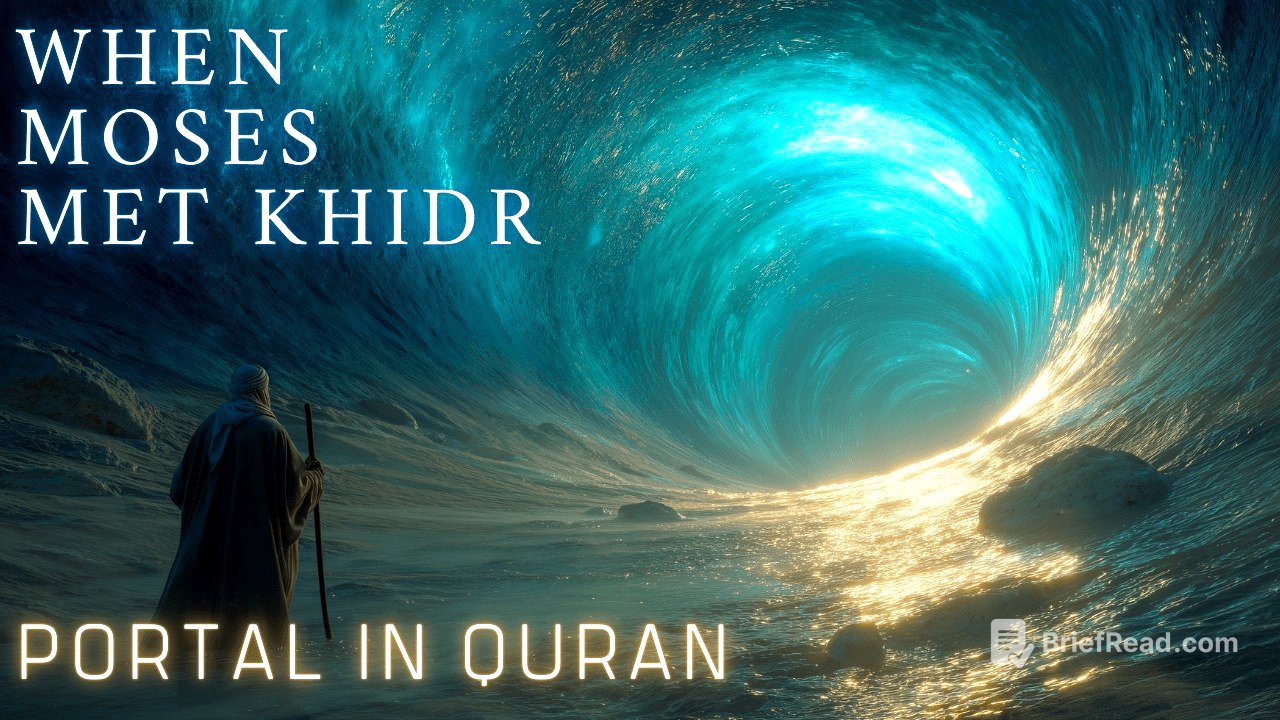
The video focuses on the Arabic word "saraban," used to describe the fish's path into the sea, meaning a tunnel or subterranean channel. This word precisely describes the geometric shape that wormhole physics predicts would be visible at the sight of a wormhole mouth opening in a body of water. The hadith adds that the fish's path through the water remained open, which is consistent with the physics of a traversable wormhole.
Time travel at Majmaʿ al-Bahrayn [24:50]
The video addresses how the dead salted fish came back to life, linking it to the classical tradition of the Ain al-Hayat, the spring of life. It proposes that the physical environment could produce effects analogous to the spring of life, pointing to wormhole solutions involving closed timelike curves (CTCs). The fish, upon entering the CTC region of the wormhole's spacetime geometry, would emerge at an earlier point in its timeline before it had died, effectively being revived through time reversal.
The Spring of Life and Exotic Matter [27:15]
The video explains that a traversable wormhole requires exotic matter with negative energy density to prevent its collapse. This exotic matter is linked to the classical tradition of the Ain al-Hayat, representing the stabilizing factor that allows the junction to exist. The spring of life can be understood as the physical sign of such an unusual condition, marking a region where the ordinary rules of nature are altered.
Conclusion [29:30]
The video concludes by emphasizing the significance of Surah Al-Kahf as protection during the end times, particularly against the trials of Dajjal, because it speaks about extraordinary and seemingly unnatural events. Understanding the surah both theologically and scientifically is crucial for recognizing that not everything extraordinary is divine and for strengthening faith, critical awareness, and scientific knowledge. The video cautions against bending the Quran to fit scientific theories, emphasizing that science must be tested and refined in the light of Quranic guidance.