TLDR;
The video explores the concept of string pairs on the guitar, which simplifies navigating the fretboard and understanding music theory. Key points include:
- The guitar is primarily tuned in perfect fourths, with a notable exception between the G and B strings.
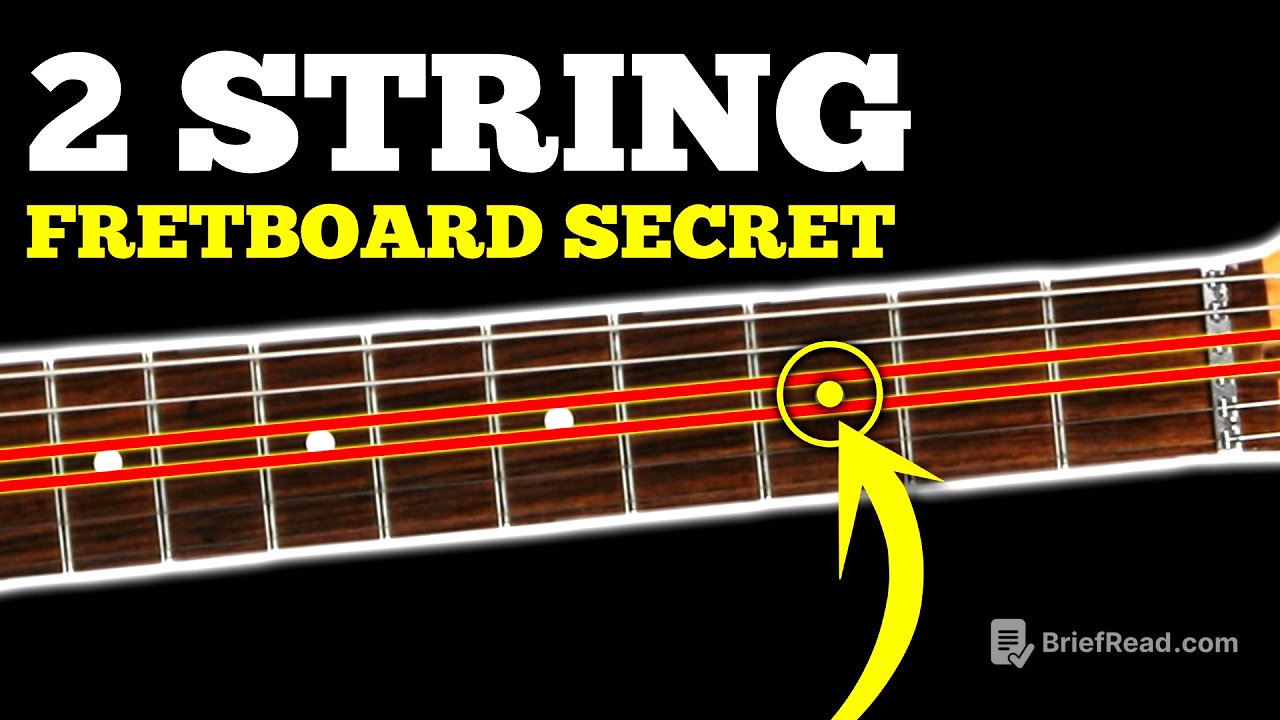
- There are three main string pairs: E–A, D–G, and B–e. Each pair allows for easier pattern recognition.
- The CAGED system is discussed for bridging these pairs and visualizing octaves on the guitar.
String pairs and why the neck feels “too big” [0:00]
The lesson addresses why the guitar neck can feel overwhelming and difficult to memorize. Concepts of string pairs are introduced, explaining how these pairs can help to transition between notes and positions without starting from scratch. The instructor emphasizes that understanding these pairs simplifies the learning process.
Standard tuning explained (mostly perfect 4ths) [0:40]
The standard tuning of the guitar is primarily in perfect fourths except for the interval between the G and B strings, which is a major third. The instructor illustrates this point using the musical alphabet, emphasizing the spacing between notes on the strings and how this affects finger placement and familiarity on the fretboard.
The problem string: G to B is a major 3rd [2:45]
The string pair issue is explored in detail, focusing on how the G to B string transition is a major third, contrasting with the other fourth intervals. This distinction is highlighted as a common source of confusion, necessitating a compensatory mental adjustment when moving between these strings.
The 3 main string pairs (E–A, D–G, B–e) [4:14]
The video identifies three main string pairs, which can help learners break down the fretboard into manageable sections. These string pairs (E–A, D–G, and B–e) are presented as the primary lanes for practicing and developing patterns without overwhelming the player with all six strings at once.
Bridge the pairs with CAGED octave shapes [7:18]
The importance of CAGED octave shapes in bridging string pairs is discussed. The five CAGED shapes correspond to different chord forms, allowing players to navigate the fretboard more effectively. Each shape's transition across strings is demonstrated, proving how these octaves connect different areas of the guitar.
CAGED octaves on the guitar (quick demos) [10:48]
Visual demonstrations of CAGED octaves are provided, showcasing how to form these shapes on the guitar. The instructor highlights the connection between root notes and their respective octave shapes across various string pairs, reinforcing the concept of bridging strings seamlessly.
Move a power chord across the string pairs [12:55]
The video discusses moving a power chord between string pairs. By demonstrating a G5 power chord, the instructor illustrates how the same finger placement can be applied across different octaves and string pairs, maintaining musical harmony while transitioning through the fretboard.
Pentatonic fragments across pairs (minor and major) [16:21]
The use of pentatonic scales across string pairs, categorizing them into minor and major fragments, is explored. Specific patterns called "rectangle and leg" are discussed, allowing players to move the same melodic line through multiple octaves effortlessly, enhancing their fretboard flexibility.
Major triads and arpeggios across pairs [19:30]
The concept of major triads and their related arpeggios is covered using string pairs. The instructor demonstrates how to find the root, third, and fifth of a chord, showing how to transition between different string pairs while maintaining the integrity of the chord structure.
Blues scale idea across three registers [21:15]
The video concludes with an exploration of the blues scale across three different registers. The instructor uses specific scale patterns to demonstrate how to incorporate the blues scale using string pairs to create a diverse range of sounds and improvisational possibilities on the guitar.



![[제40회 골든디스크] 디지털 음원 본상 - JENNIE (제니)](https://wm-img.halpindev.com/p-briefread_c-10_b-10/urlb/aHR0cDovL2ltZy55b3V0dWJlLmNvbS92aS9hVlpuYkJsZFdZUS9ocWRlZmF1bHQuanBn.jpg)