TLDR;
This video from National Geographic provides an overview of our solar system, detailing its formation, the different types of planets it contains (Terrestrial and Jovian), and the various zones of space debris like the asteroid belt, Kuiper Belt, and Oort Cloud. It highlights the unique characteristics of each planet and their significance within the solar system.
- The solar system formed approximately 4.5 billion years ago from a collapsing cloud of interstellar gas and dust.
- The planets are categorised into Terrestrial (rocky) and Jovian (gas and ice giants).
- The solar system includes various zones of space debris, such as the asteroid belt, Kuiper Belt, and Oort Cloud.
Introduction to the Solar System [0:02]
Our solar system is one of over 500 known solar systems within the Milky Way galaxy. It originated around 4.5 billion years ago from the collapse of an interstellar gas and dust cloud, forming a solar nebula. This swirling disc of material eventually coalesced to create the solar system. The solar system resides in the Orion star cluster of the Milky Way, and only 15% of stars in the galaxy have planetary systems, including our sun.
Terrestrial Planets [0:40]
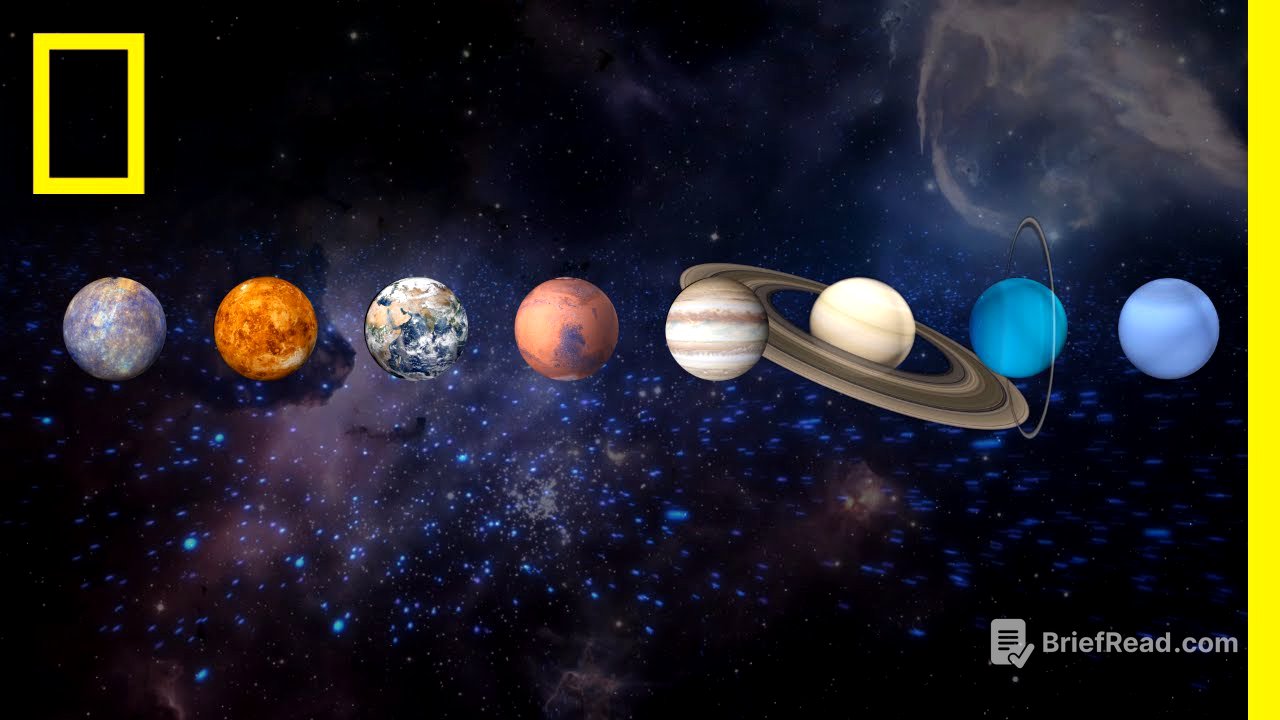
Revolving around the sun are eight planets, divided into Terrestrial and Jovian categories based on their composition. Terrestrial planets—Mercury, Venus, Earth, and Mars—are primarily composed of rocky material with solid surfaces, few or no moons, and no ring systems. Mercury, the smallest and closest to the sun, has the shortest orbit, lasting about three Earth months. Venus is the hottest planet, reaching temperatures of up to 867 degrees Fahrenheit due to its carbon dioxide atmosphere and extensive lava flows. Earth, a world of water, uniquely supports life.
Mars [1:36]
Mars, the last of the Terrestrial planets, may have supported life around 3.7 billion years ago when it had a watery surface and moist atmosphere.
Jovian Planets [1:48]
Beyond the Terrestrial planets lie the Jovian planets: gas giants Jupiter and Saturn, and ice giants Uranus and Neptune. Gas giants are mainly helium and hydrogen, while ice giants contain rock, ice, and a liquid mixture of water, methane, and ammonia. All Jovian planets have multiple moons, ring systems, no solid surface, and are immense in size. Jupiter is the largest planet in the solar system, while Saturn is the second largest, featuring rings wide enough to span the distance between Earth and the moon, yet only a kilometre thick.
Ice Giants and Space Debris [2:39]
Past Saturn are the ice giants, Uranus and Neptune. Uranus, slightly larger, rotates on its side. Neptune is the outermost and one of the coldest planets. The asteroid belt, a flat disc of rocky objects, orbits the Terrestrial planets and contains remnants from the solar system's formation, ranging from microscopic dust to the dwarf planet Ceres.
Kuiper Belt and Oort Cloud [3:12]
The icy Kuiper Belt, another disc of space debris, orbits the Jovian planets and contains dwarf planets like Pluto, and is the origin of many comets. Beyond the Kuiper Belt is the Oort Cloud, a vast, spherical collection of icy debris marking the edge of the solar system where the sun's gravitational and physical influences end.
Conclusion [3:41]
The unique configuration of planets and celestial objects in our solar system, all revolving around a life-giving star, makes it a special place.