TLDR;
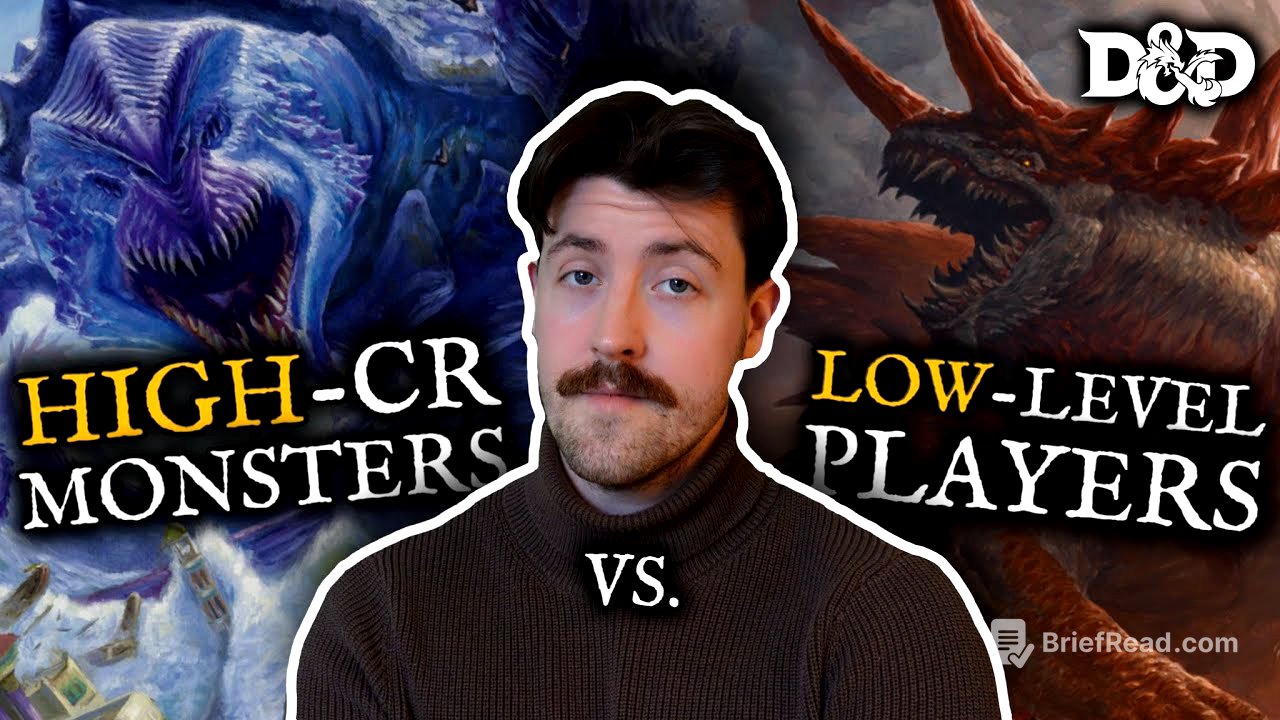
This video explains how to use high-challenge rating (CR) monsters as environmental challenges for low-level D&D parties, rather than engaging in direct combat. It uses a Kraken encounter as a specific example, but the system can be adapted for other enormous creatures like dragons or the Tarrasque. The key is to create a scenario where players focus on survival, rescue, and mitigation rather than direct confrontation.
- Use giant high CR monsters as environmental challenges for low-level parties.
- Focus on survival, rescue, and mitigation rather than direct confrontation.
- Adaptable for other enormous creatures like dragons or the Tarrasque.
The start [0:00]
The video introduces the concept of using giant, high CR monsters as environmental challenges for low-level D&D parties. Instead of standard combat encounters, the focus shifts to survival and problem-solving. The Kraken is used as a specific example throughout the video, but the principles can be applied to any enormous creature that the players are not equipped to fight directly, such as an ancient red dragon or a Tarrasque. A written version of the rules is available on the Tales Arcane Patreon.
Setting the scene [0:48]
The Kraken encounter begins with the players on a ship, traveling to an island or continent. As they approach land, a storm appears, and a Kraken attacks the ship. The Kraken wraps its tentacles around the ship, intending to crush the hull and sink it, while smaller tentacles attack the crew. The players have approximately 1 minute (10 rounds) to react before the ship is completely submerged, and anyone left on board perishes.
The hapless NPCs [1:54]
In this scenario, the crew members serve as a measure of the players' success. The primary goal is to save as many crew members as possible before the ship sinks. The example given involves 24 remaining crew members after the initial attack, with three lifeboats available, each capable of carrying 12 people. Launching a lifeboat takes five rounds (30 seconds), and only one can be launched at a time. This creates a challenge where players must either sacrifice some crew members or find a way to launch all three boats before the ship sinks.
Speeding up the escape [3:46]
Players have three main actions they can take each turn: speeding up lifeboat launches, slowing down the sinking of the ship, or defending the crew from tentacle attacks. To assist with launching lifeboats, a player must describe how they are helping and justify the skill check they are using. Examples include using a Charisma check (Persuasion or Performance) to motivate the crew or a Strength check (Athletics) to physically assist in hoisting the boat. A successful DC5 check reduces the remaining time for launching a lifeboat by one round.
Buying more time [5:00]
Instead of helping with the lifeboats, players can attack the large tentacles wrapped around the ship. This requires making an attack against an AC of 14. If the Kraken takes 25 points of damage in a single round, the sinking of the ship is delayed by one round. This is a valuable option for buying more time, but it requires cooperation among the players to reach the damage threshold, especially at lower levels.
Random events [7:28]
To keep the encounter dynamic and prevent it from becoming repetitive, the GM rolls a d12 at the start of each round to generate a random event. These events are designed to hinder or harm the players, adding unpredictability and chaos to the situation. Examples include the mast and rigging collapsing, requiring a Dexterity saving throw to avoid damage; lightning striking near the lifeboats, damaging those helping with the preparations; or the ship rolling, causing disadvantage on checks.
Other monsters [9:34]
The framework described can be adapted for other large monsters and scenarios. The key components include a closed environment, people to protect, a countdown to disaster, and a table of chaotic events. Player actions should focus on helping people escape, prolonging the timer, or saving lives. Examples include a red dragon attacking a town, where players can help villagers escape burning buildings, distract the dragon, or save people from being snatched. The system can also be used for natural disasters.
Conclusion [12:51]
The approach of using giant monsters as environmental challenges sets up opportunities for future encounters. Players who barely survive a Kraken attack at low levels may later seek out the same monster for a direct confrontation once they have gained more power. The video encourages GMs to create dramatic and intense monster encounters that deviate from typical D&D combat scenarios.


![[Midori] Traveler's Notebook- Camel vs Brown](https://wm-img.halpindev.com/p-briefread_c-10_b-10/urlb/aHR0cDovL2ltZy55b3V0dWJlLmNvbS92aS9uV3NFNVBrMXdUYy9ocWRlZmF1bHQuanBn.jpg)