TLDR;
The 1937 ABCs of Propaganda Analysis offers a seven-step method for evaluating persuasive messages and strengthening independent thinking. It focuses not only on techniques used by others, but also on how our emotions, identities, and social backgrounds shape our own judgments.
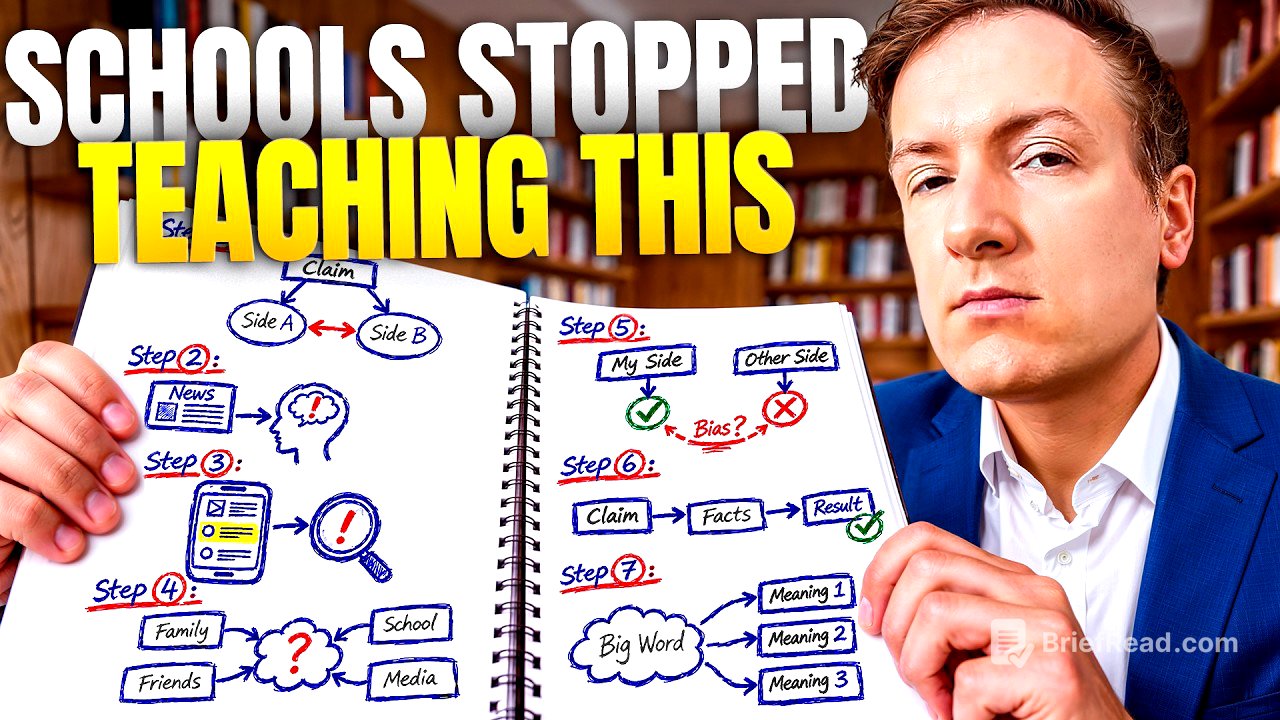
- Identify the interests and conflicts behind a message.
- Notice your emotional response and examine current issues, including those you care about.
- Question inherited opinions, scrutinize your side’s arguments, check precise claims against evidence, and define emotionally charged terms.
The ABCs of Propaganda Analysis [0:41]
The guide was published in 1937 to teach people how to think critically about persuasive messages. Its creator, Clyde Miller, had supported the prosecution of antiwar socialist Eugene Debs during the First World War. After serving in France, Miller reconsidered his position and concluded that wartime propaganda had helped make him support a conflict he had not properly examined. This experience shaped the guide’s purpose: to help people recognize the conflicts behind persuasion, rather than merely memorize a list of dishonest techniques.
A — Ascertain the Conflict [3:13]
Before judging a message, identify who is in conflict, what each side wants, and what each might gain if you accept its version of events. For example, the claim that artificial intelligence (AI) is coming for people’s jobs may sound like a contest between workers and machines. But workers seek security, employers may seek productivity and lower costs, technology companies want adoption, politicians want to appear either worker-friendly or pro-innovation, and influencers selling AI courses may benefit from making the future seem urgent.
These interests do not prove the warning false. They show that an apparently neutral prediction is part of a struggle involving groups with different aims. Recognizing that conflict helps you ask whose interpretation you are hearing, what response the message encourages, and what it may leave out.
B — Behold Your Own Reaction [4:49]
Notice what a message makes you feel: anger, relief, fear, vindication, or a desire to believe it because it supports an existing view. A title claiming that schools once taught a valuable critical-thinking guide may satisfy someone who already believes schools have declined, while someone strongly attached to public education may find the same title sensationalistic. Neither reaction proves the historical claim, but each can affect which evidence you notice and how much scrutiny you apply.
The Institute for Propaganda Analysis distributed its materials to schools, colleges, and libraries, corresponded with about 2,500 teachers, and estimated that roughly one million students used its methods by the late 1930s. The key habit begins with examining what happened inside you—not simply identifying what is wrong with someone else’s argument.
C — Concern Yourself with Today’s Propaganda [7:52]
The guide warned against becoming skilled at recognizing only propaganda from the past. The real test is to examine messages connected to conflicts that currently affect your career, health, income, religion, social group, or political identity. In 1939, English teacher Helen Davis used the institute’s materials with students at DeWitt Clinton High School in New York City. They analyzed newspaper stories and letters to editors, checked factual claims, identified prejudice, and wrote responses to a student letter defending a blank-filling target. They selected the strongest responses and sent them to the magazine that had published the original letter; the exercise reportedly influenced how its editors later handled fascism.
Students were not just memorizing a definition of propaganda: they were evaluating current messages and taking part in public debate. A practical rule follows: whenever you study a historical form of manipulation, look for its present-day equivalent. The institute also produced a separate, more famous list of seven propaganda devices—name-calling, glittering generalities, transfer, testimonial, plain folks, card stacking, and bandwagon. Those labels help identify persuasive techniques, while the ABCs also examine how your own identity may shape the evidence you accept.
D — Doubt That Your Opinions Are Your Own [9:13]
The guide argued that opinions are often shaped by family, neighborhood, religion, economic circumstances, occupation, political party, friends, and where someone grows up. This does not mean independent thought is impossible or that a belief is false because of its social origins. It means our surroundings can influence which claims seem obvious, which sources feel trustworthy, and which possibilities we consider.
To examine a strong belief, ask when you first adopted it, who around you held it, what social costs might come with rejecting it, and whether you would likely hold the same view if you had grown up in a different community. A belief may have social causes and still be true, but if you inherited it without examining its reasons, you do not yet know whether it has survived scrutiny or merely avoided it.
E — Evaluate Your Own Propaganda [10:27]
Recognizing that your background influences you is only the beginning. You must also examine the selective stories, emotionally loaded words, convenient omissions, and heroic narratives used by your own side. If you expect AI to replace most people in your profession, ask whether you treat every layoff or alarming prediction as confirmation while ignoring cases where AI changes tasks without eliminating jobs. Also ask whether you turn a possibility into an inevitability because the frightening version is easier to remember.
The reverse applies if you believe AI is overhyped: collecting examples of its mistakes while ignoring tasks it already performs well can protect a conclusion you have already reached. In either direction, apparent evaluation may actually be selective evidence-gathering in defense of an existing belief.
F — Find the Facts Before Reaching a Conclusion [12:24]
Before accepting or rejecting a claim, clarify what it means and ask who is speaking, how they are trying to influence you, what their words mean, and whether their interests align with yours. “AI is coming for your job” could mean that AI will eliminate an entire occupation, take over some tasks, reduce the number of workers employers need, or give AI users an advantage over people who do not use it. These are different claims, and evidence for one does not automatically prove the others.
The International Labour Organization estimated in 2025 that one in four workers worldwide held an occupation with at least some exposure to generative AI, while 3.3% of global employment fell into its highest exposure category. Its researchers concluded that job transformation is generally more likely than job elimination because most occupations still involve tasks requiring human participation. Workers may still be displaced, wages may change, and professions may need fewer people, but the evidence supports a complex, uneven impact rather than the simple claim that AI will replace nearly everyone. Facts can only test a claim once it is precise enough to evaluate.
G — Guard Against Omnibus Words [13:37]
Omnibus words are broad, emotionally powerful terms that can carry several meanings at once. Words such as “freedom,” “patriotism,” “justice,” “extremism,” “traditional,” “woke,” and “propaganda” can provoke strong reactions without making clear what the speaker means. The guide recommended using precise definitions as a defense: whenever an argument relies on a charged term, ask the speaker—and yourself—to complete the sentence, “By this word, I mean…”
The institute defined propaganda broadly as communication designed to influence opinions or actions toward predetermined ends. Under that definition, propaganda does not have to be false or come from an enemy government; advertisements, campaign speeches, charitable appeals, school lessons, and YouTube videos can all seek to guide attitudes and behavior. The seven habits are to ascertain conflict, behold your reaction, concern yourself with current propaganda, doubt that your opinions are entirely your own, evaluate your own propaganda, find the facts, and guard against omnibus words.