TLDR;
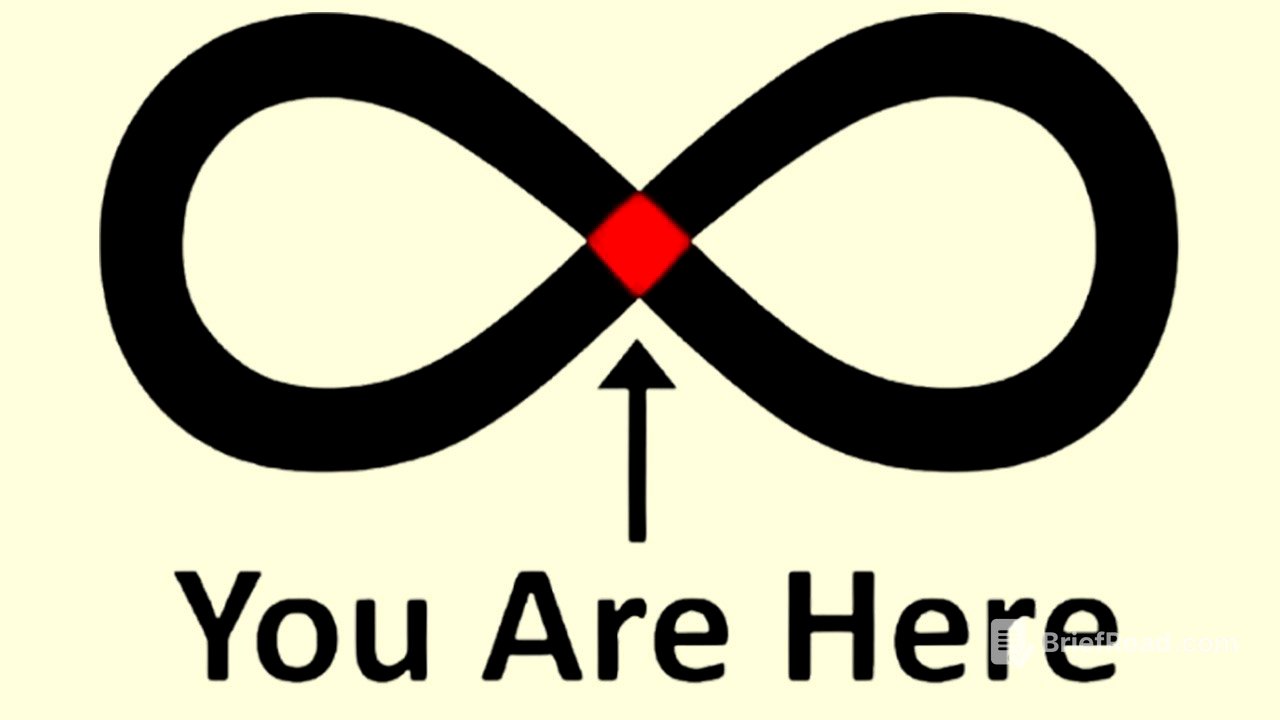
This video explores the concept of "here" and "there," challenging the illusion of separation and fixed locations. It discusses how our perception of reality is shaped by our minds and experiences, and how we can find the center of existence within ourselves. The video also touches on non-locality, the absolute and relative aspects of reality, and the idea of "suchness" as the unedited version of reality.
- The illusion of control and the constant motion of reality.
- The concept of "here" as a function of being, not a fixed location.
- Non-locality and the interconnectedness of the universe.
- The absolute and relative aspects of reality.
- "Suchness" as the unedited version of reality.
Introduction: The Illusion of Control and the Nature of Reality [0:00]
The video starts by stating that the idea of control is an illusion created by the mind, which attempts to freeze a constantly moving reality. It presents the idea that we are all "falling through the air" with nothing to hold on to, but reassures us that "there is no ground." The video challenges the perception of existing in a constant movement between two points, suggesting that this is just a surface-level understanding. It encourages viewers to stop living in the "suburbs of their own self" and recognize that all these movements and places are just projections.
Finding the Still Point: The Center Within [1:04]
The real center is not something to be found by climbing spiritual mountains or crossing psychological rivers, but rather the still point inside each individual. This is the awareness that has always been present. The video emphasizes that the center is not a fixed, measurable spot in space that can be found by traveling or pinpointing on a map. Instead, it suggests that the center of infinity has no boundaries and exists everywhere at every point, always in the present moment.
Trauma, Transcendence, and the Unbounded Field [1:58]
The video contrasts the experiences of trauma and transcendence. In trauma, people dissociate and lose their center, with memory fragments and identity scattered across events. Healing involves re-entering a "here" that feels real, embodied, and grounded. Conversely, mystics report a total expansion where the self dissolves and everything becomes "here," indicating a loosening of the localized self and a return of awareness to its unbounded field. Both trauma and transcendence break the illusion of a fixed "here," with trauma disintegrating it painfully and transcendence dissolving it ecstatically.
The Nature of "Here": A Function of Being [3:24]
The video examines the meaning of "here," noting that it doesn't refer to a specific location but rather follows the individual like a shadow. This implies that "here" is not a place at all but a function of one's being. The simultaneous existence of being "here" and "there" is explored, leading to the concept of non-locality from quantum physics, which suggests that objects are not confined to a specific location. This means that one can be everywhere without physically moving, as the universe is interconnected at a quantum level.
Absolute and Relative Reality: Two Aspects of One Truth [4:33]
Buddhist teachings, despite their diverse concepts and terms, all point to the same reality. The video uses the analogy of describing a sunset through different mediums like measuring light intensity, writing a poem, painting, or photographing it. Each portrayal emphasizes a particular aspect of the sunset, but none can fully capture its entire reality. In seeing reality clearly, we perceive two aspects: the absolute and the relative. The absolute transcends dualism, while the relative includes aspects like time, space, and individuality.
Experiencing Reality: Particular vs. Whole [7:08]
The video introduces an exercise to see reality in two different ways: the particular versus the whole. While it's true that reality consists of individuals and their interactions, it is also a seamless whole. Experiencing reality in this way means that the particulars don't ruin the wholeness, and everything is included. The video uses the analogy of watching a movie, where the events are just part of the story, to illustrate this concept. The absolute aspect of reality is how we perceive things directly, without interpreting them through our mental map or self-interest.
"You Are That": Understanding the World as It Truly Is [8:36]
The statement "You are that" is presented not just as an inspirational quote, but as an observation of how reality works. It's a key to understanding the world as a continuous dance between the observer and the observed, an endless loop where the two are inseparable. You are not simply experiencing the universe; you are the experience itself. You don't need to travel to a mystical place to find the center of existence because you already are that center.
The Dissolving of Boundaries: Being Here and Everywhere [9:29]
The video shares an account from Buddhist teacher Pemma, who experienced a mind-bending realization of being both "here" in the room and "there" in every place and moment. Her sense of self dissolved into everything around her, and the separation between "here" and "there" disappeared. The more one explores this, the more one realizes that they are not moving through space and time, but rather they are space and time. "Here" and "there" are constructs to help navigate the illusion of separation.
Challenging the Model: The Universe Within [10:25]
The video challenges the conventional model of ourselves as coordinates in a vast universe. It proposes that instead of being in the universe, the universe is in us. In non-Euclidean geometry, every point can be regarded as the center, including where you are sitting right now. Therefore, you are not on the periphery but at the axis.
The Center of Awareness: You Are the Ocean [11:22]
The video goes deeper, stating that you are not just at the center of space but at the center of awareness itself. You are not in awareness like a fish in water, but you are the ocean itself, looking back at itself with borrowed eyes. The more you try to define consciousness, the more elusive it becomes.
The Sound of One Hand Clapping: Being Everywhere [11:56]
An ancient Zen story about the sound of one hand clapping is used to illustrate the concept of being everywhere. The sound of clapping isn't confined to the meeting of two hands but exists in all places. The one hand clapping represents the singularity of the moment, which reverberates across time and space. Consciousness, like space, is curved by experience, meaning "here" and "there" are simply different bends in the same cosmic fabric.
The Holographic Universe: Tricks of Perception [13:06]
The video introduces the theoretical idea that our entire universe is a hologram, a 3D projection from a 2D plane. In this view, everything we experience, including space and time, is an illusion encoded on a cosmic surface. If reality is a hologram, then the boundaries between "here" and "there" are just tricks of perception. You are "here" in your body, but in a real sense, you are everywhere.
Time, Space, and Becoming: The Ongoing Cosmic Process [13:52]
Time and space are described as substances like clay, continuously being shaped. When we say we are "here," it's as though we're in a particular moment of this flowing substance. "There" is just the next shape that hasn't yet been formed. "Here" and "there" are not fixed but are part of a larger ongoing cosmic process of becoming.
Suchness: The Unedited Version of Reality [14:35]
"Suchness" is defined as the reality behind our commentary, the texture of a moment before we label it. It's the unedited version of reality, the raw footage before the mind adds commentary. "Suchness" is the radical act of letting things be as they are, the felt presence of a moment before interpretation. It's the quiet immediacy of being that asks for nothing and explains even less.
The Addiction to Stories and the Surrender of Control [16:01]
We don't live in "suchness" because we're addicted to stories and want meaning and narrative. "Suchness" isn't here to entertain or explain but to be. If you stop resisting it, you might notice it's enough. To rest in "suchness" is to surrender control, to stop trying to bend the moment to your preference and let it crash into you exactly as it is.
Homesickness and the Dual World [16:28]
Spiritual philosophy is described as homesickness, an urge to be at home everywhere. Our thoughts shape us, and the thoughts of "here" and "there" bring the vision of the dual world. The difference between a system and a mess is just how long you stare at it. "Suchness" is not true or false; it is what remains when all the stories fall silent.







![You're so sexy. [Bel Ami : EP.1-1] | KBS WORLD TV 240605](https://wm-img.halpindev.com/p-briefread_c-10_b-10/urlb/aHR0cDovL2ltZy55b3V0dWJlLmNvbS92aS9hTlMwcV81ZkZTNC9ocWRlZmF1bHQuanBn.jpg)