TLDR;
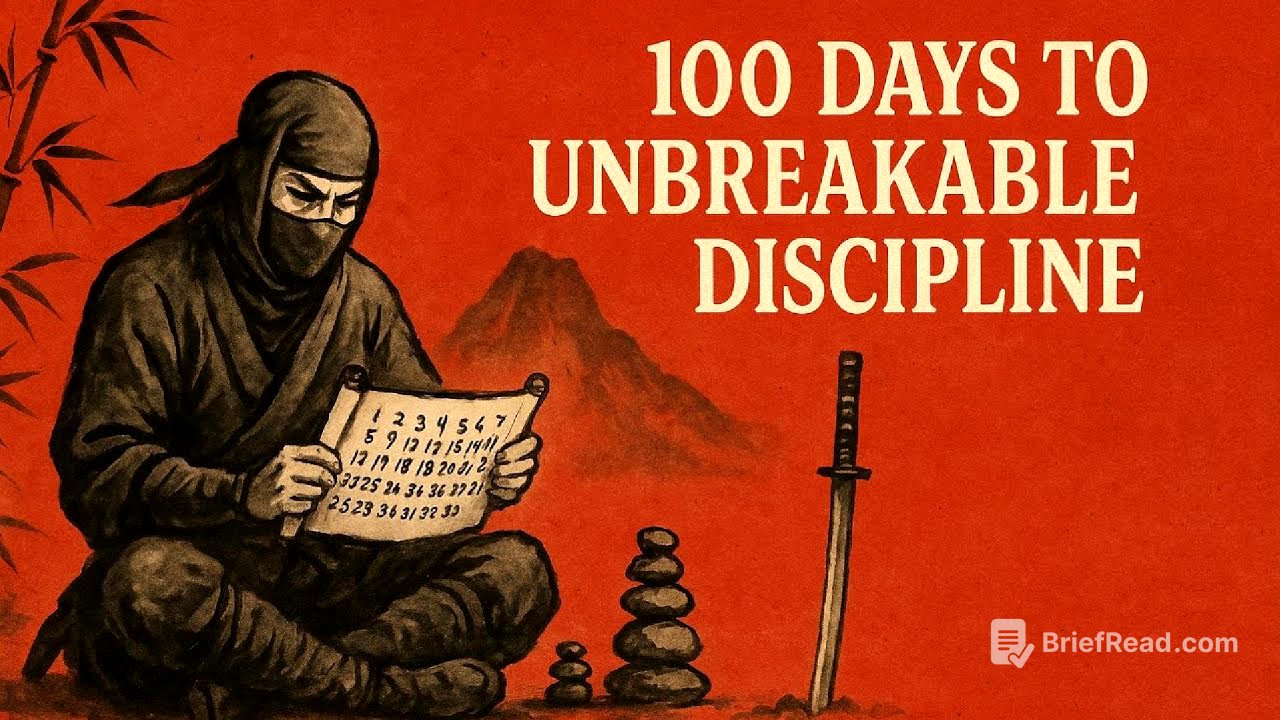
This video introduces the ancient Shinobi system called Ninpo, which transforms individuals into disciplined warriors. It emphasizes that true discipline isn't about willpower but about understanding and implementing five hidden pillars. The story of Riku, a lazy boy who becomes a disciplined shinobi, illustrates these principles.
- Public Oath (Katsui)
- Unchanging Rhythm (Rey)
- Perfect Form (Kata)
- Practice Without Gaps (Muku)
- Prior Preparation (Zeni)
The Failed Boy [1:47]
In feudal Japan, a 14-year-old boy named Riku, nicknamed "Riku the Lazy," dreams of becoming a shinobi. Despite his aspirations, he struggles with commitment, failing to follow through with his training attempts. His father, a blacksmith, dismisses his dreams as fantasies and urges him to take up his trade. Riku's father knows about a hidden Shinobi school but withholds the information, doubting his son's ability to commit. Riku's determination grows stronger, and one evening, he encounters a stranger who sees his potential and offers him a chance to prove himself.
The Death of the Weak Self [6:42]
Riku accepts the stranger's challenge to climb a steep mountain, a task he completes after immense struggle. Upon reaching the summit, he is welcomed into the Koga School and learns that he has already completed his first lesson in Ninpo. The training is rigorous, with early wake-up calls and intense physical and mental exercises. The school emphasizes the importance of oaths, where students publicly declare their commitment to the ninja way, with failure resulting in social death.
The Rhythm That Doesn't Break [12:36]
Riku learns the second pillar of Ninpo: Rey, the principle of unchanging rhythm. The master emphasizes living in the instant rather than being ruled by emotions. The lesson of the bell is that one must move when it rings, regardless of feelings. Riku understands that the goal is to outpace weakness with momentum, not to fight it. The master points out Riku's hesitation and explains that true Ninpo requires constant time, removing negotiation and weakness.
The Form That Frees [16:10]
Riku enters the Shuyo period, 100 days of absolute repetition, following the same sequence of exercises daily. The master emphasizes that creativity without structure is chaos and that mastering the form allows for meaningful expression. Despite mental resistance and whispers from other students, Riku stays with the form. His mental stamina fades as his brain realizes resistance is futile. Eventually, he experiences freedom from constant decision-making and notices subtle improvements in his technique.
The Invisible Preparation [23:38]
Riku faces a new challenge when his father arrives with a family emergency, threatening to disrupt his training. The master introduces the fourth pillar of Ninpo, Zeni, which is prior preparation. Riku writes down every imaginable obstacle and decides how he will respond to each. He returns home and helps his father, maintaining his training schedule at 4:00 a.m. The neighbors think he is insane, but Riku understands that his practice allows him to fulfill his duty.
The Mind That Doesn't Hesitate [28:44]
Riku completes the 100-day discipline, experiencing a deep silence within himself. The master reveals the fifth pillar of Ninpo: Mushin, the mind without mind, which means the absence of ego and the silence between thought and action. Riku realizes he no longer negotiates with himself; the practice simply happens. He commits to continuing his training, stating that he is no longer someone who trains but someone who is.
The Warrior Who Scares [31:50]
Three months later, Riku becomes a shinobi, his discipline frightening others. He receives his first mission, which he completes successfully. The master tells him that people will call him obsessive and extreme because his discipline exposes their weakness. Riku learns that when his discipline starts to scare people, he has reached a level beyond ordinary minds. He remembers the lazy boy he used to be and realizes that discipline has transformed him into a different being.