TLDR;
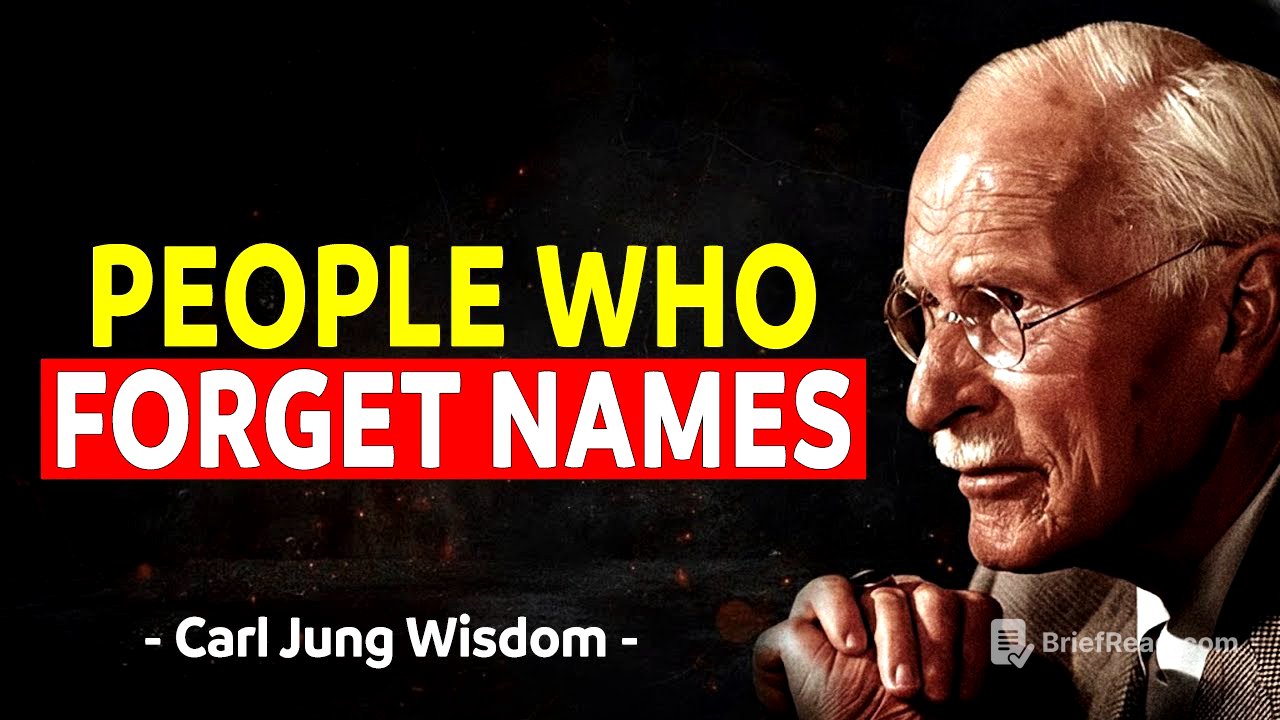
This video explores why we often forget people's names, offering a Jungian perspective that goes beyond simple memory failure. It suggests that forgetting names is often a result of unconscious processes related to the persona, intuition, the shadow self, and complexes. The video also discusses how different personality types (sensation vs. intuition) and ego inflation contribute to this phenomenon. Ultimately, it provides strategies to improve name recall by shifting from a self-centered to an other-centered perspective, using visualization techniques, and integrating the shadow self.
- Forgetting names is not a failure of intelligence but a function of the unconscious mind.
- The persona, intuition, shadow self, and complexes play significant roles in why we forget names.
- Shifting focus from self-performance to genuine interest in others can improve memory.
- Visualizing names as symbols helps bypass the brain's prioritization of survival and emotional data.
- Acknowledging and integrating the shadow self can reduce unconscious rejection of others.
Introduction: The Frustration of Forgetting Names [0:00]
The video starts by describing the common and embarrassing experience of forgetting someone's name just seconds after being introduced. It emphasizes that this is not necessarily a sign of intelligence failure, rudeness, or early memory loss. Instead, it posits that this phenomenon is a sophisticated mechanism of the unconscious mind, offering a deeper explanation rooted in Carl Jung's theories.
Jung's Perspective: Memory as a Gatekeeper [1:08]
Carl Jung believed that forgetting is not accidental but a deliberate act of the unconscious mind. He viewed the conscious mind as a small island within a vast unconscious ocean, where only items permitted by a "gatekeeper" are allowed to stay. Therefore, forgetting a name indicates that the unconscious mind has rejected that person, prompting the need to understand why the rejection occurred.
The Persona: Maintaining the Mask [2:25]
The persona, derived from the Latin word for masks worn by actors, is the face we present to the world. When meeting someone new, much of our psychic energy is used to maintain this mask, monitoring our posture, handshake, and appearance. This preoccupation leaves little bandwidth for processing external data like the person's name, as the brain prioritizes social survival over data storage.
Intuition: Unconscious Scanning and Emotional Charge [3:55]
Interactions are not just person-to-person but also unconscious-to-unconscious. Before speaking, our intuition scans others, reading micro-expressions and energetic shifts. If the intuition senses no value or a threat, it won't "tag" the file, leading to forgetfulness. Names of those who attract, terrify, or offer opportunities are easily remembered due to the emotional charge, while forgetfulness occurs in the "gray zone" of mundane interactions.
The Shadow: Unconscious Rejection and Defense [6:06]
The shadow, the dark side of the personality containing rejected aspects of ourselves, can cause us to forget names when someone activates a subtle projection of our shadow. This discomfort leads the mind to recoil, and forgetting the name becomes a passive-aggressive act of the psyche, distancing us from the person. This mechanism protects us from overwhelming connections, but chronic forgetfulness signals an imbalance, indicating either excessive focus on the persona or detachment from the sensory world.
Typology of Forgetting: Sensation vs. Intuition Types [8:44]
Sensation types engage with reality through their five senses, remembering sensory details like a red tie or the smell of cologne but forgetting the name. Intuitive types, who focus on patterns and abstract meanings, see concepts rather than people, disregarding names as surface details. The brain focuses on the structural integrity of the person, discarding the name.
Complexes and the Shadow of Authority [10:17]
A complex, an emotionally charged group of ideas in the unconscious, can trigger a defense mechanism, causing us to forget a name if it's associated with past pain. People often forget the names of superiors or those they envy, with the shadow acting out by stripping them of their title to protect the ego.
Collective Unconscious vs. Individual Label [12:13]
Our primitive brain is wired for face recognition, threat detection, and emotional resonance, not for assigning arbitrary sounds to faces. Struggling with names reflects a conflict between our ancient biological operating system and modern social software. The tension between the social persona and the animal self causes mental glitches. Information with survival value, like gossip, is easily remembered, while names lack such value.
Ego Inflation and Psychic Entropy [13:54]
Forgetting names often occurs when we are preoccupied with what we will say next, inflating the ego and leaving no space for others. Chronic forgetfulness, including appointments and promises, indicates psychic entropy, where energy is trapped in internal dialogue, causing dissociation and preventing intimacy. By not learning names, we keep the world at arm's length, protecting a sensitive core but leading to isolation and unreality.
The Solution: From Persona to Self [16:52]
Jung's solution involves waking up and integrating the shadow, shifting from the persona to the self. Operating from the self means witnessing rather than performing, opening memory channels. Pushing psychic energy outward and becoming genuinely curious about others makes names stick effortlessly.
Counterintuitive Strategy: Visualizing Names as Symbols [18:14]
Intuitive types should visualize names as symbols, translating words into vibrant archetypes to speak the language of the unconscious. This gives the name visual weight, signaling its importance to the primitive brain. Confronting the part of ourselves that doesn't care and consciously choosing to honor others by holding onto their names becomes a spiritual practice.
Synchronicity and the Potential Messenger [20:21]
Every introduction is a potential synchronicity, and forgetting a name might mean missing a vital piece of your own puzzle. The universe might be trying to introduce a guide or a lesson, but the ego is too busy checking its reflection to notice. Viewing introductions as potential synchronicities sharpens attention and makes the name a key to a door we want to open.
Conclusion: Connection Over Capacity [21:08]
Forgetting names is not a weakness but a complex machine operating on ancient software. Taming this strength involves leaving your own island, dropping the mask, and stepping into the reality of others. By seeing the human being and turning their name into an image, memory becomes a steel trap. It was never about capacity but always about connection, witnessing the stories that every name unlocks.