TLDR;
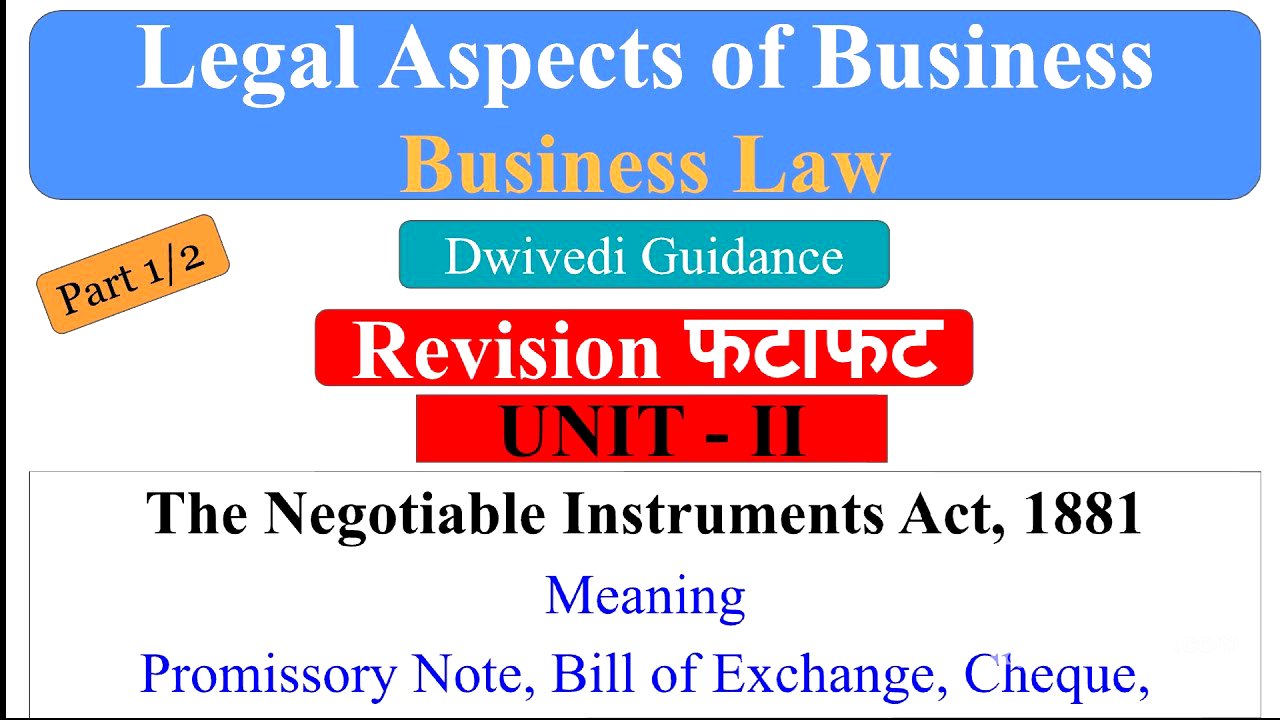
This video explains the Negotiable Instruments Act of 1881, focusing on the definitions and features of promissory notes, bills of exchange, and checks. It covers the meaning of "negotiable instrument," its types, and the parties involved in each instrument.
- Negotiable Instrument Act of 1881 defines negotiable instruments as transferable documents creating rights.
- Key instruments discussed are promissory notes, bills of exchange, and checks.
- Each instrument has specific requirements, features, and involved parties.
Introduction to Negotiable Instruments [0:00]
The video introduces the Negotiable Instruments Act of 1881, explaining that the year in the Act's name indicates when it was passed. The term "negotiable" means transferable from one person to another, while "instrument" refers to any written document creating a right in favor of someone. A negotiable instrument is a transferable written document used for business purposes, allowing the holder to sue if necessary. Transferability occurs through delivery or trade custom. Section 13 of the Act doesn't directly define a negotiable instrument but lists what it includes.
Kinds of Negotiable Instruments [3:52]
According to Section 13 of the Negotiable Instruments Act, a negotiable instrument includes a promissory note, bill of exchange, and check payable to order or bearer. These types are defined by statute under Section 137 of the Transfer of Property Act of 1882. Additionally, instruments like bank notes, demand drafts, share warrants, dividend warrants, and hundis are considered negotiable due to their use in business and transferability. The video focuses on the three statutory instruments: promissory notes, bills of exchange, and checks.
Promissory Note: Definition and Features [4:46]
A promissory note, as defined in Section 4, is a written instrument containing an unconditional promise signed by the maker to pay a certain sum of money to a specific person, their order, or the bearer of the instrument. It must be in writing and include an unconditional undertaking by the maker to pay a specific amount to the named person or bearer. The promise to pay must be unconditional, meaning no conditions are attached. The amount promised must be a certain and definite sum of money. The person to whom the promise is made must be a definite person.
Parties Involved in a Promissory Note [9:27]
The parties involved in a promissory note are the maker, the payee, and the holder. The maker is the person who promises to pay and signs the note. The payee is the person to whom the amount is to be paid. The holder is either the payee or someone to whom the note has been endorsed. The holder is the one who possesses the note and is entitled to receive payment. The payee and holder can sometimes be the same person.
Bill of Exchange: Definition and Requirements [11:03]
A bill of exchange, defined in Section 5, is a written instrument containing an unconditional order signed by the maker, directing a certain person to pay a specific sum of money only to or to the order of a certain person or to the bearer of the instrument. This is commonly used in business transactions, such as trading and purchasing raw materials. It must be in writing and include an unconditional order directing someone to pay a specific amount to a certain person or the bearer. The drawer must sign the instrument, and acceptance by the drawee is necessary.
Parties Involved in a Bill of Exchange [14:10]
The parties involved in a bill of exchange are the drawer, the drawee, and the payee. The drawer is the one who makes the order for payment. The drawee is the person directed to make the payment. The payee is the person to whom the money is to be paid.
Check: Definition and Types [14:50]
A check, as defined in Section 6, is a bill of exchange drawn on a specified banker, payable on demand. It includes electronic images of truncated checks and checks in electronic form, a line added post-digitization. Checks can be bearer checks, order checks, or crossed checks. A bearer check is payable to whoever possesses it, while an order check is payable to a specific person.
Types of Checks: Bearer, Order, and Cross Checks [16:13]
A bearer check is payable to the person who holds it, provided the "bearer" word isn't canceled. An order check is payable to the person named on it. A cross check can only be collected through a bank, either through general crossing (two parallel lines) or special crossing (specifying a bank). General crossing means the check can only be deposited into an account, while special crossing directs the payment to a specific bank.
Parties Involved in a Check [20:16]
The parties involved in a check are the drawer, the drawee (banker), and the payee. The drawer is the maker of the check or the account holder. The drawee is the bank directed to pay the money. The payee is the person or entity named on the check to whom the payment is to be made. Sometimes, the drawer can write "self" as the payee.
Conclusion [21:17]
The video concludes by summarizing the definitions of promissory notes (Section 4), bills of exchange (Section 5), and checks (Section 6) under the Negotiable Instruments Act. It also mentions other relevant sections, such as those for "holder" (Section 8) and "holder in due course" (Section 9), encouraging viewers to remember these sections for better understanding.