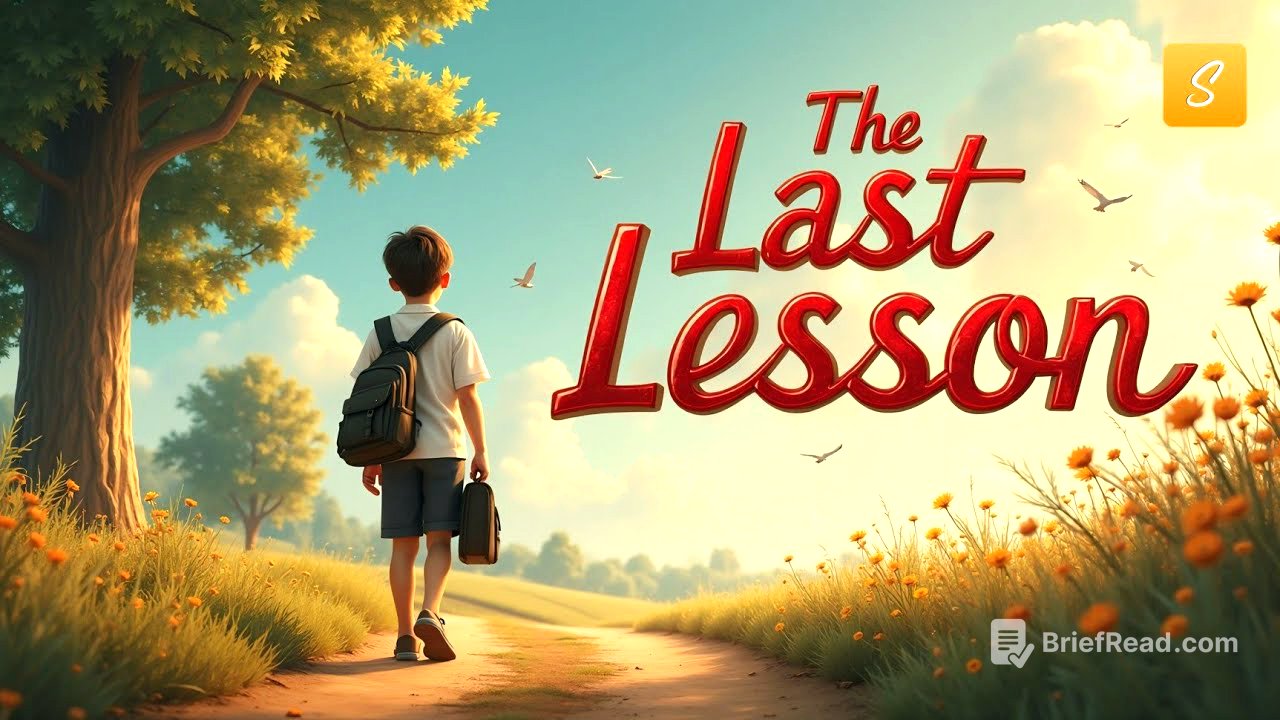
TLDR;
The video summarizes "The Last Lesson" by Alphonse Daudet, a story about a young boy named Franz and his experience on the day French is banned from schools in Alsace-Lorraine. The story explores themes of regret, patriotism, and the importance of language as a key to freedom.
- Franz dreads school because he hasn't prepared for a lesson on participles.
- The atmosphere at school is unusually quiet and somber.
- M. Hamel announces that this will be their last French lesson, as German will now be taught.
- Franz and the villagers deeply regret not valuing their language and education more.
- M. Hamel emphasizes the importance of holding onto one's language as a form of resistance.
Introduction [0:00]
The video introduces "The Last Lesson" by Alphonse Daudet, a story about a student's fear of a strict teacher, M. Hamel, especially when unprepared for homework. The narrative is set in a French town and revolves around a day that begins like any other but becomes a pivotal moment in the protagonist, Franz's, life.
Franz's Reluctance and the Unusual Day [0:30]
Franz is late for school and dreads being scolded by M. Hamel, who is to quiz the class on participles, a subject Franz knows nothing about. He is tempted to skip school and spend the day enjoying the pleasant weather and observing the Prussian soldiers drilling. However, he resists the temptation and rushes towards school, unaware of the life-altering events that await him.
The Bulletin Board and the Quiet School [1:33]
As Franz passes the town hall, he notices a crowd gathered around the bulletin board, which usually displays bad news such as updates from the Franco-Prussian wars and military orders. He doesn't stop to read it, continuing to school. Upon arriving, he finds an unusual silence, contrasting with the typical hustle and bustle of students. This quietness makes him uneasy, as if something is amiss.
Inside the Classroom: A Somber Atmosphere [2:03]
Franz enters the classroom expecting a scolding from M. Hamel, but instead, he is surprised by the teacher's gentle invitation to take his seat. He notices M. Hamel is wearing his special occasion clothes, usually reserved for prize days or inspections. The back benches, typically empty, are occupied by the village elders, including the former mayor and postmaster, all looking somber.
The Announcement: The Last French Lesson [3:38]
M. Hamel announces that this will be their last French lesson, as an order from Berlin dictates that only German will be taught in the schools of Alsace-Lorraine from now on. This news clarifies the reason for the unusual atmosphere and the presence of the village elders, who have come to pay their respects to M. Hamel's 40 years of service and to bid farewell to their beloved French language.
Regret and Realization [4:43]
Franz is filled with regret, realizing he never took his French lessons seriously. The books that once seemed boring now appear precious to him, like old friends he is about to lose. He also sees M. Hamel in a new light, appreciating him as a kind and understanding teacher. Franz understands that language is not just words but a vital part of their identity and heritage.
The Importance of Language [5:47]
M. Hamel teaches with exceptional patience, trying to impart all his knowledge before he leaves. He praises the French language as the most beautiful, clearest, and most logical language in the world. He emphasizes that holding onto their language is like holding the key to their prison, meaning that language is essential to their identity, culture, and freedom, especially when a community is under occupation.
Final Moments and Farewell [7:23]
Franz reflects on the situation, wondering if the Prussians will force even the pigeons to sing in German. As the church bells ring noon, M. Hamel stands up, appearing tall and proud. Overcome with emotion, he cannot speak. Instead, he turns to the blackboard, writes "Vive La France!" (Long Live France!), and dismisses the class with a gesture, signaling the end of the last lesson.
Conclusion [8:27]
"The Last Lesson" is more than just a story; it is a reminder to value what we have before it is taken away. It is a tale of a teacher who taught a lesson of patriotism and self-respect, and a student who learned to appreciate his language and culture. The video encourages viewers to cherish their language as it is key to their identity and freedom.