TLDR;
This lecture explains the Dining Philosophers Problem, a classic synchronization challenge. It details the problem setup, explores a semaphore-based solution, highlights potential deadlocks, and suggests remedies to avoid them.
- Philosophers can only be in thinking or eating states.
- Philosophers need two forks to eat, but forks are limited.
- A semaphore-based solution can prevent adjacent philosophers from eating simultaneously.
- Deadlock can occur if all philosophers grab their left fork at the same time.
- Remedies include limiting the number of philosophers, requiring both forks to be available before picking up any, and using an asymmetric solution where odd and even philosophers pick up forks in different orders.
Introduction to the Dining Philosophers Problem [0:06]
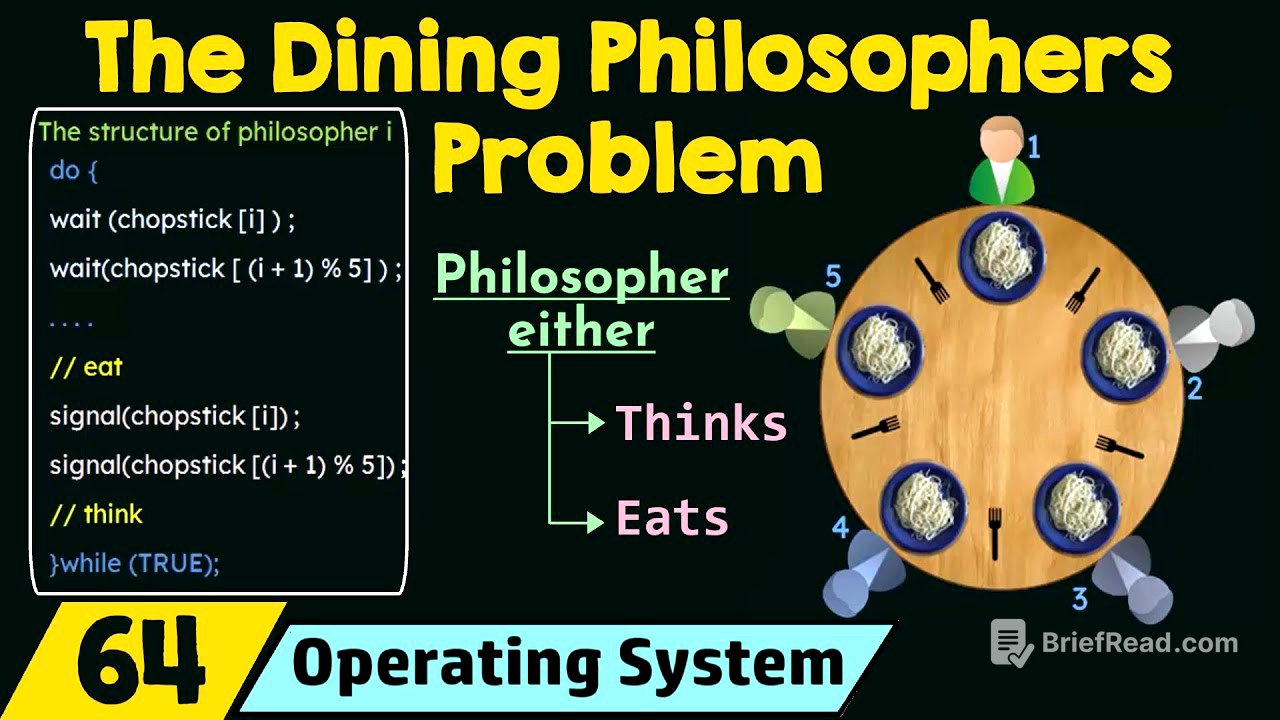
The Dining Philosophers Problem involves multiple philosophers seated around a table, alternating between thinking and eating. To eat, a philosopher needs two forks, one on either side of their plate. The challenge arises because there are fewer forks than philosophers, leading to potential contention and synchronization issues. Philosophers in the thinking state do not interact, but when hungry, they attempt to acquire both forks to eat.
Problem Statement [0:24]
The core problem is that the limited number of forks (resources) must be shared among the philosophers (processes). A philosopher must pick up one fork at a time and cannot pick up a fork already held by a neighbor. Once a philosopher has both forks, they eat without interruption, then release the forks and return to thinking. The main issue is ensuring that no two adjacent philosophers eat simultaneously, preventing them from accessing the same fork at the same time. This problem mirrors resource allocation challenges in operating systems, where processes must share limited resources in a synchronized manner.
Solving the Problem with Semaphores [5:40]
One approach to solving the Dining Philosophers Problem is to use semaphores to represent each fork. Since only one philosopher can use a fork at a time, a semaphore ensures exclusive access. A philosopher attempts to grab a fork by executing a wait operation on the corresponding semaphore and releases the fork by executing a signal operation. An array of five semaphores, each initialized to 1 (representing that the fork is free), can represent the five forks. The semaphore used here is a binary semaphore, which can have values of either 0 (in use) or 1 (free).
Philosopher Structure and Code [9:16]
The structure of a philosopher's actions involves first attempting to acquire the two adjacent forks. This is done by executing a wait operation on the semaphores representing the left and right forks. For philosopher i, the code executes wait(chopstick[i]) and wait(chopstick[(i+1) % 5]). The modulo 5 ensures that the last philosopher can access the first fork. After eating, the philosopher releases the forks using signal(chopstick[i]) and signal(chopstick[(i+1) % 5]). This solution prevents adjacent philosophers from eating simultaneously by ensuring they cannot acquire the same fork at the same time.
Potential Deadlock [12:55]
Despite preventing simultaneous eating by neighbors, the semaphore solution can lead to a deadlock. If all five philosophers become hungry simultaneously and each grabs their left chopstick, all semaphore values become zero. When each philosopher then tries to grab their right chopstick, they will wait indefinitely, as each chopstick is held by their neighbor. This situation results in a deadlock, where all philosophers are waiting for a resource that will never be released.
Remedies to Avoid Deadlock [16:29]
Several remedies can prevent deadlock in the Dining Philosophers Problem:
- Limit the Number of Philosophers: Allow at most four philosophers to sit at the table simultaneously. This ensures that at least one fork is always available, preventing a circular wait.
- Require Both Forks to Be Available: A philosopher should only pick up chopsticks if both are available, ensuring they pick them up in a critical section.
- Asymmetric Solution: Implement an asymmetric solution where odd-numbered philosophers pick up their left chopstick first, then their right, while even-numbered philosophers pick up their right chopstick first, then their left. This breaks the symmetry that leads to deadlock.
By implementing these remedies, the Dining Philosophers Problem can be solved to avoid deadlocks, ensuring fair resource allocation.