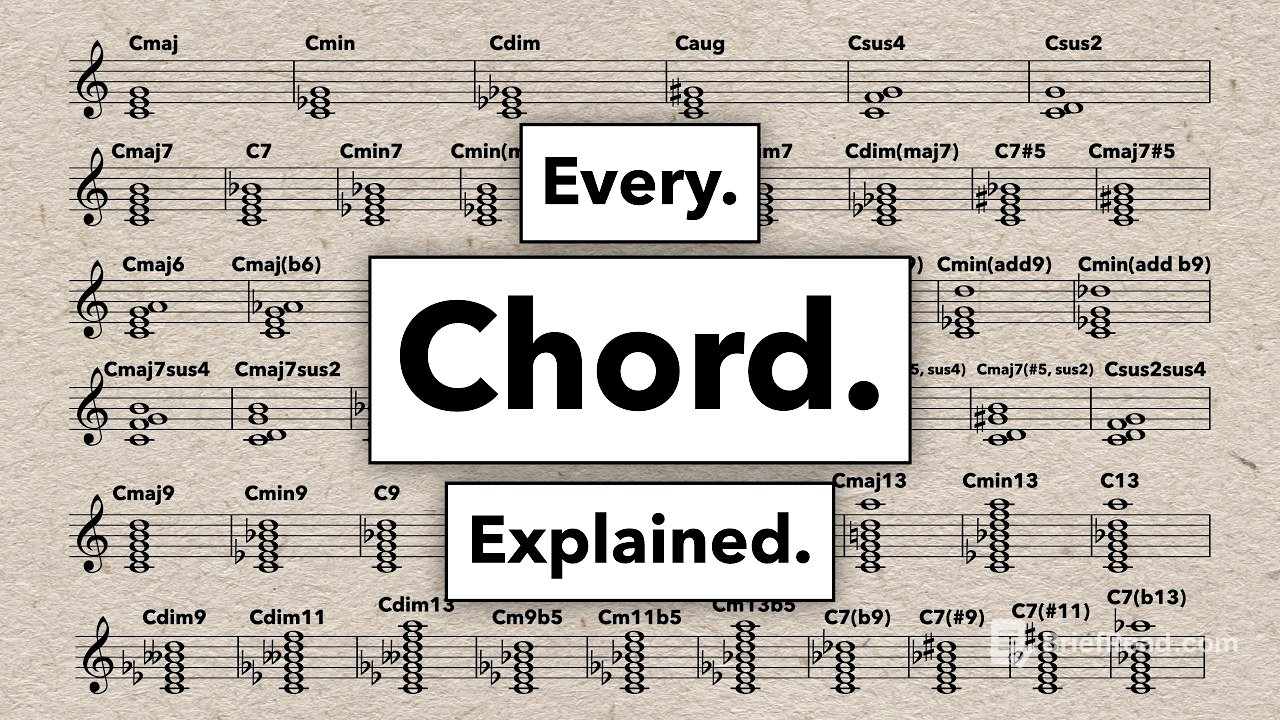
TLDR;
This video by Brad Harrison discusses the fundamental aspects of chords in music, focusing on their structure and relationship with scales. It covers various chord types, their symbols, inversions, and how chords align with musical keys. Key points include the foundational role of chords in harmony, the importance of chord inversion, and the wide variety of chord types such as triads and extended chords.
- Chords are crucial for creating harmony in music.
- Chords can be built from scales and have many variations like inversions and extended types.
Chords are The Foundation of Harmony [0:00]
The video begins by emphasizing that chords are essential to harmony in music, contrasting with melodies that might feel solitary. Chords can evoke various emotions, making music sound happy, sad, or resolving. The narrator explains that chord symbols and names help convey complex information, although mastering them can be daunting initially. Understanding these concepts is crucial for effectively playing music, and viewers are encouraged to approach the material at their own pace and refers to his channel as a resource for further learning.
The Anatomy of Chord Symbols [1:50]
This chapter explains the structure of chords and the way they are represented through symbols. Most chords are constructed using a 'snowman' shape, consisting of notes stacked in thirds. The bottom note is the root, and the arrangement of notes above it defines the chord's quality. The object is to identify the root and how the other notes relate to it, regardless of the spacing or order in which they appear. The narrator introduces the concept of inversions, describing different positions of a chord based on which note is in the bass.
Inversions pt 1 [2:45]
Inversions are explored further in this section, focusing on their significance in music theory. The narrator explains that the root position places the root note at the bottom, the first inversion has the third in the bass, and the second inversion positions the fifth at the base. Understanding inversions helps musicians identify chords despite variations in note placement, emphasizing that different arrangements can yield the same chord.
Chords Are Related to Scales [3:57]
This chapter discusses how chords are derived from scales, specifically the C major scale as an example. Chords are created by stacking notes in thirds according to the scale, leading to familiarity with the basic chords in different keys. The importance of these relationships is highlighted for understanding chord qualities, cadences, and transposing songs across keys.
Intversions pt 2 [5:07]
Continuing from the previous section, this chapter reiterates the concept of inversions by highlighting how chords retain their identity regardless of their arrangement. The narrator discusses different chord qualities, focusing on triads and their variants, explaining how these foundations establish various harmonic structures.
Triads & Sus Chords [5:38]
Triads, consisting of three notes, form the basis for most chords, with major, minor, diminished, and augmented as the four main types. Suspended chords, or "sus" chords, replace the third with either a perfect fourth or a major second and often resolve to a major or minor chord. The chapter includes a brief look at how chord symbols may vary among composers but remain fundamentally the same.
Chord Syllabus [7:10]
The narrator introduces a chord syllabus available to channel members and on Patreon, containing comprehensive chord information across all keys. This resource aims to aid learners in understanding chord quality, relationships, and how to apply this knowledge to various musical contexts.
Noisy Clan [7:43]
This section highlights a product called the decoder from Noisy Clan, which assists with navigating musical keys. The decoder provides visual information about key signatures and chords associated with those keys, making it easier for musicians to find chords and understand relationships within various keys.
Power Chords [9:12]
Power chords are introduced as two-note chords that consist of an open fifth interval, making them distinct from standard chords since they typically do not convey major or minor qualities. They are commonly used in guitar music for their strong sound.
4 Notes Chords [9:33]
The chapter transitions to four-note chords, demonstrating how they build on triads by adding a fourth note. These chords, often categorized as seven chords, include major, minor, and diminished types depending on the interval from the root.
“7” Chords [9:57]
Seven chords are further analyzed, explaining that they expand on basic triads by adding a seventh note. Various types of seventh chords are discussed, including major, dominant, minor, half-diminished, and fully diminished, adding depth to the harmonic structure.
“6” Chords [11:40]
Six chords are examined as unique varieties that involve adding a sixth note to existing triads. The distinctions between different types of six chords are highlighted, showing their inversions relative to seven chords.
Add 9 Chords [12:35]
This chapter delves into add nine chords, which typically add a ninth to a triad. These chords differ from nine chords, which include a seventh, and various examples across keys are presented, illustrating their application in different musical contexts.
Sus2 & Sus4 Variations, Sus2Sus4 [13:12]
The narrator elaborates on varieties of chords that feature suspended seconds or fourths, explaining how these modifications apply to most chord types and introduce distinct harmonic variations.
6/9 Chords [13:41]
The chapter explains six-nine chords, which combine the addition of both a sixth and a ninth to a triad. The application of these chords in various musical contexts is covered, noting their role in creating complex harmonies.
Slash Chords [14:00]
Slash chords are explored as chord symbols containing a bass note indicated with a slash. The narrator clarifies that the bass note may not belong to the chord, exemplifying common interpretations and the use of this notation for clarity in harmonic structure.
9, 11, 13 Chords - Extensions [14:43]
This segment introduces extended chords, defined as chords that include additional notes such as ninths, elevenths, and thirteenths. These extensions add harmonic richness and complexity, with a discussion on how to build them on existing chords.
Altered Extensions - b9, #9, #11, b13 [16:20]
Altered extensions, such as flat nine and sharp eleven, are outlined, particularly in the context of dominant chords. The chapter highlights how these alterations function within the chord’s structure and provide additional tonal colors.
Naming Conventions for Altered Chords [17:01]
The narrator examines naming conventions for altered chords, emphasizing the importance of clarity in complex chords. Parentheses are suggested to avoid misinterpretation between root chords and their extensions, aiding musicians in understanding their music.
Conclusion [17:54]
The video concludes by summarizing the extensive material covered, encouraging viewers to take their time mastering the information on chords. The narrator invites viewers to join as members for additional resources and support to help navigate chord theory effectively.



![[Full Lecture] Whisperings of the Postmodern World | Nouman Ali Khan | Dr. Halis Aydemir | Istanbul](https://wm-img.halpindev.com/p-briefread_c-10_b-10/urlb/aHR0cDovL2ltZy55b3V0dWJlLmNvbS92aS9kLTk5alhCVk5GOC9ocWRlZmF1bHQuanBn.jpg)