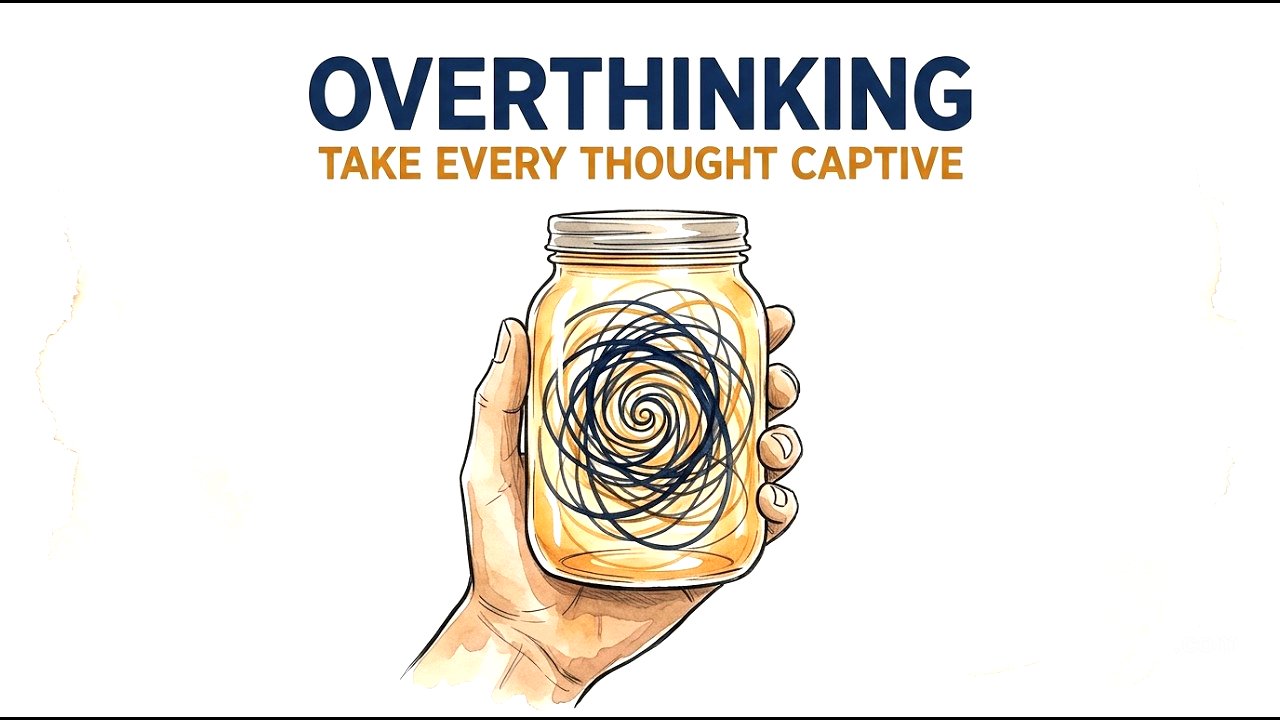
TLDR;
This video addresses the common struggle of overthinking and offers a practical, biblically-based approach to manage it. It challenges the traditional interpretation of "taking every thought captive" from 2 Corinthians 10:5, suggesting it's not about suppressing thoughts, but rather interrogating them. The video explains the neuroscience behind overthinking, introduces a three-step method of mindful observation, interrogation using a divine filter, and proactively filling the mind with truth.
- Overthinking involves rumination on the past and worry about the future, driven by the brain's default mode network (DMN) and amygdala.
- The key is to treat thoughts like prisoners of war: disarm them, question them, and align them with the truth of Christ.
- Practical steps include mindful observation, interrogation using Philippians 4:8 as a filter, and proactively filling the mind with scripture and prayer.
The Hamster Wheel in Your Head [0:00]
The video starts by describing the experience of overthinking, characterized by replaying past events or obsessively worrying about the future. Psychologists define this as rumination (dwelling on the past) and worry (forecasting a negative future). The common advice from 2 Corinthians 10:5, "Take every thought captive to make it obedient to Christ," is often misinterpreted as simply suppressing unwanted thoughts. However, this approach can be ineffective and even worsen the problem. The video suggests a different interpretation: instead of suppression, it proposes interrogating thoughts to align them with reality and truth.
The Neuroscience of Overthinking [1:49]
The video explains the neuroscience behind overthinking, focusing on the default mode network (DMN) and the amygdala. The DMN, active when the mind is at rest, is responsible for self-reflection and imagining the future. In overthinkers, this network becomes overactive, leading to repetitive thought patterns. Simultaneously, the amygdala, the brain's threat detection system, reacts to imagined social threats as if they were real dangers, releasing stress hormones like cortisol. This creates a feedback loop where negative thoughts increase anxiety, which in turn fuels more overthinking. The video emphasizes that overthinking doesn't lead to solutions but exacerbates anxiety, making the common advice to "stop thinking about it" unhelpful.
Taking Thoughts Captive: A Military Metaphor [4:38]
The video provides context of 2 Corinthians 10, explaining that Paul was addressing a church in Corinth where his authority was challenged by false teachers. Paul uses military metaphors like warfare, weapons, and strongholds to describe the spiritual battle. These strongholds are not physical fortresses but rather arguments, philosophies, and worldviews that create mental barriers against the truth of God. Examples include beliefs like "My worth is based on my performance" or "God is distant and punishing." In this context, "taking captive every thought" means more than suppression.
Interrogating Your Thoughts [5:57]
The video breaks down the Greek words in 2 Corinthians 10:5 to reveal a deeper meaning. "Take captive" (aikmalotizontes) implies capturing someone with a spear, like a prisoner of war. Instead of ignoring or suppressing prisoners, they are disarmed, questioned, and interrogated to understand their allegiances and bring them under the conquering power's authority. Similarly, "thought" (noema) refers to a structured line of reasoning or argument. The goal is to make these mental arguments "obedient" (hypakou) to Christ, aligning them with the reality of who Christ is and what He has said. This involves arresting the thought, disarming its emotional power, and challenging its validity by asking questions like, "Where did you come from?" and "Are you telling the truth?".
Ancient Faith Meets Modern Therapy [8:21]
The video draws parallels between the biblical command to take thoughts captive and cognitive behavioral therapy (CBT), particularly cognitive restructuring. CBT involves identifying negative automatic thoughts, evaluating the evidence for and against them, and replacing them with more balanced and realistic ones. The video uses the example of a negative thought following a presentation to illustrate how to cross-examine the thought by questioning its truthfulness, evidence, and potential for catastrophizing. While CBT aims for balanced and realistic thinking, the biblical approach goes further by measuring thoughts against the reality defined by God, ensuring they align with His character and truth.
Practical Steps to Take Every Thought Captive [11:10]
The video provides three practical steps to implement this approach: mindful observation, interrogation using a divine filter, and proactively filling the mind with truth. First, practice cognitive diffusion by noticing and labeling thoughts without judgment, creating space between yourself and the thought. Second, use Philippians 4:8 as an interrogation checklist, asking if the thought is true, honorable, just, pure, lovely, and commendable. Finally, intentionally fill your mind with scripture, prayer, and meditation on God's character to change the default setting of your mind and transform it so that truth becomes more natural than lies.
The Rock and the Light [13:17]
The video concludes with a story of a landscape photographer waiting for the perfect light to capture a rock formation. The rock represents the unchanging truth of God's character and promises, while the light represents the temporary conditions of overthinking, anxiety, and rumination. The key is to focus on the rock, the constant reality of God, rather than the fleeting, distorted light of negative thoughts. Taking every thought captive is not a duty but a liberating art of refusing to be deceived, recognizing the voice of the Shepherd, and allowing the truth of God to prevail.