TLDR;
This lecture provides a detailed overview of sport-specific strength training, emphasizing the importance of aligning training programs with the demands of different sports. It covers key principles of training, energy system involvement, strength qualities, and need analysis. The lecture also addresses common errors in strength training programs and offers a case scenario to illustrate the practical application of these concepts.
- Sport-specific training should align with biomechanical, physiological, neuromuscular, and bioenergetic demands of the sport.
- Key principles of training include specificity, individuality, reversibility, progressive overload, and variability.
- Understanding energy demands (ATP-phosphagen, anaerobic glycolytic, and oxidative systems) is crucial for designing effective strength training.
Introduction [0:15]
The lecture addresses how to design a strength training program for athletes in different sports, focusing on the specific needs of a footballer named Nicl. It aims to provide answers to questions about periodization and program design, considering various factors relevant to the athlete's sport. The learning objectives include sport-specific analysis, demands, principles of strength training, rational planning, and practical considerations for creating sport-specific strength training programs.
Sport Specific Training [1:34]
Sport-specific training depends on the demands of the sport, including biomechanical, physiological, neuromuscular, and bioenergetic aspects. Tailoring the training program to these demands improves performance and reduces injury risk. Different demands necessitate different training approaches, making these considerations essential for effective sport-specific training.
Principles of Training [2:19]
Sport-specific training must align with the general principles of training, which include specificity, individuality, reversibility, progressive overload, and variability. Adhering to these principles ensures an effective training program, prevents plateaus and burnout, and helps in preventing injuries.
Energy System Involvement [2:52]
When planning a strength training program, it's important to consider the energy system involved in the sport, which can be categorized into short-term (ATP-phosphagen), intermediate (anaerobic glycolytic), and long-term (oxidative) systems. Different sports have different energy demands; for example, sprinting relies on the ATP-phosphagen system, while endurance events depend on the oxidative system. Understanding these energy demands helps determine the type of strength quality needed for the athlete.
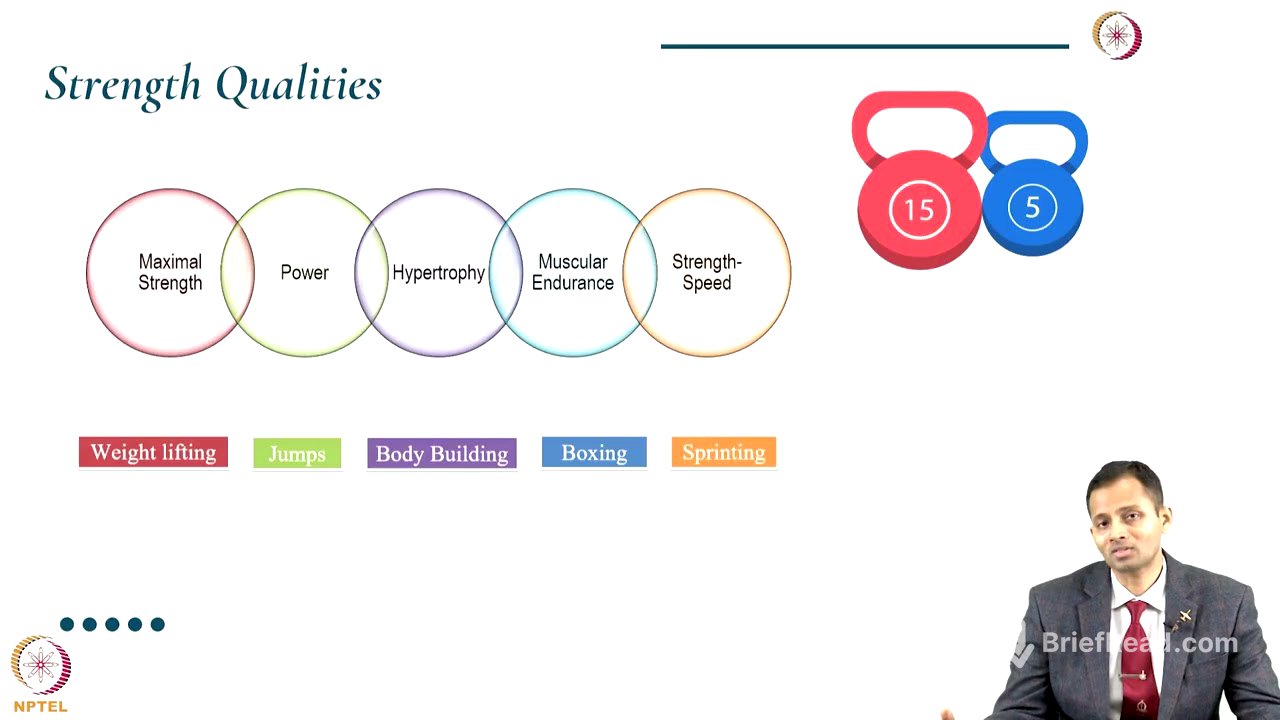
Strength Qualities [5:13]
Different sports require different strength qualities, such as maximal strength (weightlifting), power (jumping events), hypertrophy (bodybuilding), muscular endurance (boxing), and strength speed (sprinting). The strength quality to be trained depends on the demands of the sport.
Need Analysis [7:12]
Before starting any training, it is important to conduct a need analysis, which includes an athlete profile, physiological analysis, fitness battery tests, movement analysis, and injury analysis. Movement analysis is crucial, emphasizing that form takes precedence over load. Injury analysis helps in framing the program to prevent prevalent injuries in the sport and considering the individual's past injury record.
Sport Examples [8:50]
The lecture provides examples of strength training for different sports, focusing on the specific needs, bioenergetic systems, and key strengthening exercises for each:
- Track and Field (Sprinters): Focus on power and rate of force development, training the ATP-PCR and anaerobic glycolytic systems. Key exercises include Olympic lifts, resisted sprints, and plyometrics.
- Track and Field (Distance Runners): Focus on running economy and injury prevention, training the oxidative system. Key exercises include lower limb strengthening and core stability exercises.
- Football: Focus on power, agility, and endurance, with strength training depending on the player's position. Bioenergetic systems vary by position (ATP-PCR and anaerobic glycolysis for strikers, oxidative and anaerobic glycolytic for defenders). Exercises include mobility agility drills and eccentric hamstring training.
- Basketball: Focus on jumping, landing, contact resilience, and overhead throws. Strengthening exercises target knee and hip strength, shoulder strengthening, and plyometrics.
- Swimming: Focus on upper and lower body mobility, shoulder stability, and core strength. Training depends on the type of event (sprint vs. endurance).
- Baseball/Cricket: Training varies based on the player's role (batsman, fast bowler, spinner), with a focus on rotational power, deceleration power, and shoulder strength.
- Combat Sports (Boxing): Requires grip strength, isometric strength, core rotation, strength endurance, and explosive power.
- Golf: Focus on rotational power and core stability to improve swing and reduce injury risk.
Periodizing Power and Hypertrophy [17:14]
Periodization involves different strategies based on the specific goal: endurance (high volume, low load), hypertrophy (increased load, moderate to high repetitions), and power (low repetitions, moderate intensity, focus on speed). Each goal requires a different approach to volume, load, and tempo.
Phases of Training [18:53]
The strength training goal varies with each phase of training:
- Preparatory Phase: Focus on strength endurance, hypertrophy, and basic strength with high volume.
- Pre-Competitive Phase: Shift to power generation with reduced volume and sport-specific intensity.
- Competitive Phase: Focus on peaking and tapering with sport-specific drills and low volume.
- Transition Phase: Active rest to maintain adaptations without detraining effects.
Team Sports [21:48]
Team sports training is based on different seasons: offseason (preparatory phase), preseason (pre-competitive phase), in-season (multiple competitions), and transition phase. The focus shifts from basic strength and hypertrophy to higher intensity power activities, maintaining adaptations during the in-season and incorporating skill work and active rest during the transition phase.
Common Errors in Sport Specific Strength Training Programs [22:53]
Common errors in sport-specific strength training programs include disregarding individuality, generic programs not catering to sport-specific demands, lack of progressive overload, inappropriate periodization models, and insufficient recovery time. Balancing stimulus and recovery is crucial to avoid detraining effects or overuse injuries.
Case Scenario: Nikl, the Footballer [25:19]
The lecture revisits the initial case scenario of Nicl, an amateur college football athlete, emphasizing the importance of considering his position in football (striker, midfielder, or defender) to tailor the strength training program. Periodization should be based on competitions and the annual training cycle, incorporating monitoring with perceived exertion and load monitoring.
Summary [27:01]
Key takeaways include identifying strength demands based on the sport, athlete profiling, aligning goals with training phases and principles, manipulating variables, progressive overload, and monitoring internal and external loads. Recognizing individual differences is essential for tailoring programs effectively.