TLDR;
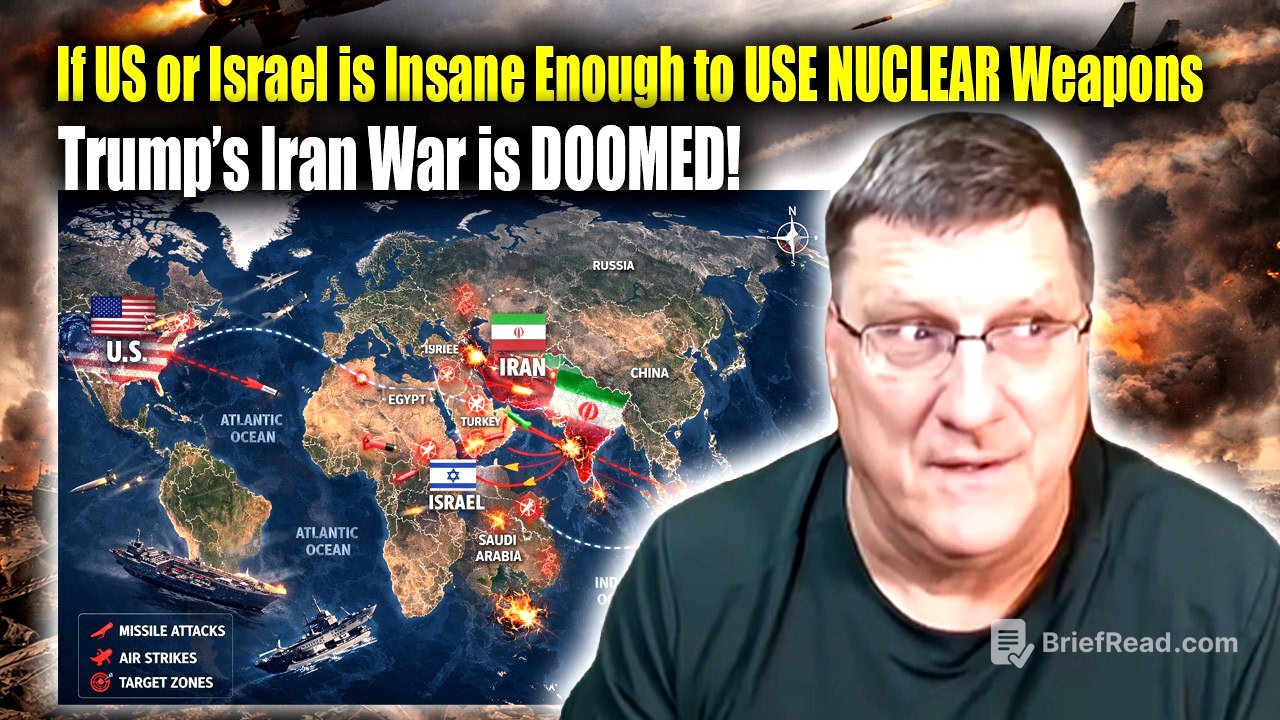
The speaker asserts that the United States has lost its war with Iran due to poor planning, reliance on flawed intelligence, and the destruction of American military power in the Middle East. The speaker criticizes the use of AI in targeting, which led to the bombing of a school and the death of civilians, and highlights the incompetence of those managing the war. The speaker also discusses the potential for Iran to develop nuclear weapons and the strategic implications of the conflict, including the impact on global energy markets and the involvement of other countries like Azerbaijan. The speaker contrasts the U.S.'s reliance on technology with Iran's effective, old-school intelligence gathering and precision targeting.
- The U.S. lost the war with Iran due to poor planning and flawed intelligence.
- AI-driven targeting led to civilian casualties and proves incompetence.
- Iran's strategic actions are shutting down global energy production.
- The U.S. military has suffered unprecedented damage in the Middle East.
- Iran may be on the path to developing nuclear weapons.
US Incompetence and Failed Strategy in the War with Iran [0:00]
The speaker believes that the United States and Israel would take responsibility for actions against Iran, with the U.S. handling ballistic missile suppression. The speaker expresses disbelief that the U.S. would initiate an attack without substantial intelligence, akin to penetrating Iran to a Venezuela-like extent. The speaker notes the predictable lack of precision-guided munitions and ballistic missile defense, emphasizing that the war should have been concluded swiftly, within five to seven days, as initially planned.
Intelligence Failure and Targeting Errors [1:05]
The speaker questions the notion of an intelligence coup, pointing out that Ali Khamenei was at home during an assassination attempt. The speaker highlights that the CIA stated Iran is fully in control and its government is functioning normally. The speaker criticizes the U.S.'s poor preparation for the war, noting that while pilots are well-trained, the failure to hit the right targets indicates a flawed strategy. The speaker asserts that the strike on the school, carried out with a joint standoff weapon and assisted by civilian contractors, proves the targeting deck is garbage and not done by professionals.
The Dangers of AI in Military Targeting [2:51]
The speaker emphasizes the importance of ensuring accuracy when American service members risk their lives in pre-planned strike missions. The speaker criticizes the use of civilian contractors and AI in target selection, stating it's unacceptable to rely on such methods when human lives are at stake. The speaker recounts experience scrubbing intelligence targets in 1985, highlighting the need to confirm and update intelligence to account for changes on the ground. The speaker suggests the Pentagon only began planning for this type of war in mid-January, opting for cheap, AI-driven solutions instead of using intelligence professionals.
Consequences of Inadequate Planning and Resource Allocation [6:05]
The speaker laments the bombing of a school, resulting in the deaths of 170 children, due to the lack of professional intelligence scrubbing. The speaker declares that the war was lost on day one, not only due to the attempt to kill Ali Khamenei but also because of the school bombing, which demonstrates a lack of readiness and ineffective targeting. The speaker claims the U.S. is merely bombing empty buildings while Iran continues its operations unhindered. The speaker mentions Donald Trump's call for quadrupling defense production, questioning the feasibility without proper funding, personnel, and equipment.
Supply Chain Issues and the Loss of Strategic Advantage [7:56]
The speaker points out that supply chain issues, exacerbated by strained relations with China, hinder the U.S.'s ability to ramp up weapons production. The speaker notes that even if production were increased, it would take at least two years to see results. The speaker reiterates that the war is lost and irreversible. The speaker mentions the mobilization of the 82nd Airborne and the potential for a ground war, contrasting it with Trump's initial stance.
Potential Expansion of Conflict and Geopolitical Implications [9:01]
The speaker references a 2007 scenario where Iran attacked Azerbaijan, leading to a U.S.-backed counterattack towards Tehran. The speaker suggests the CIA is working with Azerbaijan to fabricate false flag incidents, potentially leading to a second front. The speaker warns Azerbaijan will lose its oil infrastructure and its army will be annihilated if it attacks Iran. The speaker suggests American troops may become involved via Azerbaijan and that American special forces may already be working with Kurds in western Iran.
Failing War Plans and Global Economic Impact [11:50]
The speaker attributes the multiple, failing war plans to Donald Trump's poor judgment. The speaker criticizes Trump's unrealistic statements about the U.S. Navy's role in the Strait of Hormuz. The speaker highlights the potential for a prolonged oil shortage and the cessation of natural gas production by Qatar, which will negatively impact Europe. The speaker notes Trump's shift in policy, now allowing Russia to sell oil, effectively bankrolling the Russian war effort.
Decline of American Military Power and Diplomatic Influence [14:09]
The speaker laments the dismantling of American military installations in the Middle East, calling it the greatest destruction of American military power in U.S. history. The speaker notes the evacuation of diplomatic personnel and the vulnerability of U.S. embassies. The speaker contrasts the Iranian's measured response with the cheerleading of figures like Pete Hegseth. The speaker criticizes Jared Kushner and Steve Whitcoff's involvement in arms control, arguing they lacked understanding of the situation.
The Threat of Iranian Nuclear Weapons [15:52]
The speaker argues that Iran is now likely on the path to acquiring nuclear weapons, with the death of Ali Khamenei removing a key obstacle. The speaker believes Iran is processing enriched uranium and will soon have deliverable nuclear warheads. The speaker suggests Donald Trump could have prevented this but instead facilitated it. The speaker claims Iran has meticulously planned its response, dividing the country into 12 self-sufficient military districts, making it difficult to defeat.
The Erosion of Expertise in US Intelligence [19:29]
The speaker shares personal experiences from working as a weapons inspector in the Soviet Union and with the United Nations to illustrate the decline of expertise in U.S. intelligence. The speaker recounts how the Office of Imagery Analysis (OIA), known for its highly specialized analysts, was shut down as part of the peace dividend. The speaker describes being rejected for a CIA analyst position in 1992 because he represented the "old school" and the agency preferred people who were "freer thinking" rather than experts.
The Consequences of Replacing Experts with Generalists [23:00]
The speaker contrasts the knowledgeable CIA teams from Desert Storm with the younger, less experienced analysts who followed. The speaker recounts an incident at the UN where a team of new analysts misinterpreted crane activity at a site he had recently inspected, demonstrating their lack of expertise and failure to read his detailed report. The speaker argues that the U.S. no longer has experts, having replaced them with generalists who lack depth and are confined to narrow areas of knowledge.
The Dangers of Outsourcing Intelligence Analysis [25:51]
The speaker shares a story about the "Great American Novel," a collection of data from the Votkins factory, which was initially dismissed as valueless by contractors. The speaker then spent a weekend breaking the code of the railroads by looking at the pattern analysis, and was able to predict exactly when missiles were going to come out of the factory and what kind of missiles they would be. The speaker emphasizes the value of trained human intelligence over contracted analysis, highlighting the lack of patriotism and dedication among contractors.
The Impact of AI and Intellectual Laziness on Intelligence [28:01]
The speaker criticizes the contracting out of intelligence analysis to lazy, intellectually shallow individuals focused on deliverables rather than accuracy. The speaker connects this decline in expertise to the bombing of a school and the deaths of 170 children. The speaker calls for the hiring and proper training of real intelligence professionals who are allowed to get their hands dirty and immerse themselves in the work. The speaker laments the over-reliance on computers and the lack of deep understanding among modern intelligence analysts.
The Erosion of Traditional Research and the Rise of AI Summaries [29:27]
The speaker contrasts the current state of intelligence with the politicized intelligence of the 2003 invasion, arguing that there is now basically no intelligence anymore due to incompetence. The speaker describes techniques used to analyze Saddam Hussein's security apparatus, which involved tribal experts and extensive research. The speaker criticizes the modern reliance on AI summaries and the decline of traditional research methods like reading footnotes and consulting multiple sources. The speaker warns that the use of AI in intellectual pursuits is a "suicide pill" that eliminates the thought process and leads to ignorance.
The Parallels Between US and Israeli Intelligence Failures [33:55]
The speaker questions Israel's intelligence capabilities, suggesting they may have lost their expertise as well. The speaker recalls working with highly skilled Israeli technical intelligence officers in the 1990s who possessed deep knowledge of their subject matter. The speaker notes that around 1998, the Israelis began prioritizing political objectives over factual accuracy, leading to the departure of technical experts and the recruitment of less knowledgeable individuals.
The Use of AI in Israeli Military Targeting and its Consequences [36:20]
The speaker discusses how the Israelis started using AI to fill in intelligence gaps in Gaza around 2010, leading to flawed targeting. The speaker describes how AI was used to label individuals as Hamas fighters based on tenuous connections, resulting in the deaths of civilians. The speaker asserts that the Israelis are now just as bad as the U.S. in terms of intelligence failures. The speaker contrasts the AI-driven approach of the Israelis with the expertise and ground-level knowledge of Hezbollah fighters.
The Limitations of AI in Warfare: Lessons from Ukraine [38:20]
The speaker shares an anecdote about the Russian incursion into Kursk in 2024, where Ukrainian forces initially made rapid advances using AI-driven targeting based on NATO intelligence. The speaker explains that the AI identified gaps in Russian lines and directed Ukrainian forces to exploit them. However, the speaker notes that the Russian commander, Opti, disrupted the AI's effectiveness by employing his drone unit as a screening force, leading to the collapse of the Ukrainian offensive. The speaker uses this example to illustrate the limitations of AI in warfare, arguing that it cannot replace the human brain and is vulnerable to disruption.
The Extent of Damage to US Military Infrastructure and Iranian Strategy [40:30]
The speaker asks about the damage assessment of the U.S. military in the region and Washington's reaction. The speaker claims the U.S. is doing no real damage to Iran, merely bombing empty buildings. The speaker references an Iraqi's comment about the U.S. being good at blowing up buildings but not stopping them. The speaker explains that the Iranians are evacuating equipment before strikes, rendering the bombings ineffective. The speaker highlights Iran's ability to monitor the U.S., citing the theft of the RQ-170 drone and the infiltration of American military checkpoints in Iraq.
Precision Targeting and the Destruction of US Military Assets [44:14]
The speaker asserts that Russia is providing real-time intelligence to Iran, enabling them to precisely target U.S. military assets. The speaker claims that Iran has destroyed all of the THAAD radars, eliminating THAAD coverage outside of Israel. The speaker also mentions the destruction of early warning radars at Al-Udai Air Base, which used to provide data for missile defense systems. The speaker states that the Pentagon is admitting that the U.S. has suffered more damage to military infrastructure than at any time in its history, even more than Pearl Harbor.
Economic Impact and Compliance from Gulf Arab States [46:25]
The speaker notes that Gulf Arab states are stopping energy production due to Iranian threats, complying to avoid destruction of their energy fields. The speaker explains that shutting down oil wells improperly can cause irreversible damage. The speaker states that Kuwait is starting to shut down oil production, and Qatar is stopping gas production. The speaker claims Iran is effectively shutting down energy for the world, making the world pay a price for America's actions.
Covert Operations and Intelligence Gathering by Iran [48:43]
The speaker claims the CIA's covert meeting places are being targeted by Iran, including rooms in hotels used for meetings with agents. The speaker shares a personal anecdote about meeting with the CIA in New York City, highlighting the level of detail the Iranians know. The speaker notes that the military is also being targeted, with hotels used as barracks being blown up. The speaker emphasizes that the Iranians are very good at intelligence gathering, earning it the old-fashioned way, and are not solely reliant on AI.
The Role of AI in Intelligence: A Skeptical Perspective [50:23]
The speaker acknowledges that some believe there is a role for AI in intelligence, but remains skeptical. The speaker expresses a preference for traditional methods, such as maps and compasses, over GPS. The speaker views AI as an intellectual crutch that leads to the death of brain function. The speaker concedes that the Iranians may have found a utility for AI, but believes their success is primarily due to old-school intelligence gathering and precision targeting.