TLDR;
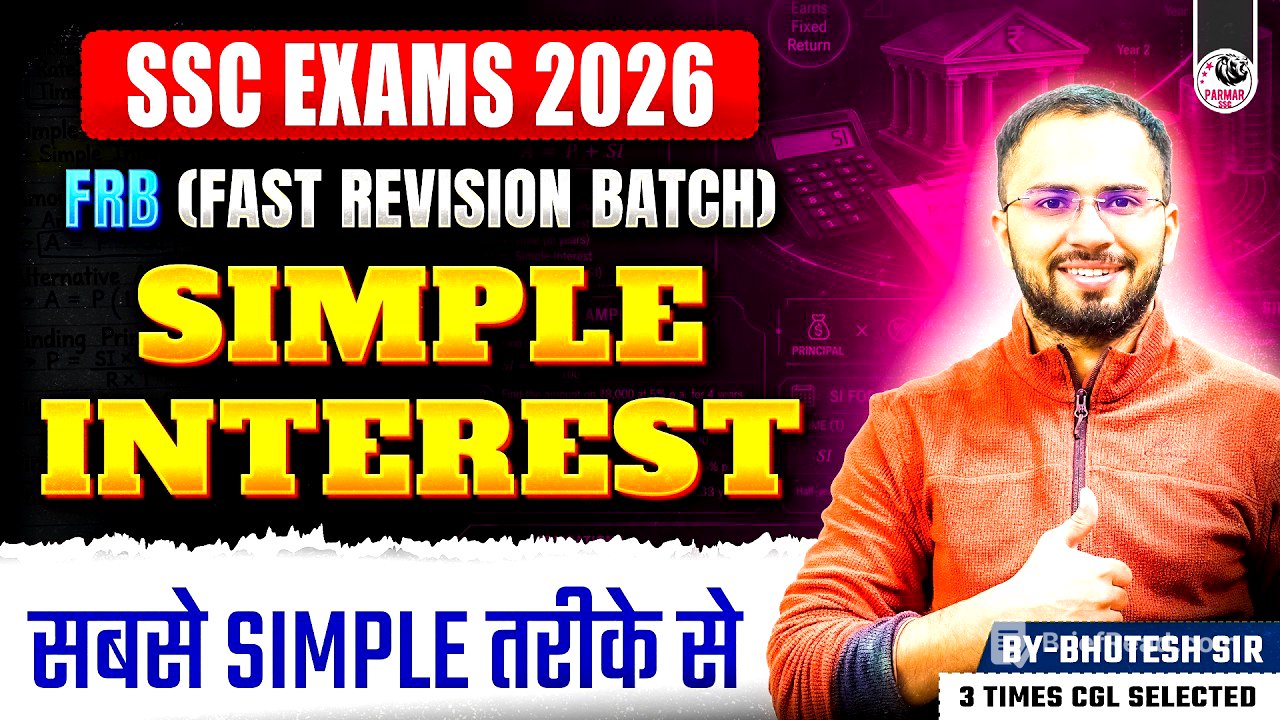
This video is a comprehensive fast revision session on Simple Interest (SI) for SSC exams and other related competitive exams. It emphasizes understanding concepts through questions and provides a unique perspective to solve problems quickly and efficiently. The session includes downloadable PDFs of board annotations, practice questions, and concept notes.
- Focuses on revision and practice for those with prior syllabus knowledge.
- Covers various SSC exams and other related competitive exams.
- Offers a complete package with video content and downloadable PDFs.
Introduction to Simple Interest [0:21]
The video introduces a fast revision batch focusing on Simple Interest (SI). It mentions previous topics covered, such as algebra, geometry, and percentages. Links to the fast revision batch playlist are provided in the video description. Besides video content, the session offers three downloadable PDFs: board annotation PDF, practice PDF, and concept notes. The presenter explains how to access these resources through the Parmar ACCDmy app, where students can find annotated PDFs, concept notes, and printable practice PDFs within the Fast Revision Batch section.
Batch Overview and Relevance [2:55]
The presenter describes the batch as a revision and practice tool for students with some prior syllabus knowledge. It aims to provide efficient content, covering the entire syllabus in approximately 100 hours. The course is relevant for various SSC exams like CGL, CHSL, CPO, MTS, and others, as well as related exams like railway and state exams. The presenter emphasizes that the batch is designed to significantly boost scores, not just provide minimal assistance. Before starting with simple interest, the presenter recommends watching the percentage video, as simple interest is an extension of percentage concepts. The presenter aims to provide a unique perspective, especially in topics like percentage, interest, profit and loss and discount.
Basic Understanding of Simple Interest [5:12]
The presenter explains the basic concepts of simple interest, including principal, rate, and amount. Principal is the initial sum borrowed, and rate is the annual percentage charged on the principal. The extra amount paid is the simple interest. The presenter uses examples to illustrate how to calculate the simple interest for different time periods. The presenter also explains that the rate is by default per year. The presenter introduces the concept of amount, which is the total sum to be paid, including the principal and the interest. The presenter provides formulas for calculating simple interest and amount: Simple Interest = Rate * Time (as a percentage of the principal) and Amount = 100% + (Rate * Time) (as a percentage of the principal).
Solving Time-Based Simple Interest Problems [10:14]
The presenter solves several simple interest problems, including calculating interest when the time period involves specific dates. The presenter explains how to calculate the number of months when the dates are the same and how to count the exact number of days when the dates are different. The presenter also explains how to handle leap years and non-leap years in these calculations.
Calculating Rate of Interest and Time Period [18:15]
The presenter solves problems related to finding the rate of interest and the time period. The presenter explains how to calculate the rate of interest when the simple interest and time period are given. The presenter also explains how to calculate the time period when the simple interest and rate of interest are given.
Understanding Present Worth and Loan Repayments [22:20]
The presenter explains the concept of present worth, which is the current value of a sum due in the future. The presenter solves problems related to finding the present worth of a sum due in a certain number of years. The presenter also solves problems related to loan repayments and calculating the rate of interest.
Problems Involving Equal Rate and Time [25:10]
The presenter solves problems where the rate of interest and the number of years are equal. The presenter explains how to convert the simple interest from fraction to percentage and then equate it to the product of rate and time. The presenter also solves problems where the number of years is numerically double the rate of interest.
Advanced Simple Interest Calculations [28:46]
The presenter solves more complex problems involving simple interest, including scenarios with varying rates and time periods. The presenter explains how to calculate the simple interest when the rate of interest is increased by a certain percentage. The presenter also explains how to calculate the simple interest when the rate of interest is a multiple of the number of years.
Problems with Equal Interest and Rate [31:36]
The presenter solves problems where the number of years is equal to the rate of interest. The presenter explains how to find the rate of interest when the simple interest is given. The presenter emphasizes the importance of carefully reading the question to determine what is being asked.
Comparing Simple Interest with Different Rates and Time Periods [33:29]
The presenter solves problems involving the comparison of simple interest earned on a certain sum of money for different time periods and at different rates. The presenter explains how to calculate the simple interest for each time period and then find the difference between them. The presenter also explains how to calculate the sum of money when the difference between the simple interests is given.
Applying Simple Interest to Multiple Borrowers [38:58]
The presenter solves problems where a person lends money to two different individuals at the same rate of interest. The presenter explains how to calculate the total interest earned by the person and then find the interest paid by each individual. The presenter emphasizes the importance of understanding the relationship between principal, rate, and time in simple interest calculations.
Advanced Rate Calculation Techniques [39:32]
The presenter introduces advanced techniques for calculating the rate of interest in simple interest problems. The presenter explains how to use the formula for simple interest to calculate the rate of interest. The presenter also explains how to use the concept of equivalent principal to calculate the rate of interest.
Difference in Interest Rates and Proportionality [1:03:19]
The presenter solves problems where the difference between the simple interests received from two different sources is given. The presenter explains how to find the difference between their rates of interest. The presenter emphasizes the importance of understanding the concept of direct proportionality in simple interest calculations.
Dividing Sums Among Heirs with Equal Future Amounts [1:07:36]
The presenter solves problems where a sum of money is divided between two heirs such that they receive equal amounts when they reach a certain age. The presenter explains how to find the share of each heir at present. The presenter emphasizes the importance of understanding the concept of simple interest and how it affects the future value of money.
Dividing Sums with Double Interest [1:10:40]
The presenter solves problems where a sum of money is divided into two parts such that the simple interest on the first part is double the simple interest on the second part. The presenter explains how to find the difference between the two parts. The presenter emphasizes the importance of understanding the concept of simple interest and how it affects the value of money.
Applying Proportionality to Simple Interest [1:14:00]
The presenter solves problems where a sum of money is divided into two parts such that the simple interest on the first part is a multiple of the simple interest on the second part. The presenter explains how to find the difference between the two parts. The presenter emphasizes the importance of understanding the concept of simple interest and how it affects the value of money.
Calculating Rate with Amount and Time [1:17:32]
The presenter solves problems where the amount obtained by investing a certain sum at a certain rate for a certain time is given. The presenter explains how to find the rate of interest. The presenter emphasizes the importance of understanding the concept of simple interest and how it affects the value of money.
Impact of Rate and Time on Simple Interest [1:20:26]
The presenter solves problems where the simple interest on a certain sum is given. The presenter explains how to find the simple interest on the same sum for a different time period and at a different rate. The presenter emphasizes the importance of understanding the concept of simple interest and how it is affected by changes in rate and time.
Problems with Same Rate and Time [1:27:08]
The presenter solves problems where the rate and time are the same for two different sums of money. The presenter explains how to find the simple interest on the second sum of money. The presenter emphasizes the importance of understanding the concept of simple interest and how it is affected by changes in the principal.
Comparing Interest from Different Sources [1:30:35]
The presenter solves problems where a person lends money to two different individuals at the same rate of interest. The presenter explains how to find the interest paid by each individual. The presenter emphasizes the importance of understanding the relationship between principal, rate, and time in simple interest calculations.
Problems with Increased Rate of Interest [1:36:43]
The presenter solves problems where the rate of interest is increased by a certain percentage. The presenter explains how to find the total amount after the increase in the rate of interest. The presenter emphasizes the importance of understanding the concept of simple interest and how it is affected by changes in the rate of interest.
Calculating Simple Interest with Varying Rates [1:39:22]
The presenter solves problems where a sum is invested at simple interest with varying rates for different time periods. The presenter explains how to calculate the simple interest on the same sum at a different rate for a different time period. The presenter emphasizes the importance of understanding the concept of simple interest and how it is affected by changes in rate and time.
Problems with Different Amounts and Rates [1:42:19]
The presenter solves problems where a certain sum amounts to different values at different rates of interest. The presenter explains how to find the rate of interest and the principal. The presenter emphasizes the importance of understanding the concept of simple interest and how it is affected by changes in rate and time.
Finding Rate of Interest with Amount and Time [1:46:14]
The presenter solves problems where a sum of money becomes a certain amount in a certain number of years. The presenter explains how to find the rate of simple interest. The presenter emphasizes the importance of understanding the concept of simple interest and how it is affected by changes in rate and time.
Recent Exam Problems [1:53:38]
The presenter solves problems that have appeared in recent exams. The presenter explains how to approach these problems and solve them efficiently. The presenter emphasizes the importance of understanding the concept of simple interest and how it is affected by changes in rate and time.
Problems with Sales and Simple Interest [2:14:05]
The presenter solves problems that involve sales and simple interest. The presenter explains how to approach these problems and solve them efficiently. The presenter emphasizes the importance of understanding the concept of simple interest and how it is affected by changes in rate and time.
Problems with Partial Repayments [2:19:48]
The presenter solves problems where a person borrows a sum of money and makes partial repayments. The presenter explains how to calculate the amount due after the partial repayments. The presenter emphasizes the importance of understanding the concept of simple interest and how it is affected by changes in rate and time.
Conclusion and Additional Resources [2:25:34]
The presenter concludes the video and provides information about additional resources. The presenter mentions the playlist for the fast revision batch and the availability of PDFs with board annotations, practice questions, and concept notes. The presenter encourages viewers to use the resources and provide feedback.