TLDR;
This video by Professor Dave Explains covers the concept of simple harmonic motion, focusing on periodic motions such as those seen in springs and pendulums. Key points include:
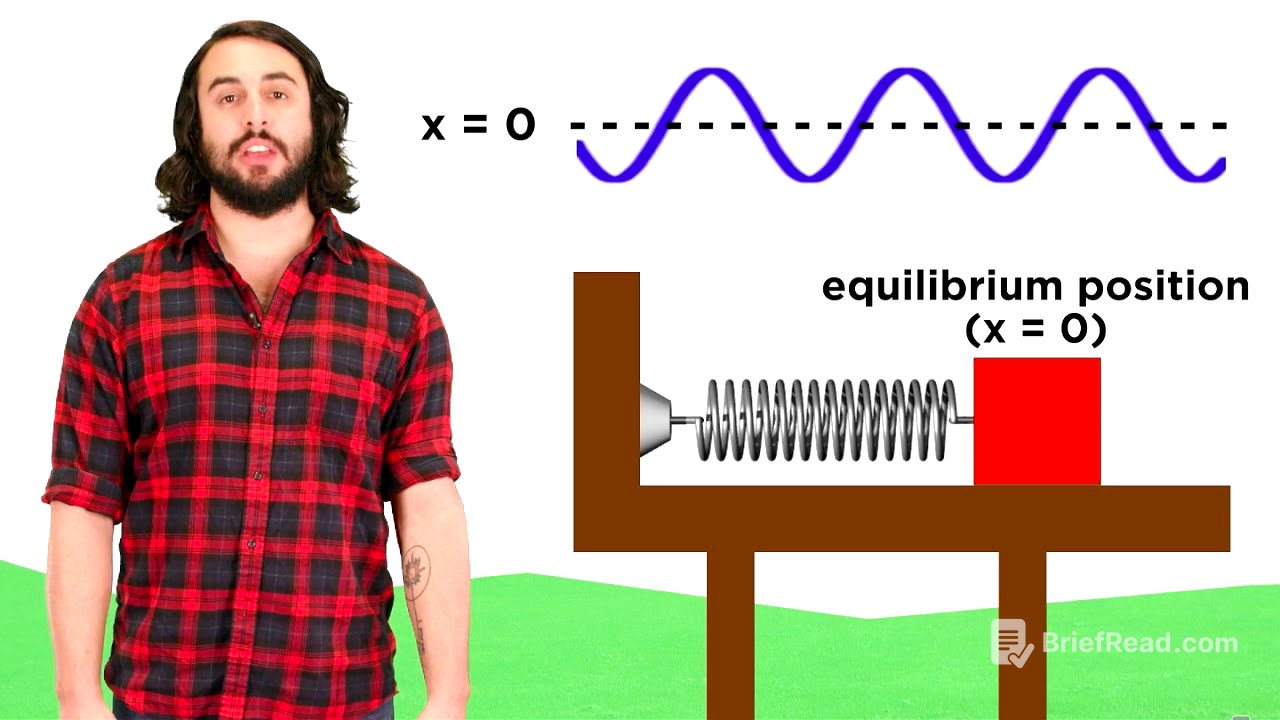
- Simple harmonic motion involves repeated movements, as illustrated by a block attached to a spring.
- Hooke's law describes the force exerted by a spring and defines the spring constant, determining how stiff or loose a spring is.
- Both elastic potential energy in springs and gravitational potential energy in pendulums are key to understanding periodic motion.
Understanding Simple Harmonic Motion [0:00]
Professor Dave introduces simple harmonic motion, highlighting its periodic nature, which differentiates it from single actions like a rock falling from a cliff. He explains that an example of simple harmonic motion is a block connected to a spring that, when pulled and released, oscillates between compressed and uncompressed states.
Energy Concepts in Simple Harmonic Motion [2:20]
The video further details the relationship between elastic potential energy and kinetic energy during the oscillation of the spring system. It describes that maximum elastic potential energy occurs at the extremes of the motion, while kinetic energy peaks as the block moves through the equilibrium position. The graphical representation of the block's position over time shows sinusoidal behavior, characteristic of simple harmonic motion.
Hooke’s Law Explained [3:30]
Hooke's law is introduced, stating that the force a spring exerts is equal to negative k times the displacement, with the negative sign indicating that the force opposes the direction of displacement. The spring constant (k) varies among different springs, dictating the force needed to compress or stretch them.
Elastic Potential Energy and Spring Constant [5:07]
The video elaborates on the formula for elastic potential energy in springs, which is one-half kx squared. At equilibrium, elastic potential energy is zero, while it reaches a maximum as the spring is maximally compressed or stretched. This concept interrelates with kinetic energy as the mass oscillates.
Periodic Motion in Pendulums [6:25]
Prof. Dave compares springs with pendulums, explaining that pendulums also showcase periodic motion, swinging between two fixed points. The pendulum’s motion involves gravitational potential energy rather than elastic potential energy, setting the stage for deeper exploration of this behavior in subsequent discussions.