TLDR;
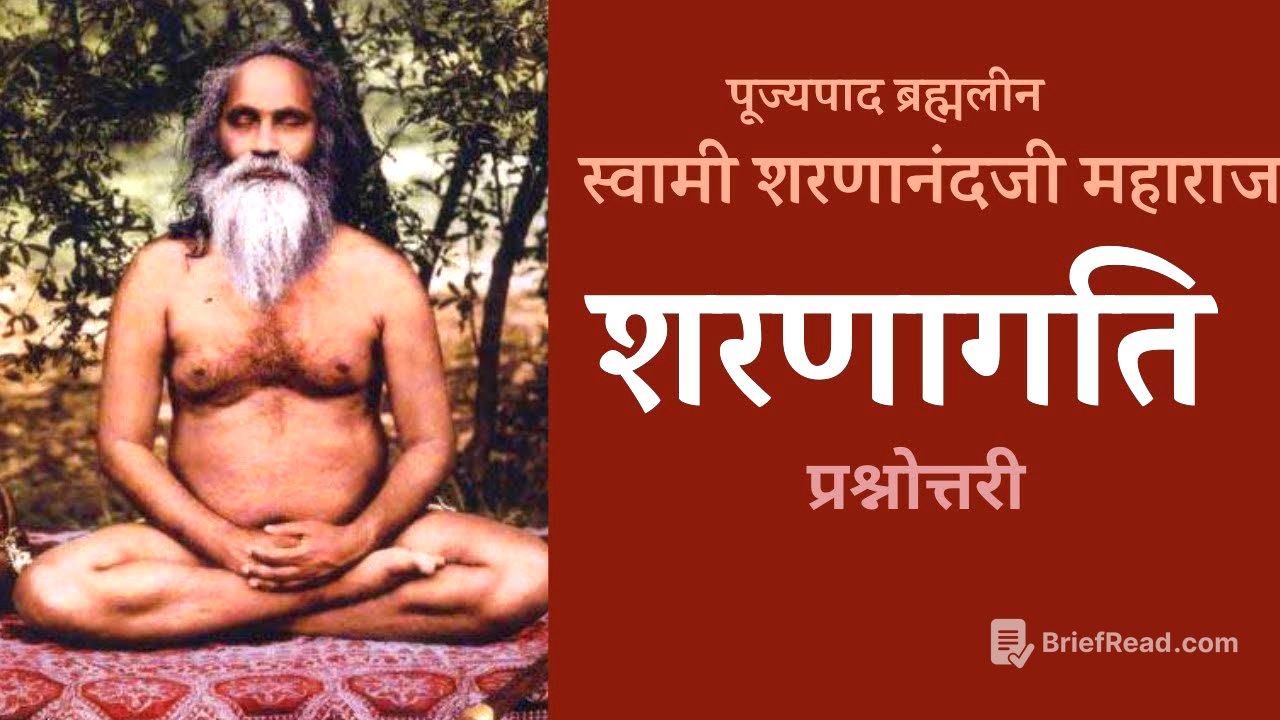
This video explores the profound benefits of surrendering to a higher power or principle, referred to as "Sharanagati." It differentiates between needs and desires, emphasizing that fulfilling needs leads to contentment, while desires perpetuate a cycle of dissatisfaction. The video also distinguishes between two types of surrender: surrender with differentiation (Bhedbhav) and surrender without differentiation (Abhedbhav), detailing their unique characteristics and outcomes. Ultimately, the video explains how surrendering fosters inner peace, dissolves ego, and aligns individuals with their true center, leading to a life of purpose and fulfillment.
- Surrender leads to fulfillment by addressing needs rather than chasing endless desires.
- Two types of surrender exist: with and without differentiation, each with distinct paths and experiences.
- True surrender dissolves the ego and aligns individuals with their ultimate center, fostering inner peace and purpose.
Benefits of Surrender [0:01]
The initial discussion centers on the advantages of surrender, highlighting that individuals are invariably surrendering to something, be it desires or a higher power. Desires are insatiable, leading to weakness, whereas fulfilling needs brings satisfaction. Surrender to a true refuge eliminates desires and fulfills needs, leading to a sense of accomplishment. Needs arise from existence, while desires stem from attachment and delusion, thus only desires can be eliminated, not fulfilled. Discerning between needs and desires is crucial, as it distinguishes an atheist from a believer.
The Nature of Sharanagati [2:03]
Sharanagati is described as a state of being rather than an action. The primary effect of surrender is the transformation of the ego. A key distinction between feeling (bhav) and action (karma) is that feeling yields immediate results, while action bears fruit in the future. Feeling is independent, whereas action requires organization, which can be a source of weakness.
Two Types of Surrender [3:03]
There are two types of surrender: surrender with differentiation (Bhedbhav) and surrender without differentiation (Abhedbhav). Surrender with differentiation involves acknowledging and accepting a beloved entity, while surrender without differentiation requires a true understanding of the refuge. The latter leads to detachment from worldly matters even before the act of surrender, with only a trace of ego remaining, which is then eliminated by the grace of the refuge. Surrender with differentiation transforms the ego, unifying the many into one.
Characteristics of a Surrendered Heart [4:14]
A surrendered heart is constantly filled with the feeling of belonging to the divine. Those who belong to someone find that everything they possess also belongs to that entity, and they continuously await the love of their beloved. As the love for the beloved intensifies, the ego diminishes, eventually leading the surrendered individual with differentiation to become one without differentiation. Even in surrender with differentiation, the individual remains connected to the refuge at all times, similar to a devoted wife who remains connected to her husband even when at her father's house.
Experiencing the Divine [5:27]
The difference between surrender with and without differentiation lies in the experiences they offer. The former savors both separation and union, while the latter experiences constant oneness with the refuge. Experience does not equate to enjoyment, as enjoyment is contingent upon circumstances and leaves a sense of being the enjoyer. However, as the joy of union deepens, the sense of being the enjoyer fades away. Therefore, those who indulge in enjoyment never attain liberation, whereas the surrendered do.
The Necessity of Sharanagati [6:32]
From a detached perspective, the refuge of the surrendered is a necessity, not a desire. Desires arise from attachment to enjoyment and delusion, while necessity awakens when the craving for enjoyment subsides. Just as the rising of the sun dispels darkness, the cessation of attachment to enjoyment brings about the awakening of necessity. Although the existence of necessity may seem insignificant, it appears as the need for a beloved due to the distance from the object of love.
The Sweetness of Surrender [8:31]
Upon becoming a lover of the beloved, the lover is filled with the sweetness of the beloved. The sweetness of surrender is so captivating that the surrendered individual is compelled to remain in a state of surrender with differentiation. When surrender with differentiation is perfected, the refuge merges the surrendered into itself without their consent, similar to how a thief is punished against their will.
The Life of the Surrendered [9:20]
Before surrender, an individual's ego is divided among many feelings. However, upon surrendering, these feelings merge into one. This merging gives the individual a dual experience within a single lifetime: the actual life and the acting life. The actual life of the surrendered is solely the love of the refuge, while the acting life is serving the world according to dharma. The surrendered acts in a way that pleases the world, fulfilling its expectations justly.
The Nature of Acting [10:32]
Acting lacks genuine feeling, and despite different actions, there is no change in affection. The actor does not forget themself, and their acting is not driven by a sense of life. At the end of the act, the accepted feeling is completely absent. It is at this moment that the surrendered turns away from everything and towards the refuge.
Merging into Infinite Power [11:16]
According to natural law, infinite power constantly attracts every being towards itself without force or control. If it did not attract, it would not continuously break the limited love of beings. That which originates from something ultimately merges back into it. Therefore, the pure stream of love that arises from infinite power will merge back into infinite power. Attempts to confine it within objects, states, and circumstances are futile. Upon surrendering, the pure stream of love merges into the refuge.
Finding Our Center [12:51]
Our center can only be that which we need. The need is for eternal life, eternal bliss, and complete independence. Therefore, our center can only be that which is complete and independent in every way. We make a grave mistake by erecting mountains of desires on the path to our center, thereby hindering our natural progress.
The Lesson of Nature [14:13]
Nature teaches us that limited existence is constantly progressing towards infinity, just as a seed progresses towards becoming a tree. Nothing remains unchanged, as if teaching us not to be bound by any limited feeling. Instead, we should progress towards our ultimate, independent center, which can be easily achieved through surrender.
The Power of Undivided Devotion [15:03]
No feeling is alive until it becomes undivided. Just as a farmer plants a seed and becomes free from doubt, the surrendered merges with the infinite, opulent, and sweet reality, developing according to their nature. By eliminating their limited nature, they become one with it. However, their feeling of surrender must be undivided, as there is no alternative in goodwill.
The Fate of the Unsurrendered [16:14]
Those who do not surrender to that infinite, opulent, and sweet eternal element are helplessly surrendering to various objects and circumstances, such as the lustful to the desired, the greedy to wealth, and the unwise to the body. The ego that arises from mere acceptance is divided among many feelings. Whenever it accepts a feeling, it surrenders to it. Therefore, one should surrender to the truth.