TLDR;
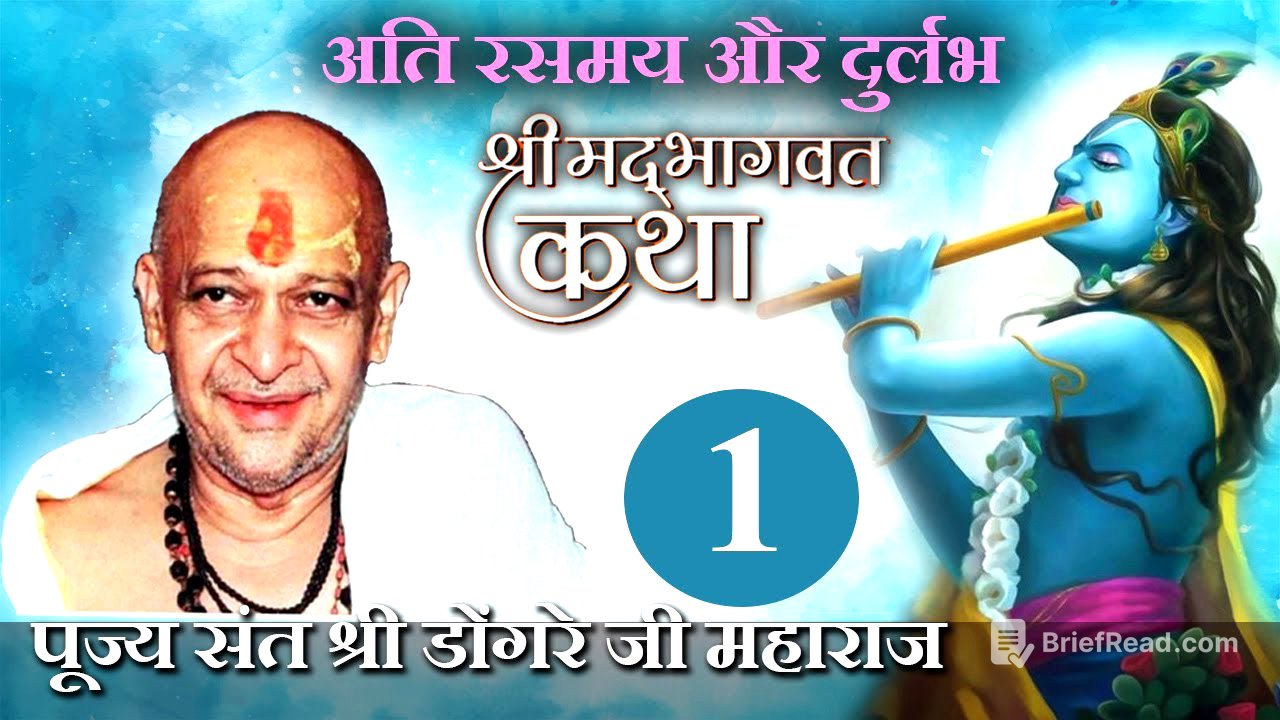
This video explores the profound connections between various deities in Hinduism, emphasizing the importance of devotion and the transformative power of divine stories. It highlights the intertwined relationships of Shiva, Krishna, Parvati, and Rama, illustrating how focusing on the divine can lead to spiritual liberation and a deeper understanding of the self. The video also touches on the significance of Bhagavat Katha, the role of saints like Narada, and the power of devotion to purify the mind and attain salvation.
- Interconnectedness of deities: Shiva, Krishna, Parvati, Rama
- Importance of devotion and divine stories
- Transformative power of Bhagavat Katha and saints
- Purification of mind and attainment of salvation through devotion
सर्वप्रथम [0:07]
The video begins by establishing the deep connection between Lord Shiva and Lord Krishna, noting that Shiva always keeps Krishna in his heart. It also highlights the harmonious presence of Lakshmi Narayan and Sita Ram together. The narrator emphasizes the rarity of seeing Shiva and Parvati together, mentioning that Shiva had to burn Kamadeva before marrying Parvati. After their marriage, Shiva narrated the stories of Rama and Krishna to Parvati, emphasizing the importance of chanting "Ram Ram."
श्री कृष्ण को भी शिवजी हृदय में धारण [0:31]
The discussion centers on the essence of love and devotion. It contrasts worldly attachments with the love for the divine, suggesting that those deeply attached to material things may not appreciate the Bhagavat Katha. True love should be directed towards the eternal, conscious Narayan.
वृद्धावस्था में भागवत की रचना करने के बाद [2:43]
Vyas Ji, after composing the Bhagavat, wished for Lord Shiva to be born as his son and narrate the Bhagavat Katha. In his old age, while chanting the Panchakshara Shiva mantra, Vyas Ji became so engrossed that Lord Shiva appeared in his ashram. Vyas Ji requested Shiva to incarnate as his son to spread the Bhagavat Katha. Shiva agreed, noting that whoever comes into this world is touched by Maya.
संसार में कौन आगे शंकर भगवान के बहुत अवतार नहीं होते हैं [4:27]
The discussion shifts to the avatars of Lord Shiva, noting that Shiva doesn't have many avatars because he constantly protects the world from chaos and unrest. The question is posed: who can progress beyond God by abandoning the meditation on God?
आनंद मिला है वो आनंद को देने के लिए [5:14]
The importance of sharing joy and happiness with others is emphasized. The narrator suggests that the joy one receives should be given to others, rather than hoarding it.
देवी के सामने देखा [5:59]
The focus shifts to the story of Sukhdev Ji Maharaj, who remained in his mother's womb for a long time, constantly meditating on Krishna. As a result, Sukhdev Ji Maharaj's nature became like that of Krishna. It's explained that whoever one meditates upon, one becomes like that deity.
मैं मैन के पेट में हूं आप बहुत प्रेम से मेरे को बेटा बेटा [7:11]
Sukhdev Ji Maharaj, while still in his mother's womb, tells Vyas Ji that he has never been touched by Maya. He refers to Lord Narayan as "Madhavra," emphasizing that God is beyond Maya. The concept of "Madhavra" is explained as one who is against Maya, clarifying that God is never influenced by Maya.
दक्षिण भारत में रामेश्वरम के मंदिर में [7:39]
The discussion continues on the concept of "Madhavra," explaining that there are four Madhavra forms in four directions. Sukhdev Ji Maharaj was free from Maya from birth. He attained this state through meditation and devotion. Only one who is free can liberate others.
पवित्र समय में सुखदेव जी महाराज का परगना क्यों हुआ [9:38]
Sukhdev Ji Maharaj was born at a sacred time. At the age of 16, he renounced his home, considering the entire world as his home. A knowledgeable person sees the same soul in everyone. Sukhdev Ji left his home to bring welfare to many lives.
सुखदेव जी महाराज जाते हैं तो मैन को दुख हुआ [10:51]
Sukhdev Ji Maharaj's departure caused grief to his mother, who felt that her son was very capable. Seeing him brought peace of mind, and remembering him destroyed desires.
कल्याण करने के लिए उन्होंने घर छोड़ा है [11:27]
Sukhdev Ji Maharaj left home for the welfare of others. The narrator emphasizes that whatever one likes should be offered to God. By doing so, one becomes dear to God. It's suggested that one should offer what one likes to God, rather than offering what one dislikes.
वही परमात्मा को अर्पण करो अब प्रभु के प्यारे हो जाओ [12:17]
The importance of offering what is dear to oneself to the divine is reiterated. This act of devotion makes one beloved to God.
उसके हादसे हमें एक जीवन का कल्याण होने वाला है [12:29]
Vyas Ji's wife understands that Sukhdev Ji's separation is inevitable. Vyas Ji is described as a great sage and ascetic. Despite receiving spiritual teachings, Vyas Ji follows Sukhdev Ji. Sukhdev Ji advises him to follow the divine instead of him, emphasizing that the true relationship is between the soul and God.
तुम्हारा उपदेश दिया है दारा रहा अभी नहीं रूह सरवन श्री आमीन नारायण में लिंग हो गई [13:01]
Vyas Ji is consoled with the understanding that one should not mourn for a son. The true relationship is with God, not with worldly relations. It's stated that from birth, no one is a father, wife, or son; from birth, one belongs to God.
सत्य है tatpurushti से विचार करने पर सत्य नहीं है [14:30]
The concept of familial relationships is questioned, emphasizing that these are not eternal truths. The true relationship is with God. The discussion explores the illusion of familial bonds, suggesting that these are temporary and based on past life connections.
पिता पुत्र के संबंध में वासना के बिना दूसरा क्या है [15:05]
The nature of the father-son relationship is questioned, suggesting it is often driven by desires. Sukhdev Ji advises Vyas Ji to follow the divine instead of him, as life is a temporary role of father, son, or wife.
putradaar सुदामा [16:05]
The impermanence of worldly relationships is highlighted, questioning where the beloved wife or son from previous lives are now.
महाराज ने परीक्षित राजा को कथा सुनाएं [16:55]
The story of Maharaj narrating the Katha to King Parikshit is mentioned, emphasizing that Parikshit was a medium for the welfare of many lives. Similarly, Arjuna was a medium through whom Krishna gave the teachings of the Gita.
भगवान विराजमान है [17:23]
The significance of having God present is highlighted, stating that where there is God, there can be no darkness. Arjuna's chariot had God present, with God holding the reins. Arjuna was merely a medium.
अर्जुन देव अर्जुन का एक निमित्त है [18:02]
Arjuna and King Parikshit were mediums for the welfare of the world. Sukhdev Ji Maharaj was offered for this purpose.
जो अमरप्रकाश का दर्शन करता है जो बाहर भी प्रकाशित [18:22]
The importance of seeing the eternal light, which shines both internally and externally, is emphasized.
महाराज गंगा किनारे कथा करते हैं उसे कथा में [18:40]
The narrator describes a scene where Maharaj is narrating a story by the Ganges River, and a ghost is listening. The ghost finds the story very joyful and considers himself inferior to Sukhdev Ji Maharaj.
कथा के आरंभ में शुक्र देव जी महाराज को वंदन [19:17]
The video transitions to the beginning of a story, offering salutations to Shukdev Ji Maharaj.
जी महाराज [20:13]
Sukhdev Ji Maharaj tells Vyas Ji that he is not his son, emphasizing that the true relationship is between the soul and God. He renounces everything.
की संत है नारद जी महाराज लोक संघ ही संत [20:31]
Narad Ji Maharaj is described as a saint who travels the world for the welfare of others, promoting dharma and bhakti so that society can be happy.
एक बार नरसी अनेक देवों में घूमते हुए [20:49]
Narad Ji, while wandering among various deities, arrives at Badrinath in Vishalakshetra.
बहुत बढ़ गया है [21:10]
The discussion highlights a decline in devotion and an increase in materialistic pursuits. Life has become dominated by भोग ( ভোগ), leading to the destruction of भक्ति (ভক্তি).
उनको जगत देने की इच्छा होती है [21:42]
People desire to see the world but do not wish to see the one who created it. Life has become focused on काम (কাম), पैसा (পয়সা), and भोग ( ভোগ), leading to the destruction of भक्ति (ভক্তি).
ऐसा कोई उपाय बताओ [22:16]
The need for a solution to awaken people is expressed. The narrator mentions that the Katha was narrated in Anandvan near the Ganges, emphasizing the importance of Kashi as Anandvan.
गंगा किनारे [22:55]
The scene shifts to the Ganges River, where a story is about to be narrated. Many saints, great souls, and kings are present.
सभी को मानते हैं कथा में चलो [23:17]
The importance of attending the Katha is emphasized. Some people, filled with pride, believe they already know everything.
विचार किया मेरी प्रेरणा से कोई कथा सुनेगा [23:47]
The narrator reflects on the idea that if someone listens to the Katha or chants God's name through his inspiration, he will also receive a share of the merit. It's emphasized that one should support good deeds.
भगवान श्री कृष्ण सुदामा में रहे तब भगवान ने अपना दिव्या भागवत शास्त्र में रखा [24:30]
When Lord Krishna resided in Sudama, he placed his divine essence in the Bhagavat scripture. The power that is in God is also in the Bhagavat scripture. Some saints even say that the Bhagavat is superior to God.
उनको श्री कृष्ण भगवान का दर्शन हुआ [24:52]
The narrator shares examples of individuals who had divine visions. Ravan saw Ram but didn't change his ways until the end. Some people do not give up their sins even after seeing God. It's suggested that such individuals should love God's name and listen to God's stories.
रावण दुर्योधन के जैसे भागवत की कथा सुनने [25:30]
Even if individuals like Ravan and Duryodhan listen to the Bhagavat Katha and chant God's name, their intellect may not be purified. What cannot be achieved through God can be achieved through God's name.
इस कथा में पाप का नाश करने की शक्ति [26:02]
The power of the Katha to destroy sins is highlighted.
संपत्ति बहुत थी संतति एन होने से वह दुखी था [26:20]
A man, despite having wealth, was unhappy because he had no children.
एक बार मरने को तैयार हूं [26:34]
The man prepares to commit suicide.
थोड़ा विचार करें तो बिहार में आएगा हम सभी जीव आत्मा के [26:42]
The narrator suggests that if one thinks a little, one will realize that all beings are souls.
भक्त शब्द का अर्थ होता है कल्याण कल्याण करने वाली [26:54]
The meaning of "Bhakt" is explained as one who brings welfare. The human body is not the soul; the soul desires to be one with Shiva.
आत्मा के पत्नी का नाम है [27:23]
The concept of the soul's partner is introduced.
जो किया है वो सभी अपनी बुद्धि में घटता है [27:29]
It's stated that whatever one does is reflected in one's intellect.
मानव की बुद्धि के जैसी है [27:36]
The nature of human intellect is discussed.
जगत का विचार कैसा है [27:50]
The nature of the world's thoughts is questioned.
मेरा मैन कैसा है मेरा मैन कहां जाता है [28:15]
The narrator questions the nature and direction of one's mind.
अपने स्वरूप का विचार नहीं कहती है [28:32]
The importance of contemplating one's true nature is emphasized.
उनका बुद्धि के साथ संबंध होने पर सत्संग करें तो विवेक रूपी शत पुत्र का जन्म हो [28:39]
It's stated that when one's intellect is connected with सत्संग (Satsang), it leads to the birth of विवेक (Vivek), which is like a good son. Without सत्संग (Satsang), विवेक (Vivek) cannot be awakened.