TLDR;
This video explores the unique situation of Cyprus, a divided island with the capital Nicosia, which is the only capital globally split between two nations. It discusses the historical background of the division, the ongoing conflict, the contrasting lifestyles of the Turkish Republic of Northern Cyprus and the Republic of Cyprus, as well as the recent struggles for reunification.
- Cyprus is divided between the Republic of Cyprus and the Turkish Republic of Northern Cyprus, separated by the Green Line.
- The conflict traces back to Ottoman occupation, British administration, and ethnic tensions leading to the 1974 Turkish intervention.
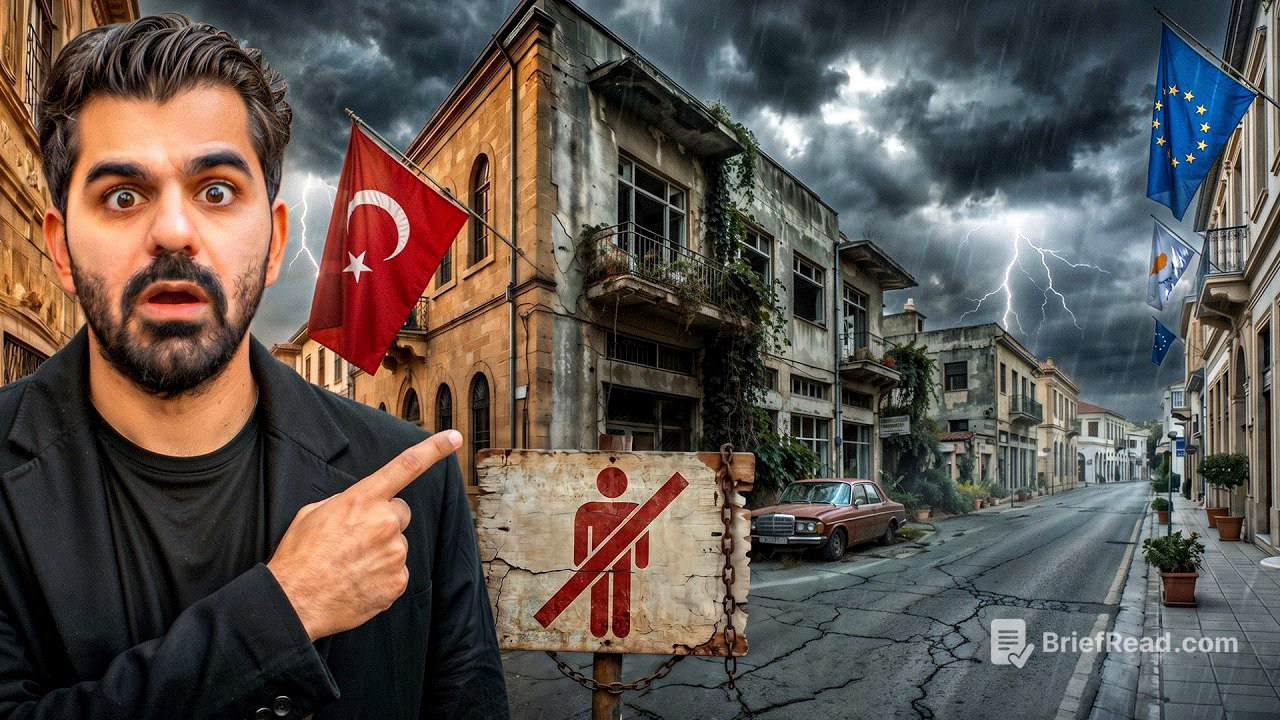
- Varosha, a ghost town, exemplifies the conflict's legacy, representing properties once held by Greek Cypriots that are now inaccessible and under control of Turkish authorities.
Nicosia: The Divided Capital [0:15]
The narrator introduces Nicosia, the capital of Cyprus, emphasizing its unique status as the only capital globally that is divided between two countries. By crossing a specific line, one can enter either the Republic of Cyprus, part of the EU, or the Turkish Republic of Northern Cyprus, which is not recognized internationally. This split has led to a complex social and political landscape.
Historical Background [2:10]
The historical context of the division is outlined, beginning with the Ottoman occupation of Cyprus in 1571 and transitioning to British rule in 1878. The narrator details how British administration originally stirred conflicts between Greek and Turkish Cypriots, culminating in violent events like the Eoka massacre in 1963. Tensions escalated until 1974, leading to the Greek Cypriots initiating conflict, prompting Turkish military intervention and the establishment of a divided island.
The Impact of Turkish Intervention [4:25]
In 1974, a coup led by Greek nationalists prompted Turkish intervention to protect Turkish Cypriots, who made up about 18% of the island's population. The Turkish forces then controlled 37% of Cyprus, establishing the Turkish Republic of Northern Cyprus in 1983, which is deemed an occupation by the UN.
Current Division and Buffer Zone [6:09]
The narrator describes the current division in Cyprus along the UN-established Green Line, which spans 180 km. The area serves as a buffer zone to minimize conflict and maintain peace between both regions. However, movement across this line remains heavily regulated, with various restrictions for Turkish citizens compared to those from the Greek side.
Experiences in Northern Cyprus [9:04]
The narrator shares personal experiences from Northern Cyprus, discussing the daily life and unique cultural elements. Turkish coffee and tea are popular, reflecting Turkish traditions, while the complexity of crossing borders brings forth the contrasting experiences of individuals living on either side of the division.
Transition to Southern Cyprus [17:36]
Crossing from Northern Cyprus into Southern Cyprus, the narrator highlights the differences in currency and cultural experiences. The Greeks and Turks previously lived together peacefully before the separation, expressed through their shared histories and familial ties. The desire for reunification is still alive, with sentiments reflecting on the beauty of the island and a longing for a peaceful coexistence.
The Ghost Town of Varosha [12:34]
Varosha, an abandoned city and ghost town in Northern Cyprus, symbolizes the longstanding issues between the two communities. Once a thriving resort area, it became desolate following the Turkish invasion in 1974. The video depicts the area’s bleakness, noting how past inhabitants still hold onto their keys, representing their lost heritage and homes.
Future Perspectives [23:30]
The video concludes with reflections on the present and future of Cyprus, emphasizing the recent political developments regarding gas reserves in the Mediterranean and ongoing discussions around a potential resolution. The interviewees express a mix of hope for eventual reunification and skepticism about whether it can truly be realized, recognizing the intricate political landscape that persists.