TLDR;
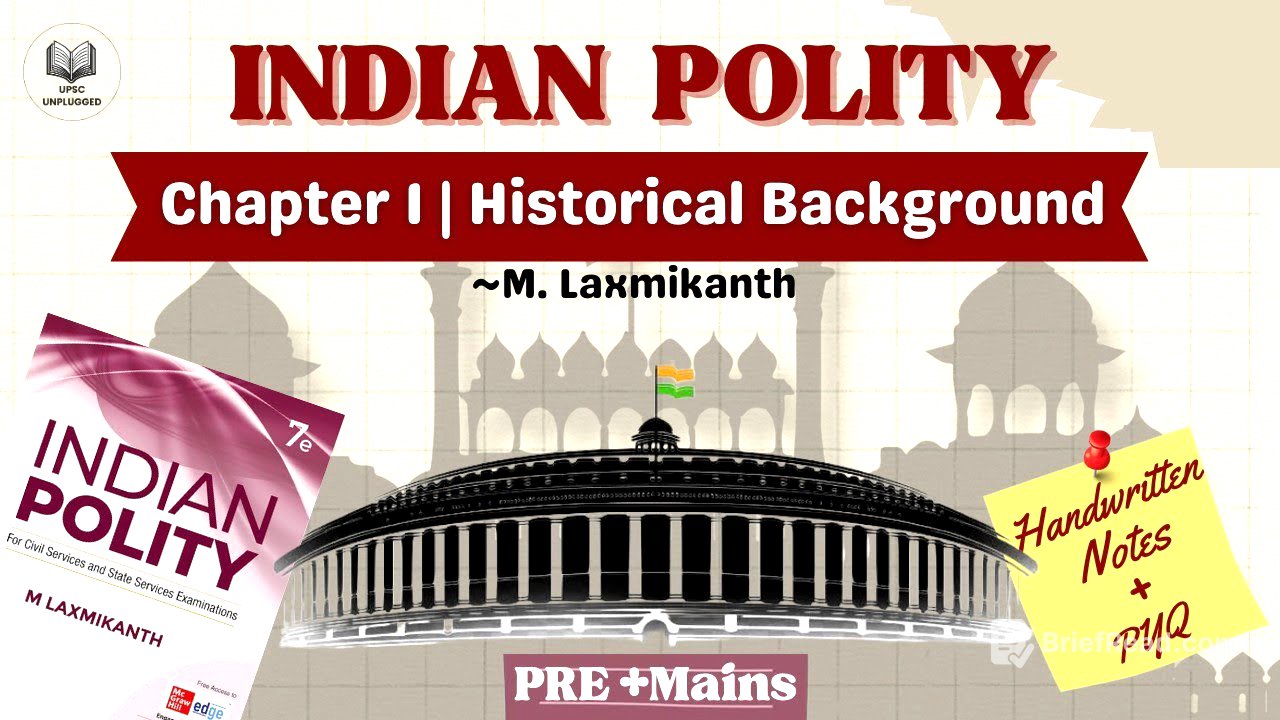
This video provides an overview of the historical background of the Indian Constitution, focusing on the acts and events that shaped India's political and administrative structure under British rule. It covers the period from the East India Company's establishment to the Indian Independence Act of 1947, categorising the acts under Company Rule and Crown Rule.
- The East India Company's initial trading charter and gradual acquisition of administrative powers.
- Key legislative acts, such as the Regulating Act of 1773, Pitt's India Act, and the Charter Acts, which incrementally increased British control.
- The transition to Crown Rule following the Sepoy Mutiny of 1857, leading to direct governance by the British Parliament.
- The Indian Independence Act of 1947, which marked the end of British rule and the partition of India.
East India Company Establishment [0:18]
In 1600, the East India Company was established through a charter granted by the British monarchy, giving a group of elite businessmen a trade monopoly in the Indian Ocean and legislative powers to create rules for their business. By 1608, the Company had arrived in India, establishing its first factory in Masulipatnam in 1611 and another in Surat in 1612. By 1634, Shah Jahan extended the Company's exclusive trading rights from Surat to Bengal.
Transition to Administration [1:23]
The East India Company expanded its operations, establishing trading posts in Madras, Bombay, and Calcutta, which became major presidencies. The Battle of Plassey and the Battle of Buxar led to the Treaty of Allahabad, granting the Company 'Diwani' rights (revenue collection) in Bengal, Bihar, and Orissa. This marked the Company's shift from pure trade to administration, allowing them to collect revenue and exert administrative influence.
Sepoy Mutiny and British Parliamentary Intervention [2:35]
The Sepoy Mutiny (Revolt of 1857), also known as the First War of Independence, prompted the British Parliament to increase its oversight of the East India Company. The British Parliament began to interfere, eventually leading to direct control. The period of British rule is categorised into Company Rule and Crown Rule, each marked by distinct legislative acts.
Regulating Act of 1773 [4:07]
The Regulating Act of 1773 was the first attempt by the British Government to control the East India Company's affairs. It centralised power by designating the Governor of Bengal as the Governor-General of Bengal, under whom the governors of Bombay and Madras would operate. The act also led to the establishment of the Supreme Court in Calcutta, comprising one Chief Justice and three other judges.
Pitt's India Act of 1784 [5:51]
Due to the ineffectiveness of the Regulating Act, Pitt's India Act of 1784 divided the East India Company's functions into commercial and political. It established the Court of Directors (East India Company) and the Board of Control (British Parliament), forming a dual government. The British Parliament increased its control, designating the Company's territories as "British Possessions in India" and asserting supreme administrative control.
Charter Act of 1813 [7:33]
The Charter Act of 1813 ended the East India Company's trade monopoly, except for tea and trade with China, allowing other British companies to trade in India. It affirmed British sovereignty over the Company's territories, promoted Christian missionaries, and encouraged Western education. Local governments were also permitted to impose taxes.
Act of 1833 [8:26]
The Act of 1833 marked the final step towards centralisation, renaming the Governor-General of Bengal as the Governor-General of India, with complete civil and military powers. Lord William Bentinck became the first Governor-General of India. The act stripped the governors of Bombay and Madras of their legislative powers, designating new laws as "Acts" instead of "Regulations". The East India Company was transformed into a purely administrative body, ending its commercial activities. While there was a suggestion to allow Indians into the Civil Services, the Board of Directors rejected it. This act also abolished slavery.
Charter Act of 1853 [9:37]
The Charter Act of 1853 introduced the separation of legislative and executive powers. The Governor-General of India had a six-member council, and the legislative council was referred to as the Indian Legislative Council, a precursor to the Indian Parliament. Local representation was introduced, with four members out of six being appointed from local British residents. The act also introduced open competition for civil services, allowing Indians to participate, though exams were still held in the UK.
Government of India Act, 1858 [11:38]
Following the Revolt of 1857, the British Parliament took direct control of India, marking the beginning of Crown Rule. The Government of India Act, 1858, abolished the East India Company and transferred its powers to the British Crown. The Viceroy, representing the British Crown, was appointed, and Lord Canning became the first Viceroy of India. The dual government system was abolished, and the office of the Secretary of State was created, who was a member of the British Cabinet, advised by a 15-member council.
Indian Council Act of 1861 [13:04]
The Indian Council Act of 1861 initiated decentralisation by restoring legislative powers to Bombay and Madras. The council included Indians, such as the Raja of Benares, the Maharaja of Patiala, and Sir Dinkar Rao, though they were nominated rather than elected. The Viceroy was granted the power to issue ordinances in emergencies, valid for six months. New legislative councils were also established.
Indian Council Act of 1892 [14:15]
The Indian Council Act of 1892 introduced indirect elections, but this did not satisfy Indian demands for greater representation.
Indian Council Act of 1909 (Morley-Minto Reforms) [14:27]
The Indian Council Act of 1909, also known as the Morley-Minto Reforms, introduced elections and separate electorates for Muslims in legislative councils. The size of the Indian Legislative Council was increased from 16 to 60 members. Indians were included in the Executive Council, with Satyendra Prasad Sinha being the first Indian to join the Viceroy's Executive Council as a Law Member. Lord Minto is known as the Father of Communal Electorates.
Government of India Act, 1919 (Montagu-Chelmsford Reforms) [15:26]
The Government of India Act, 1919, also known as the Montagu-Chelmsford Reforms, aimed to establish a responsible government in India. It created the office of the High Commissioner of India and introduced bicameralism in the Indian Legislature. Communal representation was extended to Sikhs, Indian Christians, Anglo-Indians, and Europeans. The Central Public Service Commission (UPSC) was established in 1926. Dyarchy was introduced, dividing provincial subjects into transferred (governed with the aid of ministers) and reserved (governed by the Governor's Executive Council). Limited franchise was granted, and a statutory commission was planned to analyse the Act's success after ten years.
Government of India Act, 1935 [18:54]
The Government of India Act, 1935, is a significant source for the Indian Constitution, with more than 50% of the Constitution derived from it. It was the longest act enacted by the British Parliament. Sindh was separated from Bombay, Bihar and Orissa were separated, and Burma was separated from India. The act proposed an All-India Federation, granted residual powers to the Viceroy, abolished dyarchy, introduced bicameralism in six provinces, and extended communal representation to Scheduled Castes, women, and labourers. An advisory team was provided to the Secretary of State, and the Reserve Bank of India was established. Federal, Provincial, and Joint Public Service Commissions were created, and the Federal Court (precursor to the Supreme Court of India) was established.
Indian Independence Act, 1947 [20:17]
The Indian Independence Act, 1947, marked the end of British rule in India, driven by the Indian National Congress, the Quit India Movement, and various reforms. It led to the partition of British India into India and Pakistan, based on the Mountbatten Plan. The act permitted the formation of a Constitution Assembly to draft a constitution for independent India and abolished the office of the Secretary of State.