TLDR;
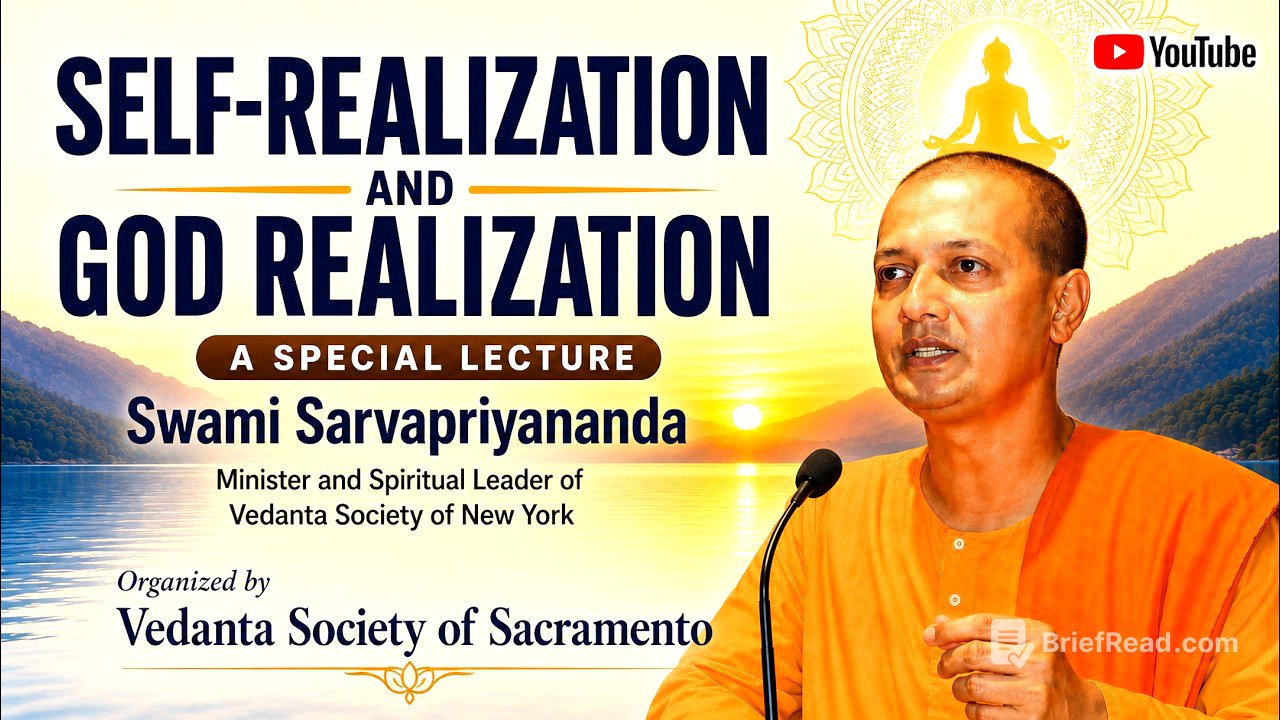
In this lecture delivered by Swami Sarv Priyanandha, the focus is on the concepts of self-realization and God realization within the context of Vedanta philosophy. Key points discussed include the nature of suffering, the dichotomy between self-inquiry and God-centered approaches, and their implications for spiritual seekers.
- Exploration of the nature of suffering and the quest for happiness.
- Differentiation between God realization and self-realization.
- Importance of overcoming ignorance through knowledge.
- Insights on the unity of all beings from a Vedantic perspective.
Introduction to Vedanta and Swami Sarv Priyanandha's Background [0:03]
Swami Sarv Priyanandha introduces himself, sharing his background as the minister of the Vedanta Society of New York. He speaks about his journey in monastic life and how he has contributed to the spiritual community. He is welcomed warmly and the audience is reminded to refrain from photography during the talk.
Gratitude and Connection to Other Traditions [3:25]
Swami expresses gratitude to the Vedanta society and acknowledges the historical connections between Hinduism and Zoroastrianism. He highlights how ancient philosophies of India are often misunderstood as pessimistic, yet they offer hopeful solutions to human suffering through various paths, including self-realization and God-realization.
Understanding Suffering in Life [7:17]
Swami discusses the pervasiveness of suffering in human life, covering physical, mental, and emotional pain. He emphasizes that although suffering is universal, ancient Indian philosophies provide pathways to overcoming pain and achieving lasting happiness.
Philosophical Insights on Indian Traditions [11:25]
The lecture explores how different Indian spiritual traditions, including Buddhism and Jainism, approach self-realization and God-realization. The Swami explains how spirituality can be related to both the divine and individual inquiry into one’s essence.
Self-Realization vs God-Realization [12:32]
Swami explains the distinction between self-realization, which focuses on understanding oneself, and God-realization, which involves connecting with a divine entity. He discusses how both paths lead to similar realizations about existence and fulfillment.
The Role of Faith and Doubt in Spirituality [20:30]
Digging deeper into the God-centered approach, Swami acknowledges that faith plays a crucial role in understanding God, and that different religions have addressed doubt in various ways. Conversely, self-inquiry eliminates doubts about one's own existence, making it a more secure path.
Spiritual Practices and Their Variations [28:09]
Swami contrasts the devotional practices of God-centered traditions with the philosophical inquiries of self-centered approaches. He emphasizes that both methods can lead to the ultimate realization of the non-dual nature of reality.
The Unity of Existence in Vedanta [33:20]
The lecturer articulates how Vedanta believes all paths to be valid and emphasizes the core unity underlying existence. Recognizing oneself as non-separate from the divine leads to a profound experience of oneness.
Final Thoughts and Practical Applications [45:40]
In concluding remarks, Swami acknowledges the importance of returning to divine realization while living in the worldly realm. Through devotion, inquiry, and an understanding of divine presence in everyday life, individuals can navigate spiritual growth seamlessly.
Question and Answer Session [1:04:05]
The session includes various questions from the audience addressing practical applications of the discussed philosophies. Swami provides insights on living a balanced spiritual life, connecting through service, and maintaining one’s focus on divinity amidst worldly distractions.