TLDR;
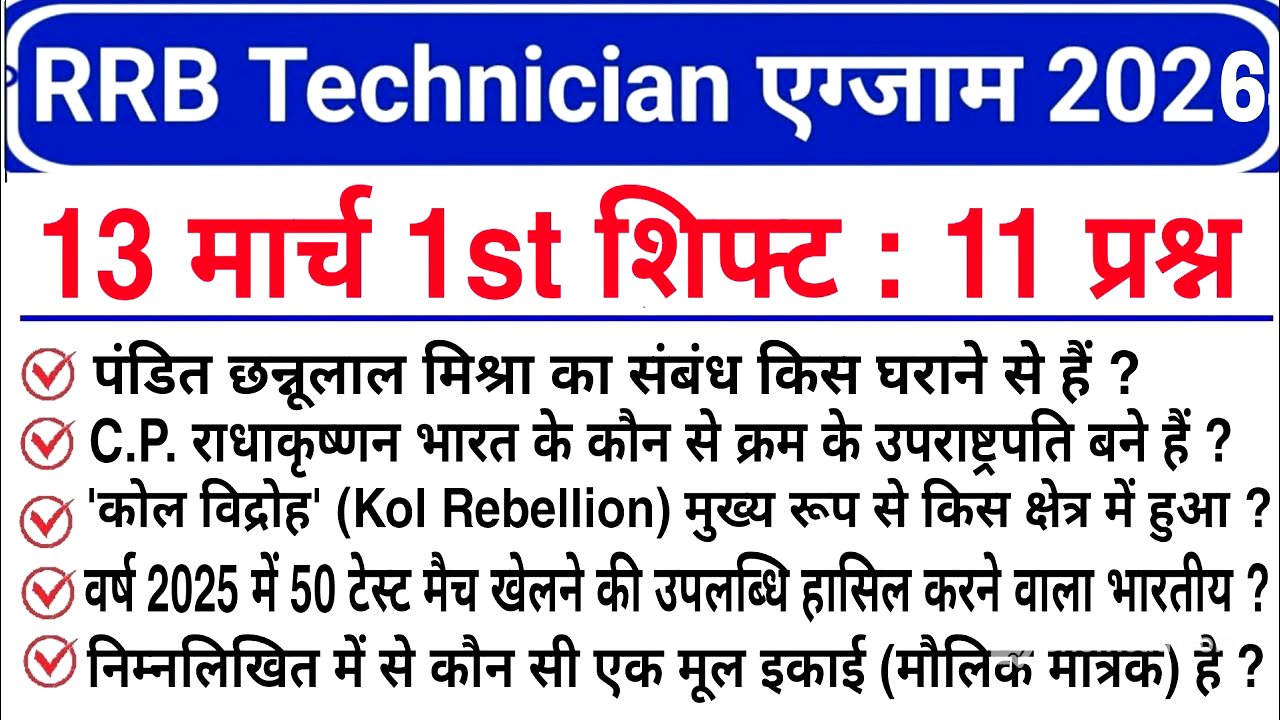
This video provides a detailed analysis of the RRB Technician exam's first shift on March 13th, offering accurate answers to the questions asked. It covers a range of topics including Indian classical music, sports achievements, history, economics, and fundamental science.
- Pandit Chhannulal Mishra's background and awards.
- Jasprit Bumrah's milestone in Test cricket.
- The first session of the Indian National Congress.
- The Kol rebellion and its impact.
- The Finance Commission's role and composition.
- CP Radhakrishnan's appointment as Vice President.
- Folk music of West Bengal.
- Citizenship articles in the Indian Constitution.
- Components of the 1991 industrial reforms.
- Matching mountains with their heights.
- Fundamental units in science.
Pandit Chhannulal Mishra [0:49]
Pandit Chhannulal Mishra is associated with the Banaras Gharana. His style includes Shastri singing Khayal, Thumri, Dadar, Kajri, and Chaati. He received the Padma Vibhushan in 2020 and the Padma Bhushan in 2010 from the Government of India. Born on August 3, 1936, in Harpur village, Azamgarh district of Uttar Pradesh.
Jasprit Bumrah's Achievement [1:43]
In 2025, Jasprit Bumrah is set to become the first Indian fast bowler to play 50 Test matches. He achieved this milestone during the second Test match against the West Indies at Arun Jaitley Stadium in Delhi on October 10, 2025. Bumrah is also the first Indian fast bowler to play 50 or more matches in all three formats: Test, ODI, and T20.
First Session of INC [2:48]
The first session of the Indian National Congress (INC) took place from December 28th to 31st, 1885, at Gokul Das Tejpal Sanskrit College in Mumbai. It was presided over by Vimesh Chandra Banerjee, with 72 representatives participating. The INC was established by A.O. Hume.
Kol Rebellion [3:47]
The Kol rebellion mainly occurred in the Chhota Nagpur region (present-day Jharkhand) in 1831-32. The main tribes involved were the Munda and Oraon, led by Budhu Bhagat, Madhra Mahato, and Jahar Bhagat. The rebellion was triggered by exploitation by outsiders (Dikku), illegal occupation of agricultural land, and unfair taxation (laga). Following the rebellion, the British implemented Regulation 3 in 1833, and the South West Frontier Agency was established.
Finance Commission [4:55]
The President of India constitutes the Finance Commission every 5 years under Article 280 of the Constitution. The commission's primary function is to recommend the distribution of taxes between the Centre and the State.
CP Radhakrishnan [5:26]
CP Radhakrishnan (Chandrapuram Pannu Swami Radhakrishnan) assumed the charge as the 15th Vice President of India on September 12, 2025. He contested the election as an NDA candidate and defeated the opposition candidate on September 9, 2025. Previously, he served as the Governor of Maharashtra and Jharkhand. He is originally from Tamil Nadu.
Folk Music of West Bengal [6:25]
The famous folk music performed by the Baul singers of West Bengal is called Baul Gaan.
Citizenship in Constitution [6:49]
Citizenship is mentioned in articles 5 to 11 of the Indian Constitution, which falls under part two of the constitution. Single citizenship has been taken from the constitution of Britain.
1991 Industrial Reforms [7:13]
Demonetization was not a component of the 1991 industrial reforms (LPG model). The LPG model emphasized liberalization, privatization, and globalization.
Matching Mountains with Height [7:57]
Matching the mountains with their heights:
- Kanchenjunga: 8586 meters (third highest peak in the world, highest in India, located on the border of Sikkim and Nepal)
- Nanga Parbat: 8126 meters (ninth highest peak in the world, located on the westernmost end of the Himalayan range)
- Anaimudi: 2695 meters (highest peak of South India and Western Ghats, located in the Idukki district of Kerala)
Fundamental Units [9:19]
Mass is a fundamental unit. Fundamental units do not depend on any other unit. There are seven fundamental units in the international system: length (meter), mass (kilogram), time (seconds), electric current (ampere), temperature (Kelvin), amount of substance (mole), and luminous intensity (candela). Force, work, and pressure are derived units formed by the combination of basic units.