TLDR;
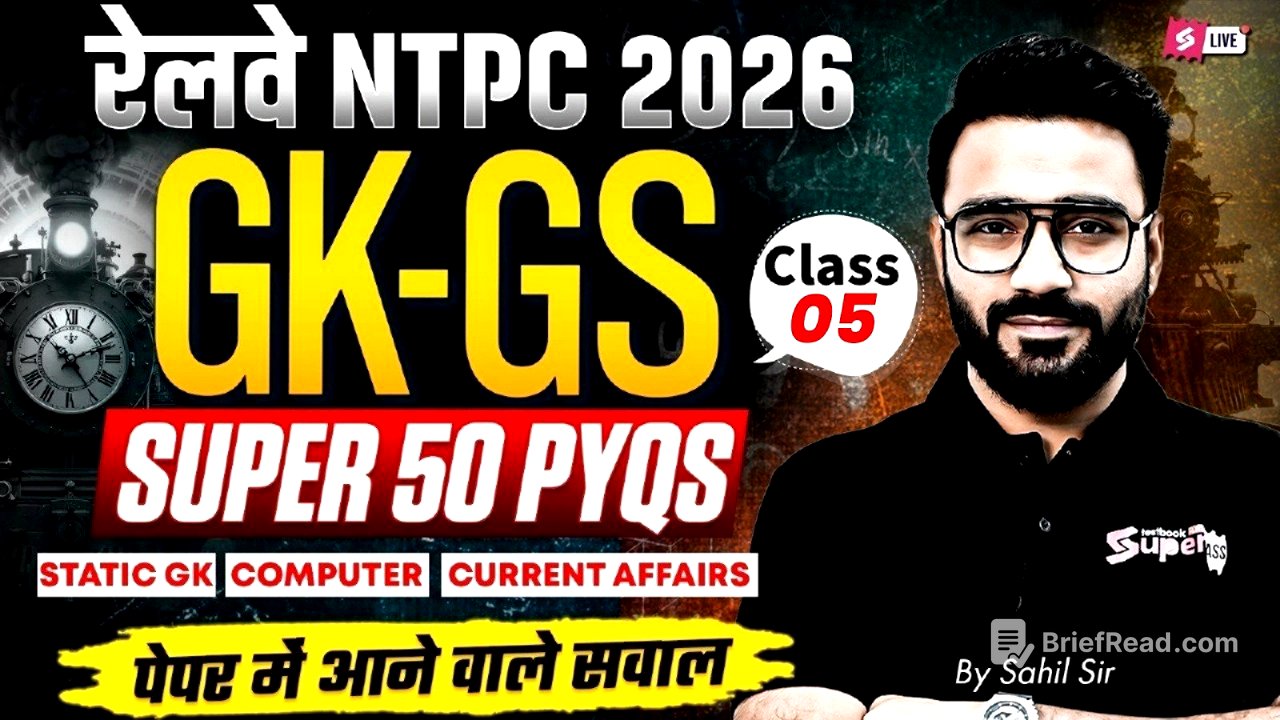
This YouTube video by Railway Testbook is a comprehensive GK/GS and current affairs session aimed at students preparing for various railway exams like NTPC, Group D, and RPF. The session includes 50 questions covering topics from geography and economics to polity and science, with detailed explanations and additional facts. The instructor also discusses upcoming resources like a GK/GS book and a new NTPC batch, and provides guidance on how to access these resources and other study materials through the Railway Testbook platform.
- Covers GK, GS, Current Affairs, and Static GK relevant for railway exams.
- Includes 50 questions with detailed explanations.
- Discusses upcoming GK/GS book and NTPC batch.
- Provides guidance on accessing study materials and discounts.
Introduction [0:04]
The instructor welcomes students preparing for various railway exams, emphasizing that the class covers GK, GS, current affairs, and static GK. He mentions the presence of Vinay Sir, who just finished his class. They briefly discuss a surprising AL P exam where reasoning and math dominated, with fewer science questions than expected, drawing a parallel to a section controller exam mix-up. The instructor assures students that attending the 5 PM (Reasoning), 6 PM (Vinay Sir's class), and 7 PM classes will help them succeed in their railway exams, highlighting that questions are directly coming from these classes.
Question 1: Narmada's Handmaid [3:14]
The first question asks which river is known as the "Handmaid of Narmada." The correct answer is the Tapi River. The instructor explains that both rivers flow between the Vindhya and Satpura ranges in South India and drain into the Arabian Sea, hence the comparison.
Question 2: Vembanad Lake [4:19]
The question is about the location of Vembanad Lake, which is India's longest lake. The correct answer is Kerala. The instructor provides additional facts about other significant lakes in India, such as Wular Lake (largest freshwater lake in Jammu & Kashmir), Chilka Lake (largest saltwater lake in Odisha), Cholamu Lake (highest altitude lake in Sikkim), and Sambhar Lake (highest salinity lake in Rajasthan).
Question 3: Pranhita Wildlife Sanctuary [5:32]
The question asks about the location of the Pranhita Wildlife Sanctuary. The correct answer is Telangana.
Question 4: Climate and Health Africa Conference [5:48]
The question is about the location of the Climate and Health Africa Conference in 2024. The correct answer is Zimbabwe. The instructor recalls the Under-19 World Cup, where India defeated England by 100 runs in the final match held at the Harare Stadium in Zimbabwe. He mentions Vaibhav Suryavanshi, who scored 175 runs and was named Man of the Match and Man of the Tournament.
Question 5: Core Economics - GDP [7:30]
The question defines the term for the total value of all goods and services produced within a country's borders over a specific period. The correct answer is GDP (Gross Domestic Product). The instructor explains how to calculate Net Domestic Product (NDP) by subtracting depreciation from GDP. He also explains how to derive Gross National Product (GNP) by adding Net Factor Income from Abroad (NFIA) to GDP, and how to calculate NFIA by subtracting imports from exports. He also explains how to calculate Net National Product (NNP) by subtracting depreciation from GDP and adding NFIA. National Income is referred to as NNP at Factor Cost (FC).
Question 6: Simhachalam Temple [10:17]
The question asks about the location of the Simhachalam Temple, which was recently in the news. The correct answer is Andhra Pradesh. The instructor mentions the discovery of ancient Telugu inscriptions and a Hanuman statue at the temple, located in Visakhapatnam. He also notes that the capital of Andhra Pradesh is Amaravati. The instructor asks the students whether they would prefer a GK/GS book in Hindi or English.
Question 7: Constituent Assembly Member [12:52]
The question asks which of the following was not a member of the Constituent Assembly of India. The correct answer is Mahatma Gandhi. The instructor explains that the Constituent Assembly was established in 1946 under the Cabinet Mission Plan. The drafting committee took 2 years, 11 months, and 18 days to create the constitution, involving 11 sessions and costing ₹46 lakh.
Question 8: Barahmasi River [14:21]
The question asks which of the following rivers is a "Barahmasi" (perennial) river in India. The correct answer is the Indus River. The instructor explains that perennial rivers are those that flow year-round, typically originating from the Himalayas. The Indus River originates from the Bokhar Chu Glacier near Mansarovar Lake in Tibet and flows through Tibet, India, and Pakistan.
Question 9: Monetary Policy Tools [15:46]
The question asks which of the following are tools of monetary policy. The correct answer is CRR (Cash Reserve Ratio) and SLR (Statutory Liquidity Ratio). The instructor explains that the Reserve Bank of India (RBI) uses monetary policy to control inflation and money supply. Other tools include the repo rate, reverse repo rate, bank rate, open market operations, and marginal standing facility rate.
Question 10: Deepam 2.0 Scheme [17:13]
The question asks which state government launched the Deepam 2.0 scheme to distribute free gas cylinders. The correct answer is Andhra Pradesh, under Chief Minister Chandrababu Naidu. The scheme aims to empower women by providing free gas cylinders. The instructor then asks about the central government scheme that provides free gas connections and cylinders, which is the Ujjwala Scheme.
Question 11: Ocean Tides [18:32]
The question defines the term for the rise and fall of ocean water twice a day. The correct answer is tides. The instructor explains that tides are caused by the gravitational forces of the sun and moon on the Earth's oceans.
Question 12: Writ of Habeas Corpus [19:32]
The question asks which writ is issued to secure the release of a person who has been unlawfully detained. The correct answer is Habeas Corpus. The instructor mentions that the power to issue writs lies with the Supreme Court under Article 32 and the High Courts under Article 226. He also mentions that the upcoming book will be topic-wise for better preparation.
Question 13: Alai Darwaza [21:50]
The question asks who built the Alai Darwaza, the southern gateway of the Quwwat-ul-Islam Mosque in Delhi. The correct answer is Alauddin Khilji.
Question 14: Factor of Production [22:23]
The question asks which of the following is not a factor of production. The correct answer is money. The instructor explains that land, labor, and capital are factors of production, and since capital includes money, money alone is not a separate factor.
Question 15: Exercise Garuda Shakti [23:05]
The question asks with which country India conducts the Exercise Garuda Shakti. The correct answer is Indonesia. The instructor lists other joint military exercises, including Yudh Abhyas (India-US), Varuna (India-France), Cyclone (India-Egypt), Malabar (India-Quad countries), Dharma Guardian (India-Japan), Nomadic Elephant (India-Mongolia), Mitra Shakti (India-Sri Lanka), and Dustlik (India-Uzbekistan).
Question 16: Red Fort and Jama Masjid [24:06]
The question asks who built the Red Fort and Jama Masjid in Delhi. The correct answer is Shah Jahan. The instructor lists other structures built by Shah Jahan, including the Taj Mahal, Moti Masjid (Agra), Shalimar Garden (Lahore), Khas Mahal (Agra), and Shahjahanabad (Old Delhi).
Question 17: Thado Tribe [24:55]
The question asks in which state the Thado tribe resides. The correct answer is Manipur. The instructor mentions other tribes in Manipur, acknowledging how difficult it is to remember all the names.
Upcoming Resources and Exam Strategy [26:03]
The instructor announces an upcoming new batch for NTPC and a complete GK/GS book, which will include a free one-year current affairs PDF. A math book is also in the works. He emphasizes that the focus is on helping students clear their exams. He also mentions that the last NTPC exam had questions within the syllabus.
Question 18: Iron Man of India [27:11]
The question asks who is known as the Iron Man of India. The correct answer is Sardar Vallabhbhai Patel. He also mentions that Lala Lajpat Rai is known as Punjab Kesari.
Question 19: Chemical Symbol of Arsenic [28:02]
The question asks for the chemical symbol of arsenic. The correct answer is As. The instructor also provides the symbols for argon (Ar), actinium (Ac), and silver (Ag).
Question 20: Upper House of Parliament [28:39]
The question asks which is the upper house of the Indian Parliament. The correct answer is Rajya Sabha. The instructor explains that the Parliament consists of the Lok Sabha, Rajya Sabha, and the President (Articles 79, 80, 81, and 52-62, respectively). The Lok Sabha is the lower house, and the Rajya Sabha is also known as the Council of States or the House of Elders.
Question 21: No-Confidence Motion [29:40]
The question asks who has to resign if a no-confidence motion is passed in the Lok Sabha. The correct answer is the Council of Ministers. The instructor explains that a no-confidence motion can only be introduced in the Lok Sabha with the support of 50 members. If passed, the entire Council of Ministers must resign, leading to re-elections.
Question 22: Approval for a Bill to Become Law [31:01]
The question asks whose approval is required for a bill passed by the Parliament to become law. The correct answer is the President.
Question 23: Net Worth [31:28]
The question defines the term used to describe the total value of a company's assets minus its liabilities. The correct answer is net worth.
Question 24: Joint Session of Parliament [32:29]
The question asks who presides over a joint session of the Lok Sabha and Rajya Sabha. The correct answer is the Speaker of the Lok Sabha. The instructor explains that the President can call a joint session if a bill passed by the Lok Sabha is not being passed by the Rajya Sabha. The joint session is called under Article 108, and the concept was borrowed from Australia.
Question 25: Spreadsheet Software [33:43]
The question asks in which field spreadsheet software is used. The correct answer is statistics.
Question 26: M-Commerce [34:08]
The question asks what is M-commerce. The correct answer is mobile commerce, which refers to shopping done via mobile phones.
Question 27: Gas in Coal Mines [34:52]
The question asks which gas is responsible for explosions in coal mines. The correct answer is methane, also known as marsh gas. The instructor urges viewers to like and subscribe to the channel.
Question 28: Firecracker Explosion [35:57]
The question asks what is the term for a firecracker explosion. The correct answer is combustion.
Question 29: Deodorant Ingredient [36:23]
The question asks what is used in antiperspirant deodorants. The correct answer is aluminum.
Question 30: 86th Amendment Act [37:03]
The question refers to the amendment act that provides free and compulsory education to children between 6 and 14 years. The correct answer is the 86th Amendment Act of 2002, which added Article 21A and a fundamental duty.
Question 31: Space Exercise 2024 [37:42]
The question asks where the inauguration of the space exercise "Antariksh Abhyas 2024" took place. The correct answer is New Delhi. This is the first-ever space exercise conducted by the Defence Space Agency.
Question 32: Subansiri Lower Hydroelectric Project [38:21]
The question asks on the border of which two states is the Subansiri Lower Hydroelectric Project located. The correct answer is Assam and Arunachal Pradesh. The instructor mentions that Subansiri is a tributary of the Brahmaputra River.
Question 33: International Solar Alliance [39:19]
The question asks where the seventh session of the International Solar Alliance (ISA) was held. The correct answer is New Delhi. The instructor notes that the ISA was established in France and is headquartered in Gurgaon (Gurugram).
Question 34: Government of India Act 1858 [39:56]
The question asks which law took away all the powers of the East India Company. The correct answer is the Government of India Act 1858, which transferred the powers to the British Crown.
Question 35: Sir Thomas Roe's Visit [42:00]
The question asks in which year Sir Thomas Roe visited Jahangir's court. The correct answer is 1615. The instructor mentions that William Hawkins visited in 1609.
Question 36: Turtle Wildlife Sanctuary [42:36]
The question asks in which district of Uttar Pradesh is the Turtle Wildlife Sanctuary located. The correct answer is Varanasi.
Question 37: Number of Schedules in the Constitution [43:36]
The question asks how many schedules are there in the Indian Constitution. The correct answer is 12. Initially, there were eight schedules when the constitution was created.
Question 38: Right to Health [44:07]
The question asks under which article the right to health is given to every citizen of India. The answer is implied to be Article 21, which guarantees the right to life, though not explicitly stated. The instructor reviews Articles 19 (freedom), 20 (rights upon arrest), and 21A (right to education).
Question 39: Tropic of Cancer [44:54]
The question asks from which of the following states does the Tropic of Cancer pass. The correct answer is Tripura and Mizoram. The instructor lists all eight states through which the Tropic of Cancer passes: Gujarat, Rajasthan, Madhya Pradesh, Jharkhand, Chhattisgarh, West Bengal, Tripura, and Mizoram.
Question 40: Town Planning [45:48]
The question asks under which part does town planning comes. The correct answer is Part IX-A. The instructor explains the 73rd and 74th Amendments, which introduced Panchayats and Municipalities, respectively.
Question 41: First Country to Implement GST [47:27]
The question asks which country first implemented GST (Goods and Services Tax). The correct answer is France, in 1953. India implemented GST in 2017 through the 101st Amendment.
Question 42: Founder of the Mauryan Empire [47:52]
The question asks who was the founder of the Mauryan Empire. The correct answer is Chandragupta Maurya.
Question 43: Largest Saltwater Lake in India [48:01]
The question asks which is the largest saltwater lake in India. The correct answer is Chilka Lake in Odisha.
Question 44: Right to Education Article [48:12]
The question asks under which article the right to education is given to every citizen. The correct answer is Article 21A.
Question 45: Kala Pani [48:22]
The question asks which Indian territory was known as "Kala Pani" before independence. The correct answer is Andaman and Nicobar Islands.
Question 46: Residuary Powers [48:36]
The question asks who had the power to make laws on residuary subjects according to the Government of India Act 1935. The correct answer is the Governor-General of India. Now, the power lies with the Parliament. The instructor explains that residuary powers are for subjects not listed in the Union, State, or Concurrent Lists.
Question 47: Bills for Reconsideration [49:12]
The question asks which bill the President cannot return for reconsideration. The correct answer is a Money Bill. The President can return an ordinary bill once but cannot return a Money Bill or a Constitutional Amendment Bill.
Question 48: Japanese Word for Harbor Wave [50:06]
The question asks which Japanese word means "harbor wave." The correct answer is tsunami.
Question 49: Supreme Court Decisions [50:16]
The question states that any law declared by the Supreme Court is binding on all courts within India. This is stated in Article 141.
Conclusion and Resources [50:57]
The instructor concludes the class and asks students to share their scores in the comment box. He provides information on where to find the PDF of the class and how to access the NTPC batch. He guides viewers to the description of the class, where links for the NTPC Pragyan Batch, Group D Abhiyan Batch, and the PDF are available. He explains how to join the Telegram channel for the PDF and how to access the NTPC and Group D batches. He recommends using the coupon code "AVS" to get a discount and additional benefits like a 1000-question PDF, 10 mock tests, and access to a paid Telegram channel for discussions and guidance. He encourages students to like the class, subscribe to the Railway Testbook channel, and join Abhinandan Sir's math class next.