
TLDR;
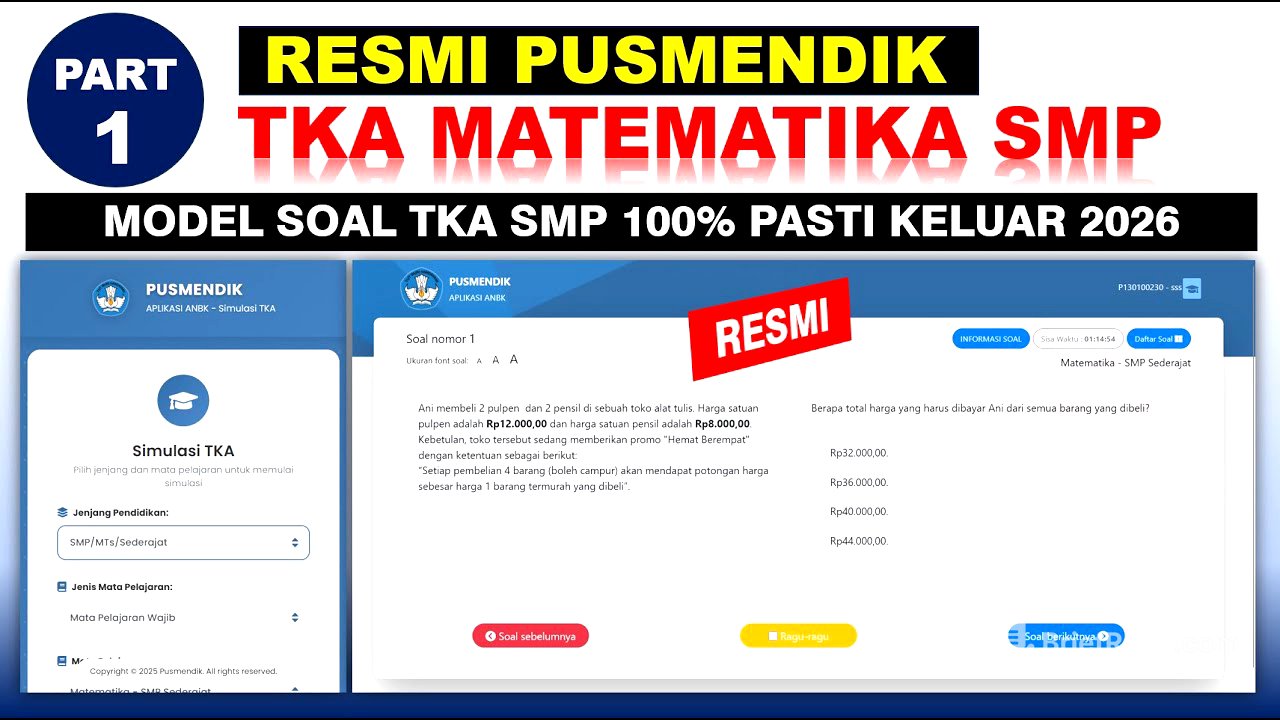
This video provides a step-by-step walkthrough of a mathematics test simulation from pusmendikkemdikbud.go.id, designed for students preparing for mandatory exams. It covers the test format, question types, and strategies for solving problems, including practical examples with detailed explanations.
- Test simulation from official source
- Covers various math problems
- Step-by-step explanations
Introduction to the Test Simulation [0:00]
The video introduces a mathematics test simulation for SMP (Sekolah Menengah Pertama - Junior High School) students, sourced directly from pusmendikkemdikbud.go.id. The presenter emphasizes that this is an official resource from the government, making it highly relevant for students preparing for mandatory exams. The tutorial begins with logging into the test platform, inputting a sample name (Duvid) and birthdate, and entering the provided token to access the test.
Navigating the Test Interface [0:59]
The presenter describes the test interface, highlighting key elements such as the question number, remaining time (1 hour 14 minutes initially), the question itself, and a list of all 30 questions. The test duration is 75 minutes, allocating approximately 2.5 minutes per question. The interface allows users to mark questions for review ("ragu-ragu") and navigate between questions in order or by direct selection.
Question Types Overview [2:19]
The video reviews the different types of questions featured in the test. These include standard multiple-choice questions, multiple-choice questions with multiple correct answers, and literacy-numeracy questions that require reading a passage, performing calculations, and answering related questions. There are also true/false questions, where only one option can be selected.
Problem 1: Applying Discount [3:40]
The first problem involves calculating the total cost of Ani's purchase of two pens and two pencils, considering a "buy four get discount" promotion. The pens cost Rp12,000 each and the pencils cost Rp8,000 each. Without the discount, the total would be Rp40,000. However, the promo gives a discount equal to the price of the cheapest item (Rp8,000), reducing the total to Rp32,000.
Problem 2: Estimating Price [6:31]
The second problem requires estimating the cost of 19.6 kg of rice if 1 kg costs Rp12,750. This is framed as a direct proportion problem: as the quantity of rice increases, so does the price. The presenter suggests approximating 19.6 kg to 20 kg and Rp12,750 to Rp12,500 for easier calculation. The estimated cost is 20 * Rp12,500 = Rp250,000. The correct answers are that the price is less than Rp260,000 and more than Rp240,000.
Problem 3: Finding Common Factors [10:05]
The third problem involves finding the common factors of three given numbers: 33² - 3², 8² + 296, and 36 * 35. The presenter uses prime factorization to break down each number into its prime factors. 33² - 3² is simplified to 36 * 30 and then factored. 8² + 296 is calculated as 360 and then factored. 36 * 35 is factored directly. The common factors are then identified by comparing the prime factorizations of all three numbers.
Problem 4: Calculating Maximum Volume [15:32]
The fourth problem involves calculating the maximum volume of a disinfectant solution made from liquids A and B, given the ratio A:B = 3:5 and that 2.5 liters of liquid B are available. The amount of liquid A needed is calculated using the ratio, resulting in 1.5 liters. The maximum volume of the solution is then the sum of the volumes of A and B, which is 1.5 + 2.5 = 4 liters.
Problem 5: Calculating Total Price of Goods [17:42]
The fifth problem involves calculating the total cost of 2 1/4 kg of chili peppers, given that 1/2 kg costs Rp35,000. The problem is set up as a direct proportion. 2 1/4 is converted to the improper fraction 9/4. By cross-multiplying and simplifying, the total cost is found to be Rp157,500.
Continuation in the Next Video [20:19]
The presenter announces that problems 6 through 30 will be discussed in the next video.






![The Shadow of Hate: A History of Intolerance in America (1995) [HIGH QUALITY]](https://wm-img.halpindev.com/p-briefread_c-10_b-10/urlb/aHR0cDovL2ltZy55b3V0dWJlLmNvbS92aS83bnlGLUNlSDVzSS9ocWRlZmF1bHQuanBn.jpg)