TLDR;
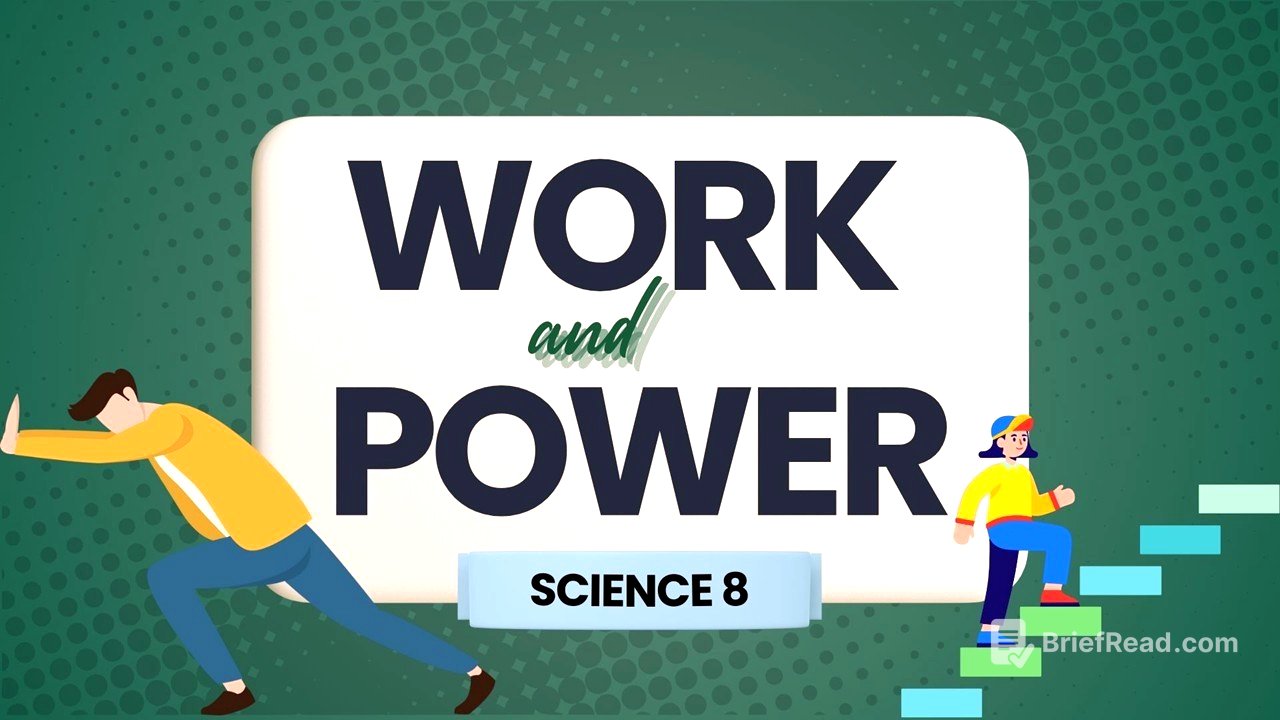
This video provides a comprehensive explanation of work and power in physics. It clarifies the definitions of work and power, explains the conditions necessary for work to be done, and provides formulas for calculating work and power in various scenarios. The video also includes practical examples and problem-solving exercises to help viewers understand and apply the concepts.
- Work is done when a force causes displacement of an object in the same direction.
- Power is the rate of doing work, indicating how quickly work is completed.
- Formulas for work include W = Fd (when force and displacement are parallel) and W = Fd cosθ (when force and displacement are at an angle).
- The formula for power is P = W/t (power equals work divided by time).
Intro [0:00]
The video introduces the concepts of work and power in physics, emphasizing that these terms have specific meanings different from everyday usage. It highlights that this topic is relatively easy to understand and teach, making it suitable for classroom observation. The learning objectives include recognizing work as force causing displacement, understanding power as the rate of doing work, and solving related problems.
Review Task: Work or No Work [3:03]
The video starts with a review activity where viewers guess whether work is done in different situations. Examples include a student pushing a car that doesn't move (no work), lifting a book from the floor to a table (work), walking with a backpack at a constant height (no work), pulling a toy cart (work), and pushing against a wall that doesn't move (no work). These scenarios set the stage for understanding the specific conditions under which work is considered to be done in physics.
Unlocking Vocabulary: Work and Power [4:51]
This section focuses on defining key vocabulary terms related to work and power. Terms include displacement (the shortest distance from initial to final point), force (a push or pull on an object), parallel vectors (vectors in the same direction), time (duration of events), and perpendicular vectors (vectors forming a right angle). Understanding these terms is crucial for grasping the concepts of work and power.
Understanding the Concept of Work [6:00]
The video explains that in physics, work has a specific meaning: it is done when a force applied to an object causes it to move. Not all activities requiring effort are considered work in physics. For work to be considered, a force must be applied, the object must have displacement, and the force and displacement must be parallel or in the same direction.
Conditions for Work [8:22]
The conditions for work to be considered in physics are detailed: a force must be applied, the object must experience displacement, and the force and displacement must be in the same direction (parallel). The video revisits the initial review examples to explain why some scenarios involved work while others did not, based on these conditions.
Formula for Work [12:36]
The video introduces the formula for calculating work: Work = Force × Displacement (W = Fd). It also presents a special formula for situations where the force and displacement are at an angle: Work = Force × Displacement × Cosine(θ) (W = Fd cosθ). The units for work are explained as joules, with a review of the units for force (newtons) and displacement (meters).
Identifying Work in Different Situations [14:20]
Practical examples are provided to illustrate work in different scenarios, such as pushing a box, lifting a book, and pulling a cart. The concept of negative work is introduced, which occurs when the force and displacement are in opposite directions, such as when friction opposes the direction of motion. Situations where no work is done, like holding a heavy bag without moving or pushing a wall that doesn't move, are also explained.
Work Done by an Oblique or Angle Force [17:40]
The video addresses situations where the force is applied at an angle, such as pulling a suitcase with a handle. In these cases, the formula Work = Force × Displacement × Cosine(θ) is used. It is emphasized that if the angle is 90 degrees, no work is done.
Problem Solving Challenge: Work [19:52]
The video presents several sample problems to calculate work. These problems include scenarios such as a forklift lifting a load, calculating the force exerted on a rock, and determining the work done when pulling a box at an angle. The step-by-step process of identifying given values, required values, formulas, solutions, and answers is demonstrated.
Exploring Power: Problem Solving [25:53]
The video transitions to explaining the concept of power, defining it as the rate of doing work. The formula for power is introduced as Power = Work / Time (P = W/t), with the unit for power being joules per second or watts. The relationship between work and power is highlighted, emphasizing that power indicates how quickly work is completed.
Sample Problem: Power [27:50]
The video provides sample problems to calculate power. One example involves volunteers pushing a vehicle, requiring the calculation of work before determining the power exerted. Another problem involves lifting a box, where the time taken to complete the task is calculated using the given power and force.
Formative Assessment: Multiple Choice [30:40]
A multiple-choice quiz is presented to assess understanding of work and power. Questions cover calculating work done by lifting an object, determining power output, and converting units. These questions reinforce the application of the formulas and concepts discussed in the video.
Formative Assessment: True or False [33:42]
A true or false quiz is presented to assess understanding of work and power. Statements cover the nature of work as a scalar quantity, the relationship between work and power, and the conditions for maximum work. The quiz reinforces the application of the formulas and concepts discussed in the video.