TLDR;
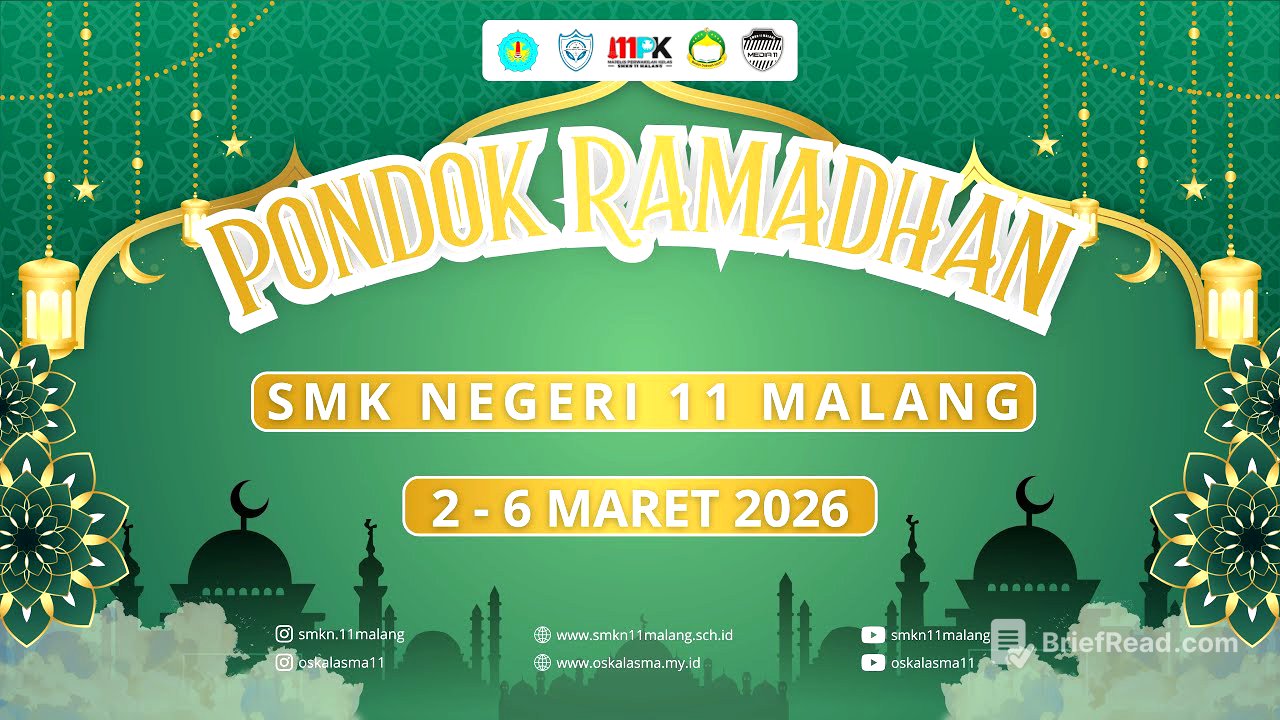
This video captures a Ramadan event at SMKN 11 MALANG, featuring prayers, quizzes, Quran readings, and motivational speeches. The event aims to inspire students to embrace good deeds, discipline, and teamwork, emphasizing the importance of personal responsibility and continuous self-improvement.
- The event includes interactive sessions, quizzes, and Quran readings.
- Motivational speeches focus on discipline, teamwork, and personal responsibility.
- Students are encouraged to apply these principles in their daily lives and future careers.
Salat Duha and Event Guidelines [0:25]
The event begins with instructions for Salat Duha, encouraging all participants to engage in the prayer. Coordinators are tasked with managing their groups, ensuring order and preventing disruptive behavior such as talking or joking. Absences are noted, and participants are reminded to cooperate to maintain a focused environment.
Quiz Time [2:35]
To fill time before Salat Duhr, a quiz is proposed. The quiz involves participants answering Ramadan-related questions, with correct answers earning prizes. The quiz aims to be engaging and educational, reinforcing knowledge about Ramadan.
Maintaining Order and Introducing Quran Recitation [11:56]
Participants are urged to maintain order, with male students encouraged to set a positive example. Students are asked to remind their peers to stay quiet and focused. The next segment involves a collective recitation of the Quran, led by Maulana Hadislani Kanafi.
Quran Recitation [13:47]
Maulana Hadislani Kanafi leads the recitation of verses from the Quran, including Surah Al-Fatihah and selections from other Surahs. The recitation is performed with proper Tajwid, emphasizing clarity and reverence.
Reflections on Fasting [35:34]
The hosts reflect on the ongoing Ramadan, noting it's the 12th or 13th day of fasting. They inquire about participants' fasting experiences, including whether anyone has missed a day. The discussion transitions to the upcoming Eid al-Fitr celebrations.
First Material: Conditions of Fasting [40:29]
The first speaker discusses the conditions required for fasting in Islam. These include being Muslim, of age, free from menstruation (for women), and of sound mind. Children are not obligated to fast, and the speaker expresses confidence in the students' understanding and adherence to these conditions.
Importance of Intonation and Response [41:49]
The speaker emphasizes the importance of responding appropriately to greetings, adjusting intonation to match the tone of the greeting. The speaker connects this to the broader principle of receiving responses based on one's actions and treating others well.
The Story of Farid: Initiating Good Deeds [55:13]
The speaker shares a story about a student named Farid who took the initiative to clean a dirty bathroom at SMK 11. Despite initial mockery, Farid's consistent efforts inspired others to join him, eventually leading to a cleaner school environment. The story illustrates the power of individual initiative and perseverance in promoting good deeds.
Identifying and Addressing Local Issues [1:04:55]
The speaker instructs the students to identify a small problem in their environment and propose a simple action to address it. Examples include cleaning up trash or improving mosque facilities. Students share their identified problems and proposed solutions, emphasizing personal responsibility and proactive problem-solving.
Lessons from the Exercise and Quranic Guidance [1:15:39]
The speaker reflects on the exercise, noting that everyone knows what needs to be done but often lacks the motivation to act. The speaker references the first verse revealed to Prophet Muhammad (PBUH), "Iqra," emphasizing the importance of observing and learning from one's surroundings. The speaker encourages students to start with small acts of kindness and not delay good deeds.
Examples of Good Deeds from Islamic History [1:21:58]
The speaker discusses examples of good deeds from Islamic history, including Prophet Ibrahim's (AS) courage in destroying idols and Prophet Muhammad's (PBUH) resilience in the face of adversity. These stories encourage students to emulate the prophets' dedication to righteousness, even when facing challenges.
Closing Remarks and Dua [1:36:00]
The speaker concludes by urging students to start good deeds immediately, emphasizing that personal responsibility and initiative are essential. The session ends with a collective recitation of Salawat and a heartfelt Dua for the well-being and success of the students and their families.
Reflection and Zakat Fitrah Announcement [1:41:14]
The hosts announce that the first material is complete and students can fill out their modules. They also announce the dates for Zakat Fitrah collection, specifying the amount of rice or money to be contributed.
Completing Reflections and Infak Announcement [1:48:37]
Students are given time to complete their reflections. The hosts announce that there will be an infak collection, encouraging students to donate as they are able.
Second Material Introduction [1:55:19]
The hosts introduce the second material, and the speaker, AD Irwan Sunarya, is welcomed.
Introduction and Rules [1:56:29]
AD Irwan Sunarya introduces himself and sets the ground rules for his session. He emphasizes that he will not be speaking in Javanese and that students are free to engage as they wish, but they must be able to answer questions and practice what he teaches. He values truth and accuracy above all else.
Background and Experience [2:01:37]
AD Irwan Sunarya shares his background, including his experience as a radio announcer, MC, and staff protocol for the Regent of Bulungan. He highlights his diverse experiences, from hosting metal concerts to managing official events, to establish his credibility and connect with the students.
The Difference Between Smart and Foolish [2:09:07]
The speaker contrasts smart and foolish approaches to starting a business. Smart people overthink and complicate the process, while foolish people take action and learn as they go. He encourages students to prioritize action over excessive planning.
Controlling What You Can [2:10:54]
The speaker introduces the concept of controlling what you can and not focusing on what you cannot. He uses the analogy of the right hand (things you can control) and the left hand (things you cannot control). He advises students to focus on their own actions and responses rather than trying to control others' opinions or behaviors.
Stop Overthinking and Start Moving [2:14:55]
The speaker urges students to stop overthinking and start taking action. He encourages them to develop their skills and become experts in their chosen fields, so that people will seek them out and value their expertise.
PKL and Discipline [2:17:01]
The speaker emphasizes that practical work experience (PKL) is not just a trial but a real-world learning opportunity. He stresses the importance of discipline, punctuality, and professionalism in the workplace. He warns that a lack of discipline can lead to termination.
Discipline is for Yourself [2:23:21]
The speaker highlights that discipline is not for bosses or superiors but for oneself. He explains that discipline is about self-respect and personal integrity. He encourages students to maintain high standards for themselves, regardless of external pressures.
Teamwork and Responsibility [2:30:10]
The speaker emphasizes the importance of teamwork and collective responsibility. He explains that the actions of one individual can affect the entire team or institution. He urges students to be mindful of their behavior and its potential impact on their school and community.
Personal Experiences and Encouragement [2:32:51]
The speaker shares personal experiences of overcoming unemployment by maintaining a positive attitude and helping others. He encourages students to believe in themselves, develop their skills, and contribute to their teams.
Controlling What You Can (Reprise) [2:41:18]
The speaker revisits the concept of controlling what you can, urging students to focus on their own responses and actions rather than external factors. He encourages them to channel their energy positively and not be consumed by negativity.
Closing and Istighfar [2:44:23]
The speaker concludes by expressing his hope that his words have inspired the students to become better individuals. He emphasizes that the responsibility for success lies with each individual. The session ends with a collective recitation of Istighfar and Dua.
Reflection and Instructions [2:46:36]
The hosts instruct the students to complete the reflection in their modules and announce that they will have 15 minutes to do so.
Reflection Time and Feature Announcement [2:55:47]
Students are given time to complete their reflections. The hosts mention a feature and ask if it has been tried yet.
Review of Material [2:57:29]
The hosts ask a student to summarize the material presented by Kak Ahmad. The student highlights the importance of starting rather than just planning and the importance of maintaining discipline.
Writing Quranic Verses [3:01:10]
The next activity involves writing Quranic verses from Surah At-Taubah and Surah Al-Hujurat in the modules. Students are instructed to write neatly, accurately, and without errors, following proper Quranic writing rules.
Quran Recitation Preparation [3:38:32]
The hosts prepare for another Quran recitation session, requesting cooperation from the students. Kak Maulana is invited to lead the recitation.
Quran Recitation [3:44:41]
Kak Maulana leads the recitation of various Surahs from the Quran.
Closing Remarks [4:13:14]
The hosts express their gratitude to the students and Kak Maulana for their participation. They apologize for any shortcomings and conclude the event by reciting Alhamdulillah together.
Final Instructions [4:18:57]
The coordinators are reminded to collect the modules. Students are instructed to prepare for Salat Zuhur.