TLDR;
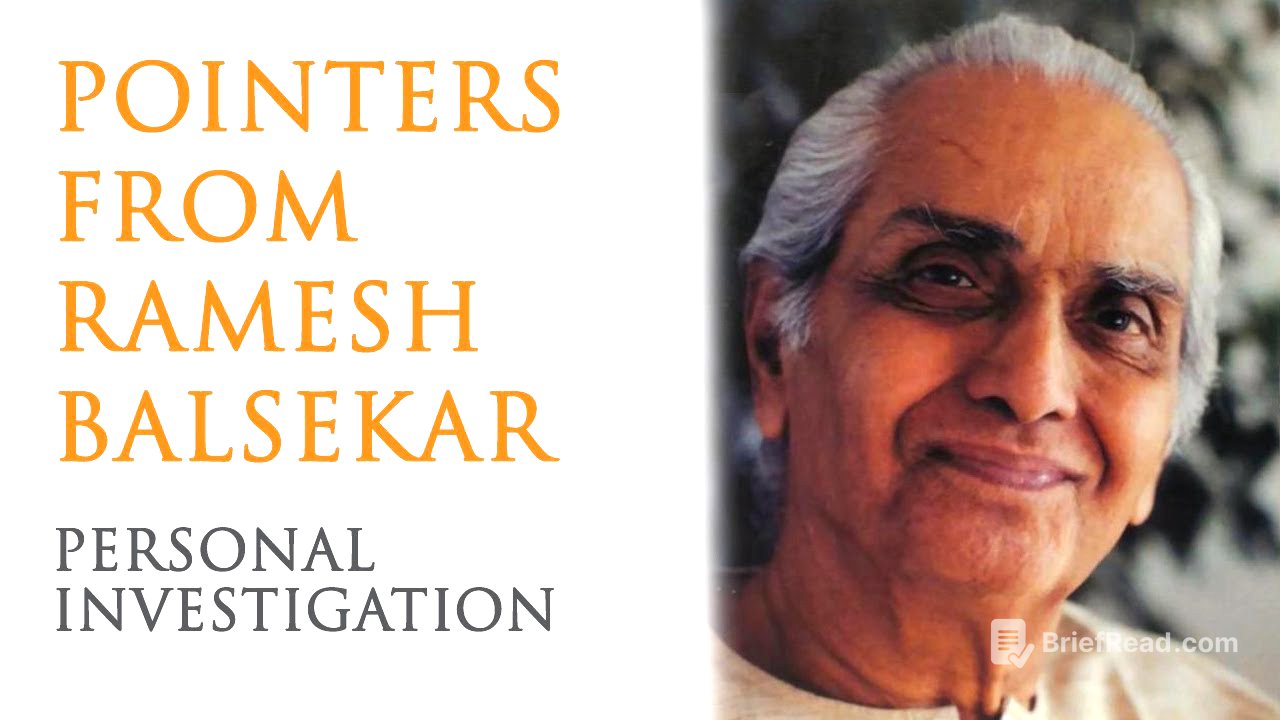
This video explores the concept of personal investigation as a path to understanding enlightenment, distinguishing between the sudden flash of enlightenment and the gradual process of integrating this understanding into daily life. It uses the story of William Tell and everyday examples to illustrate how many events and actions are beyond our control, challenging the notion of individual agency and emphasizing the importance of accepting the present moment and trusting in a higher power.
- Personal investigation involves reviewing daily events to recognize the limited control we have over our actions.
- Enlightenment is a sudden realization of the interconnectedness of all things and the acceptance of a higher power.
- Deliverance is the gradual integration of this understanding into daily life, leading to increased equanimity and peace of mind.
Personal Investigation as a Practice [0:33]
Ramesh suggests personal investigation as a simple yet profound practice. This involves reviewing the day's events in a relaxed setting, such as sitting in a comfortable chair with a beverage, to recognize how many occurrences were beyond one's control. The process entails identifying a specific action believed to be self-initiated and questioning whether it truly was a conscious decision or a result of a thought. The arising of that thought led to the action, highlighting the lack of control over the origin of thoughts. External stimuli like sights, smells, or sounds often trigger actions, further emphasizing the limited control we have over our responses.
Questioning the Notion of Individual Action [1:41]
The investigation continues by questioning whether actions are truly our own, considering the myriad factors beyond our control that lead to them. The speaker illustrates this point by recounting how seekers from distant lands managed to reach Ramesh's doorstep, emphasizing the collaboration of the universe in making that journey possible. The thought to visit Ramesh itself arises from an unknown origin. By repeatedly investigating actions and realizing "not my action," one may eventually reach the understanding that they are not the doer of their actions. The example of friendships is used to illustrate how random encounters and uncontrollable events lead to these relationships.
The Story of William Tell [4:47]
The story of William Tell is presented to illustrate the series of uncontrollable events that lead to specific outcomes. William Tell's refusal to bow to the tyrant's hat leads to a series of events, including the apple-shooting challenge. Despite the immense pressure, William Tell's skill allows him to shoot the apple without harming his son. The presence of a second arrow, intended for the tyrant, leads to further complications. Ultimately, a storm allows William Tell to escape and eventually kill the tyrant with the second arrow. The speaker emphasizes that numerous events beyond William Tell's control, such as the storm and the tyrant's initial act of hanging the hat, conspired to create the final outcome.
Recognizing the Limits of Control [8:21]
The speaker continues to illustrate the limits of control with everyday examples, such as the inability to choose when to fall asleep or wake up. Even with an alarm clock, the waking up is triggered by an external agent. The impact of the moon on the body, particularly for women, is another example of an uncontrollable influence. Despite these limitations, there is a persistent need to feel in control. The speaker points out that essential elements like the sun are freely given, yet often taken for granted, while we focus on the illusion of controlling our lives.
Enlightenment as a Sudden and Gradual Process [10:06]
The speaker addresses whether enlightenment is a sudden or gradual process, comparing it to climbing a flight of stairs. Enlightenment can occur suddenly, like the shift between the 99th and 100th step, but it is preceded by a gradual climb. Enlightenment is defined as the clear understanding that all there is is the source, consciousness, or God. Deliverance, on the other hand, is the integration of this understanding into daily living, which involves dealing with situations as they arise and trusting in a higher power. Enlightenment is sudden, while deliverance is gradual.
Deliverance and Integration into Daily Life [11:18]
The flash of total acceptance that one cannot be the doer of any deed is sudden, but living daily life with this sense of non-duality is gradual. The speaker uses the analogy of learning to drive: obtaining a license is one thing, but becoming a seasoned driver who can navigate heavy traffic without stress takes time. Similarly, deliverance is realized in retrospect when one notices they are more equanimous and less reactive than before. This peace of mind and change in reaction is the essence of deliverance, highlighting a gradual shift in perspective and behavior.