TLDR;
This lecture discusses the political structure introduced by the Spanish colonial government in the Philippines, the colonial policies implemented, native responses to these policies, and the causes of early uprisings. It covers the centralized form of government, the roles of various officials, and the countervailing institutions meant to check abuses. The lecture also examines taxation, forced labor, government monopolies, harsh agrarian policies, and the reasons behind the fragmented revolts before the 1896 revolution.
- The Spanish introduced a centralized government structure.
- Colonial policies included taxation, forced labor, and government monopolies.
- Early uprisings were fragmented due to varying grievances.
Introduction [0:04]
The lecture begins with a greeting and an introduction to the topic: the political structure of the colonial society introduced by the Spaniards. It mentions a handout provided earlier and promises a recap of the political structure, covering the central government down to the barangay level.
Political Structure of the Colonial Government [0:49]
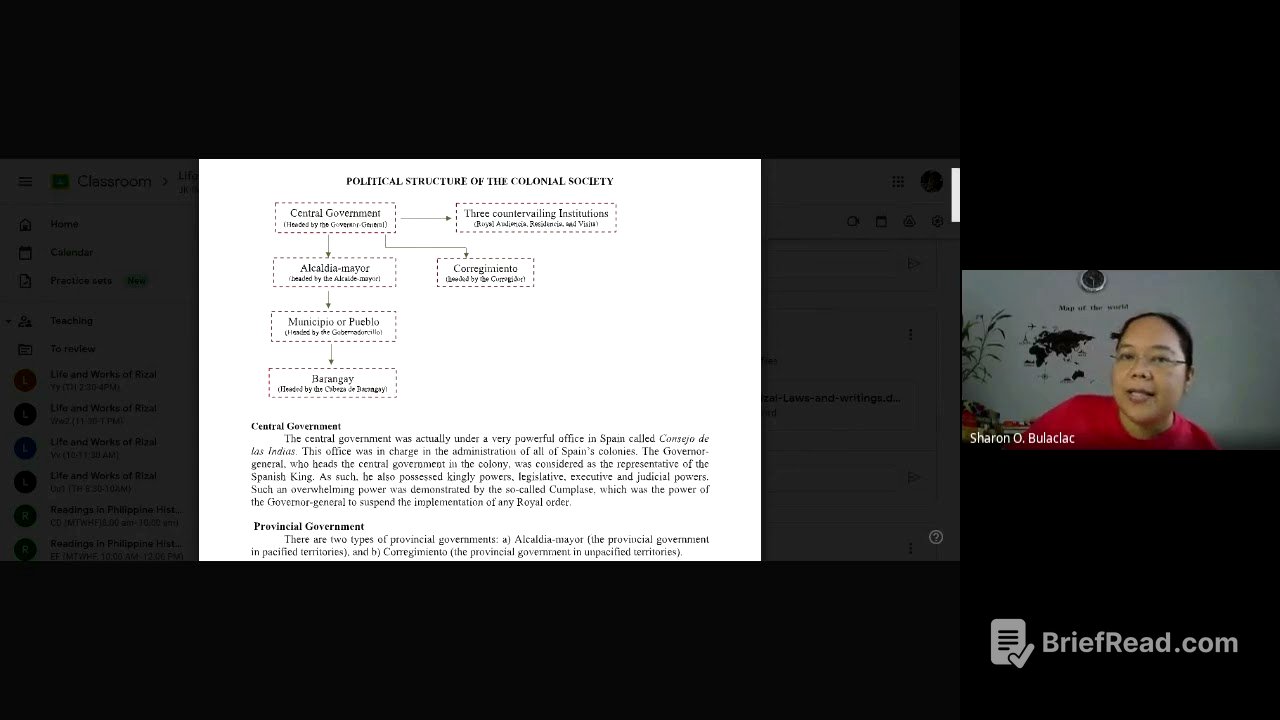
The Spanish introduced a centralized form of government, replacing the pre-colonial barangay system. This structure included the central government headed by the Governor-General, followed by the Alcaldía Mayor, Municipios (headed by the Governorcillo), and the Barangay. Alongside the Alcaldía Mayor was the Corregimiento, representing unpacified territories. Pacified areas transitioned to Alcaldía Mayor status. The Governor-General held significant power, encompassing executive, legislative, and judicial functions. Three countervailing institutions—Royal Audiencia, Residencia, and Visita—were meant to check abuses, but their effectiveness was limited due to the Governor-General's influence and widespread corruption.
Countervailing Institutions: Expectation vs. Reality [3:44]
The lecture explains the three countervailing institutions designed to check the power of the Governor-General: the Royal Audiencia (like the Supreme Court), the Residencia (investigation of the outgoing Governor-General by the incoming one), and the Visita (secret investigation by the Council of the Indies). However, these institutions were often ineffective. The Governor-General appointed judges to the Royal Audiencia, compromising its ability to check his power. The Residencia was often abused for extortion, and the Visita was easily compromised due to the small Spanish population in the Philippines. Corruption was rampant, with positions often bought and exploited for profit. Political instability in Spain further exacerbated the problem, leading to frequent changes in leadership and a focus on immediate financial gain.
Corruption and its Roots in the Colonial System [8:35]
The Spanish colonial government influenced the system of corruption in the Philippines. Filipinos were limited to positions at the municipality or pueblo level, such as Gobernadorcillo and Cabeza de Barangay, who were responsible for tax collection. These officials often exploited their positions to enrich themselves, collecting more than the prescribed amount and pocketing the excess. This practice contributed to the entrenchment of corruption. The traditional Bayanihan system was replaced by a system that encouraged corruption.
Colonial Policies: Taxation [13:16]
The lecture transitions to colonial policies and native responses, focusing on taxation. The tribute, a payment by natives recognizing Spanish sovereignty, was eventually replaced by the cedula, a graduated poll tax based on income. The cedula also served as identification. Compulsory contributions to the church, such as for novenas and bell ringing, were also imposed.
Colonial Policies: Forced Labor [14:50]
Forced labor, or polo y servicios personales, required able-bodied men aged 16 to 60 to render labor for 40 days. These laborers, called polistas, were supposed to receive rations and allowances, but these provisions were often not provided. Spanish officials exploited the system for personal gain by adding names to the list of polistas and pocketing the provisions. Exemption from forced labor could be obtained by paying a falla, but many could not afford it due to existing taxes and contributions.
Colonial Policies: Government Monopolies [19:51]
Government monopolies included the Bandala system, the Galleon Trade, and the Tobacco Monopoly. The Bandala system required natives to sell their products to government stores, with each province meeting certain quotas. The Tobacco Monopoly designated certain provinces to exclusively plant tobacco, leading to scarcity of food and famine. Farmers faced abuses such as cheating in the grading of tobacco leaves and payment in promissory notes. The Galleon Trade, officially known as the Manila-Acapulco trade, primarily benefited the Spanish, with limited participation from Filipinos. The Spanish were paranoid about outside forces and suppressed international trade, focusing instead on the Galleon Trade.
Colonial Policies: Harsh Agrarian Policies [24:51]
The Spanish implemented harsh agrarian policies using the Regalian Doctrine, which claimed all lands belonged to the King of Spain. This doctrine led to the loss of ancestral domains. The encomienda system, later replaced by the hacienda system, resulted in abuses and the displacement of many natives from their lands.
Causes of Early Uprisings [26:44]
The lecture discusses the causes of early uprisings against Spanish rule, categorizing them into religious uprisings, personal grievances, opposition to Spanish imposition, and agrarian complaints. Religious uprisings were fueled by the suppression of indigenous beliefs and practices. Personal grievances arose from mistreatment by government officials. Opposition to Spanish imposition included resistance to taxes, forced labor, and the tobacco monopoly. Agrarian complaints stemmed from the loss of land due to the hacienda system and lack of proper land surveying. These revolts were fragmented, lacking a unified goal against the Spanish. The lecture concludes by noting that it took a long time for Filipinos to realize their common grievance and unite against the Spaniards.