TLDR;
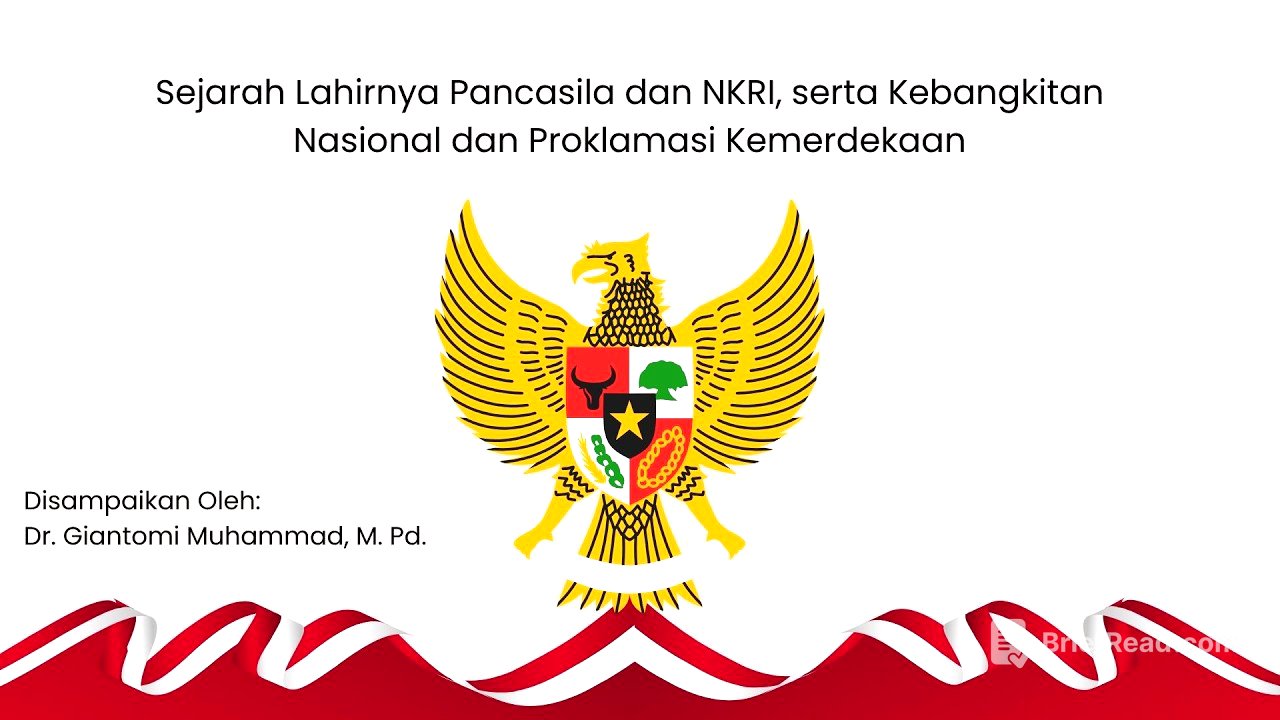
This video provides an overview of Pancasila, the foundational philosophical theory of Indonesia, and its historical context. It discusses the evolution of Pancasila from pre-independence periods to the present day, highlighting key events, ideologies, and figures involved in its establishment.
- Pancasila was articulated as the foundation of the Indonesian state during national discourse.
- Important historical events such as the 1945 Jakarta Charter and the adoption of the 1945 Constitution are discussed.
- The video emphasizes the ongoing relevance of Pancasila in modern Indonesia amidst challenges such as radicalism and social inequality.
Introduction to Pancasila [0:02]
The speaker opens with a greeting and introduces the topic of Pancasila, highlighting its significance as a course subject. The aim is to explore the historical development and application of Pancasila in daily life, specifically how it connects to the academic program.
Historical Context of Pancasila [0:24]
The history of Pancasila is essential for understanding its roots. The speaker emphasizes a quotation from Sukarno about the importance of remembering history. The chapter explains the various phases of Pancasila’s history, including events leading to its formation during Indonesia's struggle for independence.
Pre-Independence Period [2:08]
The speaker describes the historical roots of Pancasila, noting that elements such as divinity, humanism, unity, deliberation, and justice have already existed in Indonesian society before independence. Key developments such as Sukarno’s speech on June 1, 1945, are highlighted, marking the introduction of Pancasila as the state foundation.
Formation of Pancasila [2:34]
Details are provided on June 22, 1945, when Committee of Nine formulated the Jakarta Charter, representing the initial draft of the state foundation. The adoption of the 1945 Constitution on August 18, 1945, is also discussed, officially embedding Pancasila within the legal framework of Indonesia.
Post-Independence Challenges [3:34]
Post-independence, Pancasila faced political and ideological challenges, suggesting its practical application was continually tested. The reforms of the country led to a reaffirmation of Pancasila as the state ideology, indicating its importance in fostering national identity.
Sukarno's Contributions [11:17]
The speaker emphasizes Sukarno's role as a visionary leader who proposed key principles for the nation's foundation before the country's independence. These principles include nationalism, internationalism, democracy, social welfare, and religious tolerance, forming the bedrock for Pancasila’s establishment.
Adoption of the Jakarta Charter [13:26]
On June 22, 1945, the Jakarta Charter was established by the Committee of Nine, outlining the foundational principles of Pancasila. The differences in the initial proposals, particularly regarding the first principle about religious obligations, are discussed as significant points of debate.
Establishment of the 1945 Constitution [16:04]
The speaker shares the proceedings following Indonesia's declaration of independence on August 17, 1945, which led to the establishment and adoption of Pancasila as the state foundational ideology on August 18, 1945, during the first sessions of the Preparatory Committee for Indonesian Independence (PPKI).
Pancasila in Contemporary Indonesia [17:31]
The narrative transitions into how Pancasila functions in contemporary society amidst radical ideological challenges, emphasizing its foundational role in fostering democracy, social justice, and human rights in Indonesia.
Conclusion and Reflections [26:33]
The speaker summarizes the history and significance of Pancasila, encouraging its values to be upheld in personal and social life. The presentation concludes with a reaffirmation of Pancasila's relevance in facing current societal challenges and promoting unity within diverse Indonesian society.