TLDR;
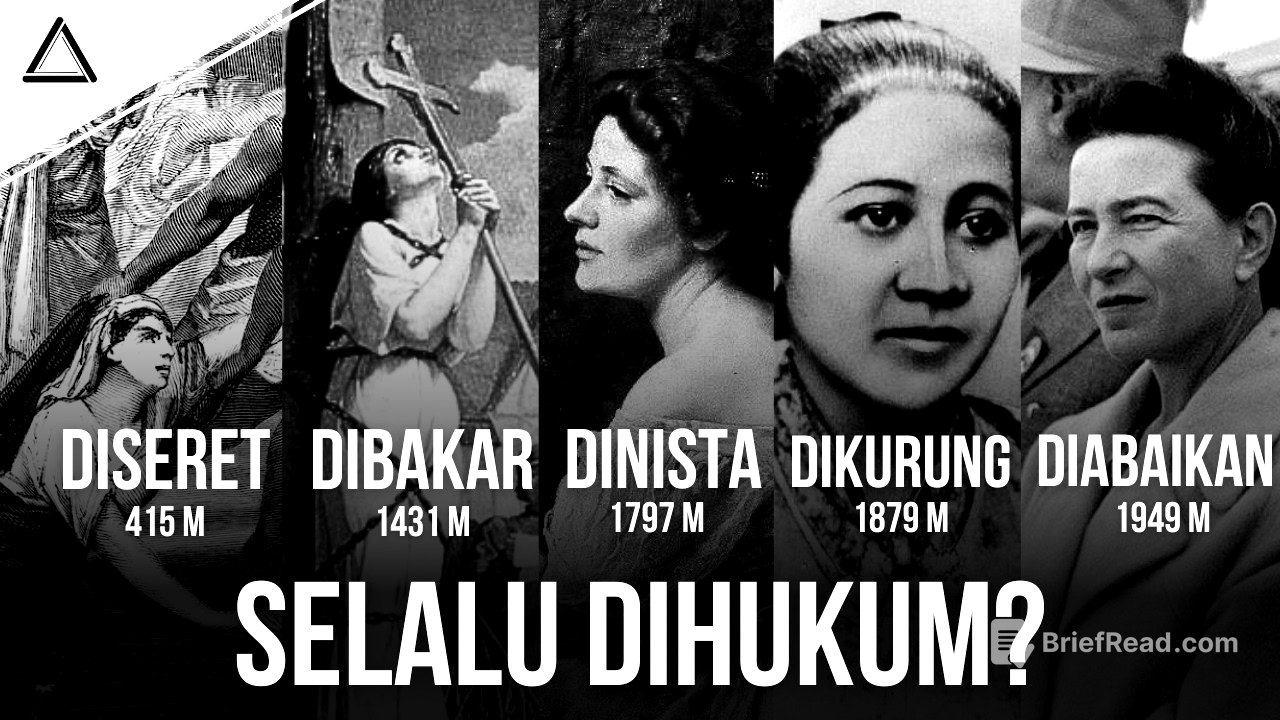
This video discusses historical female figures who fought against patriarchal systems, highlighting their struggles for recognition and autonomy. It emphasizes that the stories of women are often marginalized, illustrating their journey from being seen as subjects to becoming acknowledged individuals in their own right.
- The video covers the lives of Hypatia of Alexandria, Joan of Arc, Mary Wollstonecraft, Simone de Beauvoir, and Raden Adjeng Kartini.
- Each chapter presents the challenges these women faced and their contributions to the fight for equality and recognition.
Intro [0:00]
The introduction outlines the recurring historical pattern of women being marginalized, often depicted only in relation to men. It emphasizes that despite attempts to break these barriers, women have historically faced severe backlash, including violence and suppression. The video aims to showcase these struggles through the lives of notable female figures, indicating that the fight for women's rights is about recognizing their humanity and autonomy.
Hypatia Of Alexandria 350 - 415 M [2:05]
Hypatia, a mathematician and philosopher born in Alexandria, faced a violent death due to her stand for knowledge and reason during a time of significant religious tension. Despite her brilliance and contributions to science, she was accused of witchcraft and subsequently murdered by a mob instigated by political and religious conflict. Her legacy illustrates not only the persecution of intellectuals but also the specific targeting of women who defy societal norms, making her a symbol of the struggle against ignorance and oppression.
Joan Of Arc 1412 - 1431 M [9:32]
Joan of Arc emerged during the Hundred Years' War, claiming divine guidance to lead French forces to victory against England. Despite her military successes, she was captured, tried for heresy, and executed by burning at the stake. Joan's story reflects the complexities of a woman stepping beyond traditional gender roles, becoming an emblem of courage and national pride while also highlighting the severe consequences faced by women who challenge societal expectations.
Mary Wollstonecraft 1759 - 1797 M [17:46]
Mary Wollstonecraft rose as a prominent advocate for women's rights during the Enlightenment, emphasizing that women should receive the same educational opportunities as men. She critiqued the societal norms that relegated women to roles focused on beauty and compliance rather than intellect and agency. Wollstonecraft's seminal work, "A Vindication of the Rights of Woman", argued for women's rational capabilities and the need for educational reform, laying the groundwork for modern feminist thought.
Simone De Beauvoir 1908 - 1986 M [28:17]
Simone de Beauvoir, a key figure in existentialism and feminism, explored what it meant to be a woman in a society dominated by male perspectives. Her famous work, "The Second Sex", delves into the historical construction of femininity and the systemic barriers that women face. De Beauvoir argued that gender is a social construct and emphasized the importance of women's freedom and identity beyond traditional roles, making significant contributions to feminist philosophy.
Raden Adjeng Kartini 1879 - 1904 M [39:07]
Raden Adjeng Kartini, a pioneer of women's education in Indonesia, challenged the restrictive traditions of her time, particularly the practice of seclusion for women. Advocating for education and empowerment, she wrote letters about the need for women's rights and education reform. Despite her early death at 25, Kartini's writings became influential in promoting women's rights and education in Indonesia, inspiring future generations in the fight for equality and recognition in a colonial context.