TLDR;
This video explores how to overcome suffering through the lens of Advaita Vedanta, drawing insights from Krishna's teachings and the Buddha's wisdom. It emphasizes the importance of recognizing the unity of consciousness, maintaining mental evenness, and practicing detachment in worldly interactions. The discussion includes practical approaches to handling unpleasant circumstances, understanding the nature and causes of suffering, and integrating spiritual practices into daily life to find peace amidst challenges.
- Realize the unity of consciousness.
- Maintain mental evenness.
- Practice detachment in worldly interactions.
Introduction [0:00]
The video begins by posing the question of how to overcome suffering, referencing the Buddha's teachings on old age, sickness, and death. It introduces three key practices for Advaita practitioners: centering oneself in the realization of non-dual consciousness (Atman), maintaining an evenness of mind, and practicing detachment in interactions with the world. The core message emphasizes not getting stuck or stagnant with anything, recognizing the impermanence of worldly things, and understanding that grasping onto the changing world leads to sorrow.
Three Instructions from Krishna [0:40]
The initial teaching emphasizes centering oneself in the realization that we are all one non-dual consciousness, the Atman. The second instruction focuses on maintaining an evenness of mind, not allowing anything to disturb one's serenity amidst sorrow and happiness. The third instruction addresses interactions with the world, advocating for detachment and non-attachment. It encourages flowing like water, avoiding stagnation with people, things, or places, and maintaining the perspective of a spiritual seeker without grasping onto anything.
The Problem of Unpleasant Circumstances [7:13]
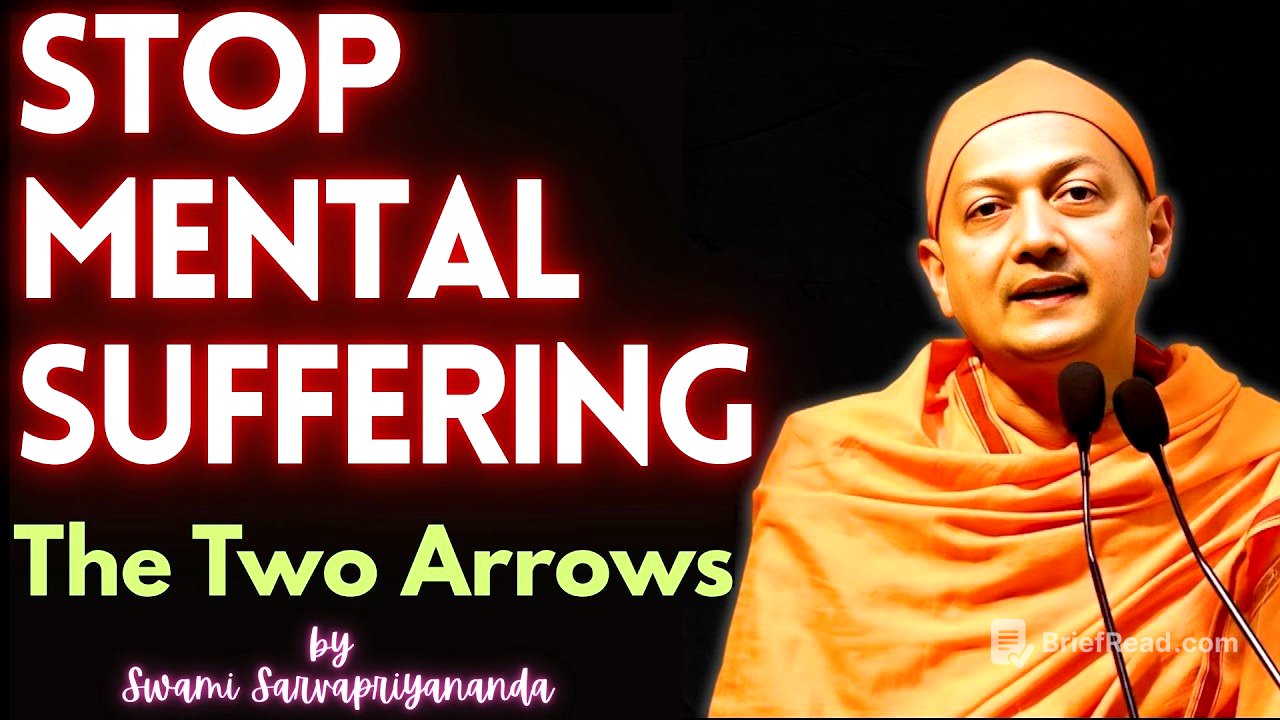
The discussion shifts to handling unpleasant circumstances and remaining centered as witness consciousness. It addresses the question of why enlightened individuals still experience sorrows. The Buddha's teaching on the "two arrows" is introduced: the first arrow represents what the world throws at us (old age, disease, death, failure), and the second arrow is our reaction to it. The real suffering lies in the reaction (the second arrow), and the goal is to find peace and ease despite what the world brings.
Investigating Dukkha (Suffering) [13:57]
The video explores suffering from three perspectives: causal (karnadishi), nature (swarupadrishti), and practice (sadhanadishi). The causal perspective identifies three levels of causes: problems caused by nature, problems caused by other living beings, and problems caused by one's own body and mind. A deeper analysis reveals that the immediate cause of suffering is a mental modification in the form of sorrow. The deepest level involves identifying with that mental modification, claiming "I am unhappy."
Deeper Analysis of the Cause of Suffering [18:57]
The discussion references cognitive behavior therapy and Albert Ellis's REBT (Rational Emotive Behavior Therapy), which introduces the ABC model: Activating event, Belief system, and Consequent behavior. The key is to debate or dispute the belief system (D) to change the reaction to external events. The deepest level of understanding involves recognizing and switching the identification from "I am body-mind" to "I am the witness of the body-mind," thus detaching from the misery.
What Exactly is Sorrow? [28:04]
From the Advaita perspective, the highest understanding is that sorrow is Brahman itself, the ultimate reality. A more accessible understanding is that sorrow is an appearance of Brahman, like a movie on a screen. The third level of analysis suggests that sorrow is a transformation of nature (Prakriti Parinama), a modification of neural systems or the play of Gunas (Sattva, Rajas, Tamas), particularly the Rajas Guna, which produces pain.
Inquiry into Sorrow from Spiritual Practice [34:01]
From the perspective of Jnana (knowledge), pain is an offense against one's Advaitic understanding. It's a violation of the knowledge that one is the witness consciousness. From the perspective of Bhakti (devotion), all sorrow is taken as the grace of God. From the perspective of Karma, actions are offered to the Lord, and the results (pleasant or unpleasant) are accepted as Prasad (sacred offering).
Summary and Takeaways [45:48]
The video concludes by summarizing the three-fold investigation of suffering: understanding the causes, nature, and spiritual practices related to sorrow. The executive summary reiterates the importance of being centered in the knowledge of one consciousness, maintaining evenness of mind, and practicing detachment in worldly transactions.