TLDR;
This video introduces part three of an overview of the world system, focusing on the deedent and ancestral estates. It explains how individuals are often unknowingly attached to a bankrupt system through the franchise of a nation-state corporation (deedent estate) while being separated from their underlying ancestral estate. The video also contrasts commercial remedies like the Secured Party Creditor process with the status correction process, advocating for reclaiming one's status as a living beneficiary to escape the debt-based matrix. It further discusses the historical context of global financial systems, including the Bretton Woods Agreement and its implications for worldwide bondage.
- Introduces the concept of deedent and ancestral estates.
- Contrasts commercial remedies with status correction.
- Explains the historical context of global financial systems and their impact on individual freedom.
Introduction to Part Three of the World System Overview [1:26]
The video introduces part three of the "Overview of the World System," building on previous discussions about how the legal and monetary systems contribute to separation from life and a bondage system. This part focuses on the deedent estate, which is the franchise of a bankrupt nation-state corporation, and the underlying ancestral lineal estate, which holds the equity and private interest that individuals often abandon. The speaker also mentions plans to update and expand the original document into a full book, incorporating new knowledge and experiences gained over the past nine years.
Two Types of Estates and Beneficiaries [5:05]
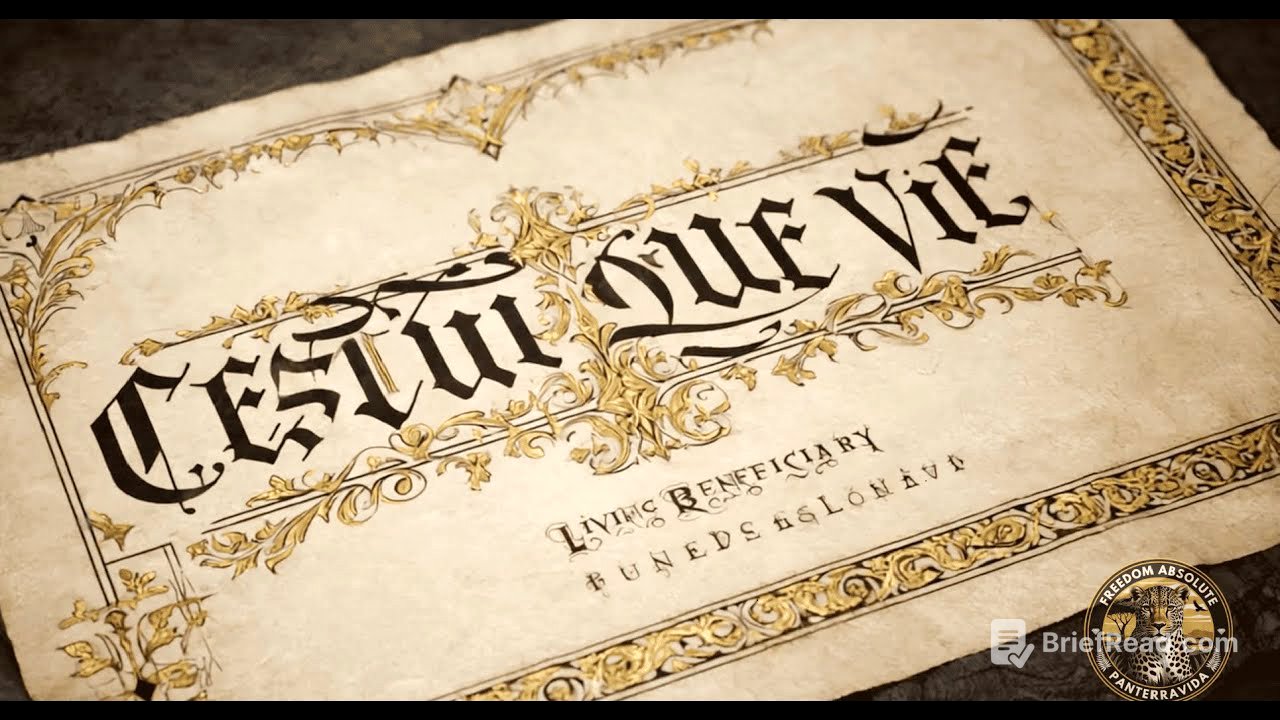
The discussion contrasts two types of estates: the original estates held by the aristocracy, which were perpetual and grounded in the land, and the more recent deedent estates. Original titles were held in the name of the living beneficiary, the cesticv, who was entitled to the full value and beneficial interests of the estate. In contrast, the current system has corporatized counties and attached civil privileges to franchises, with individuals receiving entitlements as mere privileges in the realm of the dead. The cesticv measures the duration of the estate, with the next living beneficiary automatically becoming the new cesticv upon the death of the previous one, hardwiring bloodlines to the land.
Deedent Estate and Cestui Que Trust [8:43]
The video defines a deedent estate as one belonging to someone who is dying, with franchises considered deedent estates, indicating that the attached living body is in a state of dying within the public commercial system. The beneficiary of the deedent estate is called a cesticay trust, lacking the "V" that denotes life, because the estate is a corporate subdivision of the United States. Property held in this name belongs to the United States and its creditors, pledged as collateral to support debt. This leads to a distinction between those in the land of the living with capacity and those in the realm of the dead with limited civil privileges.
Status Correction vs. Commercial Remedies [12:14]
The discussion transitions to how to become free from bondage and servitude, contrasting status correction with commercial remedies like the Secured Party Creditor (SPC) process. The speaker emphasizes that commercial remedies have proven ineffective and can have negative consequences. Underlying the public persona is the substance of value created by the ancestral lineal estate, held by the cesticv, while the deedent estate is held in a trust with limited beneficial interests vested in a cesticay trust. The public US person/citizen is a fiction created by social insurance schemes to generate public debt, with the state acting as the executor of deedent estates.
Commercial Paper and Maritime Law [15:03]
In the realm of commercial paper and monetized debt, three components are necessary to create negotiable instruments: the named title holder, the attached secured interest, and the underwriting insurance. These elements originate in maritime law, where a ship carries cargo documented by a title instrument (bill of lading) that can be insured. Modern nations adopted negotiable instruments acts in the 1880s, later codified into the UCC, with all elements of monetary policy and taxation under its purview by 1966. Codified statutes are codicils attached to the estate, underwritten by social security to ensure the transportation of cargo and its value.
Correcting Status and Claiming the Estate [18:31]
Correcting one's status involves claiming the underlying estate and proving oneself to be alive, thereby claiming the rights and beneficial interests of the ancestral lineal estates as a living beneficiary (cestayv). These estates were abandoned at birth due to a technical construction that justified maritime salvage and claims of abandoned property. Proving life is derived from the Cestui Que Vie Act of 1666, which addressed situations where beneficiaries were lost at sea and had to be pronounced dead to pass on estates. Upon returning from being lost at sea and proving life, executors must relinquish the estate back to the beneficiary, with all profits reverting to them.
Secured Party Process and Commercial Remedies [21:01]
The video addresses the Secured Party Creditor (SPC) process, comparing it to the status correction process. Despite claims of being the ultimate remedy, the SPC process involves listing the all-capital name of the fiction as the debtor and the upper/lower case name as the secured party on a UCC1 financing statement. However, because it remains within commerce, all parties are considered fictions in law in the realm of the dead. The UCC1 establishes a relationship between two or more fictions, and remaining in commerce means remaining lost at sea and considered a dead entity.
True Sovereignty and Commerce [25:17]
A true sovereign is defined as one who is solvent without impairment or obligatory attachments, having no authority above them in worldly terms. In commerce, the living being is the surety guarantor of debts attached to the franchise, making it impossible to be sovereign while attached to a bankrupt franchise. Declaring oneself sovereign while remaining a citizen attached to the franchise leads to being labeled a "sovereign citizen," which is a contradiction in terms. Using commercial processes means remaining a citizen within the United States and subject to its jurisdiction.
Commerce as the Matrix [28:02]
Commerce, with its civil codes, is described as the matrix, specifically the law merchant admiralty system. The SPC process increases the bonded debt load onto the franchise, further impairing one's status in the realm of perpetual debt. It does not correct one's status or grant standing to state a claim. Other commercial remedies, such as acceptance for value and commercial liens, are ineffective and exacerbate debt creation. Attempting to use such processes while still a surety can be seen as belligerence, insurrection, and rebellion.
The 14th Amendment and Debt Instruments [30:58]
The fourth section of the 14th Amendment states that the validity of the public debt of the United States shall not be questioned. All instruments issued under the UCC are debt instruments with a debtor-creditor relationship, circulating as currency and forming part of the debt of the United States. As a bonded surety to a bankrupt US franchise, one is bound to follow all codes and statutes, with any transgression constituting rebellion subject to suppression. The video urges viewers to understand how they have been self-deluded in thinking they can achieve remedy in commerce.
Franchises and Public Policy [34:29]
A franchise is a licensed contractor to a parent corporation, bound by its bylaws, which in the case of a municipal corporation like the United States, are private legal codes. Accepting the franchise license means being bound to these codes as having the force of law. The franchise is the initial commercial vessel attached to the trust created at birth, bonded by the registration record in vital records. Public funds are created under public policy, which replaced public law post-bankruptcy in 1933. House Resolution 192 declared that contracts requiring payment in gold are against public policy, mandating the use of commercial legal tender (debt instruments).
Bretton Woods and Global Financial Control [38:30]
Following the US bankruptcy and under war powers, the Bretton Woods Agreement established a uniformity of fixed exchange values for world currencies, with the FRN as the reserve currency. This extended the US bankrupt system to the rest of the world. The agreement initially fixed a rate of gold in exchange for Federal Reserve notes, but this was abrogated by President Nixon in 1971, leading to the era of the petrodollar and hidden inflation. The United States has been in bankruptcy since 1789, with rollovers in 1859, 1929, and 1999. The 20th century saw the extension of this system globally through the Bretton Woods Agreement, leading to worldwide bondage.