TLDR;
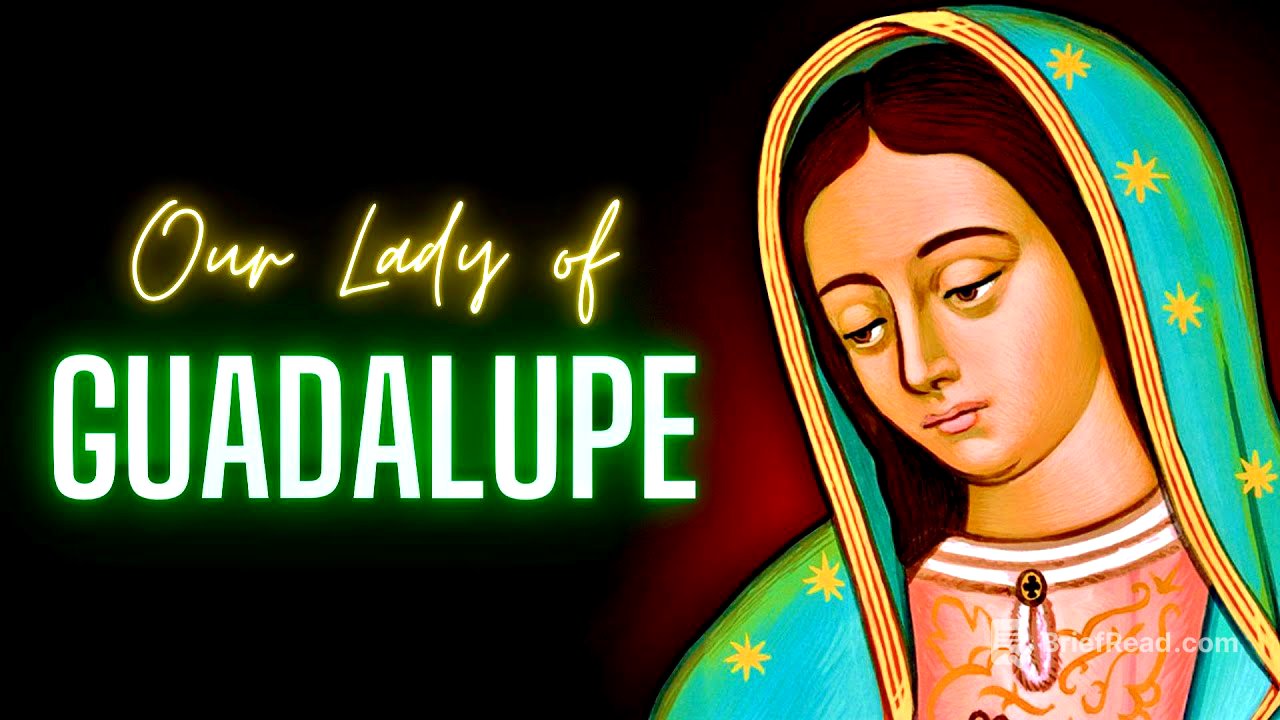
This video explores the miraculous aspects of the Tilma of Our Lady of Guadalupe, a revered image held in the Basilica in Mexico City. It discusses the historical context of the Virgin's appearance to Juan Diego, the inexplicable preservation of the tilma, scientific analyses of the image, and the hidden symbolism intended for both the Aztec and Spanish cultures. The video highlights the message of unity, love, and compassion conveyed through the image.
- The tilma, made of Agave cactus fiber, has remained intact for 500 years, defying natural decomposition.
- Scientific analyses reveal the image's colors are of unknown origin, and the eyes reflect a detailed scene of the apparition.
- The image contains codexes with symbolism understandable to both Aztec and Spanish cultures, promoting unity and love.
Introduction: The Story of Our Lady of Guadalupe [0:05]
The video introduces the story of Our Lady of Guadalupe, who appeared to Juan Diego, an Indian convert to Christianity, in 16th-century Mexico. The Aztec empire was a society known for its brutal human sacrifices. The Virgin came not with anger but with mercy, seeking to unite people through love and repentance. She asked Juan Diego to request the construction of a temple in her honor. After initial disbelief from the bishop, Mary provided a sign by having Juan Diego gather Castilian roses on Tepeyac Hill in winter. When Juan Diego revealed the roses to the bishop, the miraculous image of Our Lady of Guadalupe appeared on his tilma.
Miraculous Facts Science Can't Explain [3:31]
The tilma, made of dried Agave cactus fiber, has remained in perfect condition for 500 years, despite such material typically decomposing within 15 to 30 years. In 1921, a bomb explosion destroyed the altar and shattered windows, but the tilma remained untouched. In 1785, nitric acid was accidentally spilled on the image, yet it did not disintegrate the material. Dr. Richard, a Nobel Prize winner, analyzed the pigments and found they were of unknown origin, not derived from animal, mineral, or synthetic sources. Ophthalmologists have confirmed that Mary's eyes reflect light with the three-dimensional proportions of a human eye.
Hidden Images in the Eyes [6:00]
Dr. Tonsman discovered that the irises and pupils of the image's eyes contain a highly detailed picture of at least 13 people, reflecting the scene when Juan Diego revealed the tilma to the bishop. The perspective is from Mary's point of view. NASA scientist Dr. Philip Callahan found no traces of paint on the original image using infrared rays and noted the fabric was not treated to preserve it. He also observed iridescence, where the image's colors change from different angles, and diffraction, where Mary's face appears white up close but olive at a distance.
Astronomical and Musical Symbolism [8:00]
Gynecologist Dr. Carlos Fernandez del Castillo determined Mary's approximate delivery date to be December 25th. Astronomers discovered that the arrangement of stars on Mary's mantle matches the constellations above Mexico City on December 12, 1531, from a heliocentric perspective. Mary's head is tilted at 23.5 degrees, mirroring the Earth's angle as it orbits the sun. The constellations around Mary's head include Corona (crown), Leo (lion) over her womb symbolizing Jesus Christ, and Virgo (virgin) above her heart. Professor Ojeda-Lanez discovered the Fibonacci sequence and Kepler's triangle (golden ratio) in the image. He also found that the stars and flowers on the tilma create a perfect musical harmony when converted into musical notes, specifically aligned to the moment of the apparition.
Topographical and Cultural Symbolism [12:01]
Father Mario Rojas Sanchez applied a topological map of Mexico City to the image, finding that the flowers and stars correspond to volcanoes, rivers, and hills in the area. The tilma contains two codexes, one intelligible to the Aztecs and another to the Spanish Christians. Mary appeared as a mestiza, a person of mixed Spanish and Aztec heritage, who were considered the lowest class, symbolizing her identification with the marginalized. The blue-green color of Mary's mantle signified royalty to the Aztecs and symbolized the Star of the Sea to Christians. Her posture of prayer indicated submission to a higher power.
Aztec and Spanish Interpretations [14:55]
Mary appeared standing in front of the sun and upon the moon, signifying her superiority over the Aztec sun and moon gods, while Christians recognized the imagery from the Book of Revelation. The name Guadalupe was interpreted as "the one who crushes the serpent" in Aztec and as the location of a Spanish shrine by the Spaniards. The ermine lining symbolized royalty and purity, the black sash indicated pregnancy, and the parted hair signified virginity to the Aztecs. The four-petal Jasmine flower (queen quex flower) over her womb symbolized divinity and the center of the cosmic order. Other four-petaled flowers symbolized the new era of peace, and the Magnolia heart flower represented the transformation of human hearts. Mary's hands pointed to the cross on her brooch, a symbol of Christianity. Her eyes conveyed mercy, compassion, love, and forgiveness. An angel at her feet with eagle wings symbolized her power over even the creatures closest to God.
Our Lady's Message [18:35]
The video concludes by reiterating that the miracles, scientific phenomena, and hidden codexes in the image of Our Lady of Guadalupe convey a message of love, compassion, and unity. The video shares Our Lady's words to Juan Diego, emphasizing her role as the Mother of the true God, her desire for a temple to be built in her honor, and her promise of protection and consolation to all who seek her.
![[아마추어] FPL형광등 안정기 교체방법](https://wm-img.halpindev.com/p-briefread_c-10_b-10/urlb/aHR0cDovL2ltZy55b3V0dWJlLmNvbS92aS9sRkFCZWRvcTB6MC9ocWRlZmF1bHQuanBn.jpg)