TLDR;
This video discusses common injuries in the lower and upper extremities, as well as the spinal region, and strategies for prevention and rehabilitation. It highlights the importance of understanding joint mechanics, proper techniques, and the need for adequate recovery to avoid injuries. The video also touches on the significance of early intervention and individualised treatment plans for effective rehabilitation and return to activity.
- Common injuries in lower and upper extremities and spine
- Prevention strategies: warm-up, cool-down, technique, equipment modification, recovery
- Rehabilitation: early intervention, individualised plans, progressive loading
Introduction to Common Injuries [0:17]
The discussion covers injuries that occur in the lower and upper extremities, as well as along the spinal cord and posterior chain. Examples of lower extremity injuries include ankle sprains (inflammation of ankle tissue) and Achilles tendonitis (inflammation and damage to the Achilles tendon). These can result from poor foot control or environmental factors like uneven surfaces. Knee injuries are also common due to the multiple ligaments (LCL, MCL, ACL, PCL) that form the knee joint.
Lower Extremity Injuries: Knee and Shin [1:52]
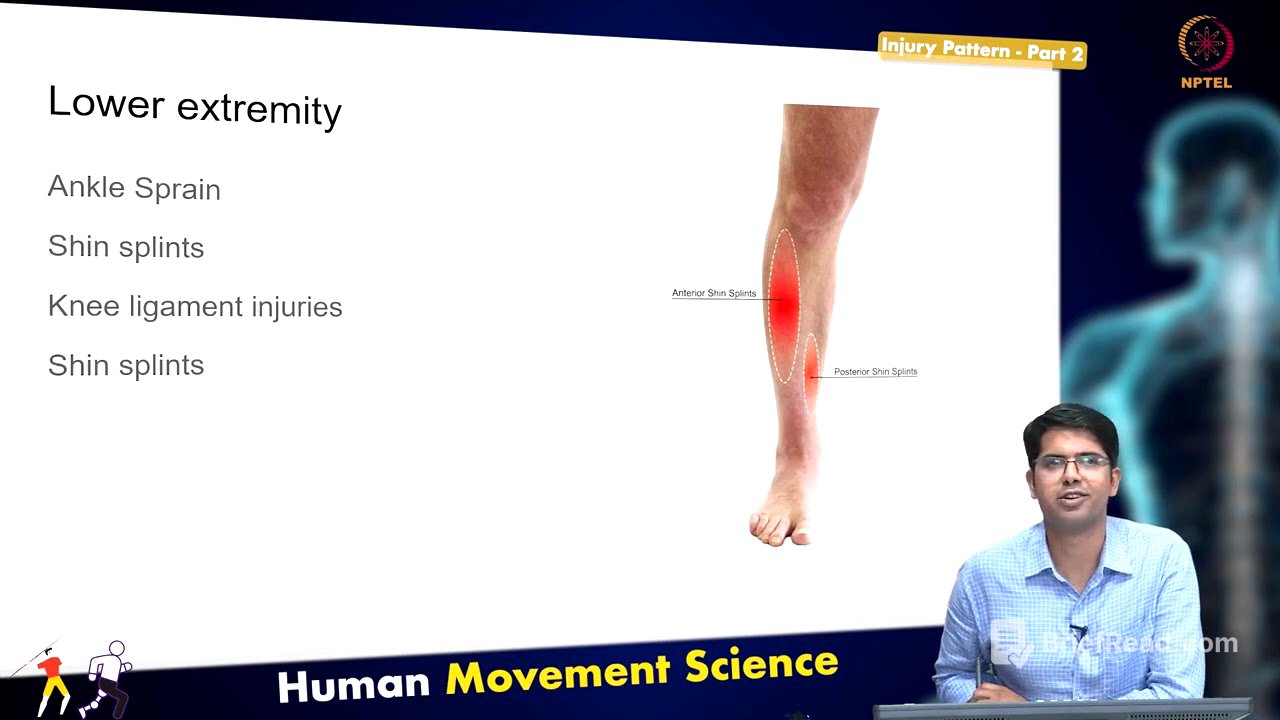
The knee is highlighted as a frequently injured joint, particularly the ACL, often damaged in dynamic sports requiring sudden changes in direction. ACL injuries can occur due to compromised biomechanics, such as the knee buckling inwards during movements like weightlifting or landing from a rebound. This places significant stress on the ligaments. Shin splints, characterised by pain in the front of the shins, are also discussed as common injuries, particularly among runners.
Upper Extremity Injuries: Shoulder, Elbow and Wrist [7:24]
Moving to the upper extremity, shoulder impingement is discussed, which restricts movement due to inflammation. Tennis elbow, an overuse injury, results from excessive stress on the muscles responsible for wrist pronation and supination, leading to microtears in the tendon. Rotator cuff injuries can cause long-term pain, affecting movements like bowling or tennis serves. Wrist strains are often acute injuries caused by lifting heavy objects or improper form during activities like boxing.
Spinal Injuries and Overuse Syndromes [10:02]
Spinal injuries include lower back pain from improper lifting form and herniated intervertebral discs due to improper loading, potentially requiring surgery. Neck strains and sprains can result from poor posture or ergonomics. Overuse syndromes, such as runner's knee (patellofemoral pain) and iliotibial band syndrome, are also mentioned. Shin splints are reiterated as an overuse syndrome caused by excessive stress on muscles without adequate recovery.
Understanding Injury Mechanisms [13:09]
The common pattern in injuries is that the injured tissue is either not designed to handle loads in the direction applied, or the injury is due to overuse without sufficient recovery time. Examples include frontal knee movement causing ACL injuries and extensive loading without recovery leading to shin splints or rotator cuff injuries. Rotator cuff injuries can also be acute due to sudden overload.
Prevention Strategies: Warm-up, Technique, and Recovery [14:13]
Preventing injuries involves proper warm-up and cool-down routines to ensure muscles are lubricated and prepared for stress. Strength and conditioning help muscles and bones adapt to physiological loads gradually. Skill acquisition and proper techniques are crucial, such as learning the correct way to land in basketball to avoid injuries. Equipment modification, periodisation, and adequate recovery between training sessions are also essential.
Rehabilitation: Early Intervention and Individualised Plans [17:24]
For rehabilitation, early intervention is vital to prevent further damage. Individualised treatment plans are necessary, as recovery rates vary among individuals. Progressive rehabilitation involves gradually increasing loading over time, monitored by medical professionals. Returning to sport requires quantifying movements and establishing objective criteria to assess improvement, ensuring a safe return to activity.
Conclusion: Injury Patterns and Movement Science [21:07]
Injury patterns encompass acute and chronic conditions. Understanding human anatomy, joint mechanics, and loading directions helps identify injury causes and develop techniques to avoid them. Movement science and quantifiable metrics are used to develop improved movement patterns, ultimately aiming to prevent injuries.