TLDR;
This video explores Michelangelo's renowned sculpture, the Pietà, emphasizing three significant details that many overlook. It discusses Michelangelo's early life, the commission's background, and the unique proportions of the figures in the composition. The video also covers how Michelangelo signed the sculpture in an uncharacteristic moment of vanity and highlights the piece’s history, including its attack and subsequent restoration.
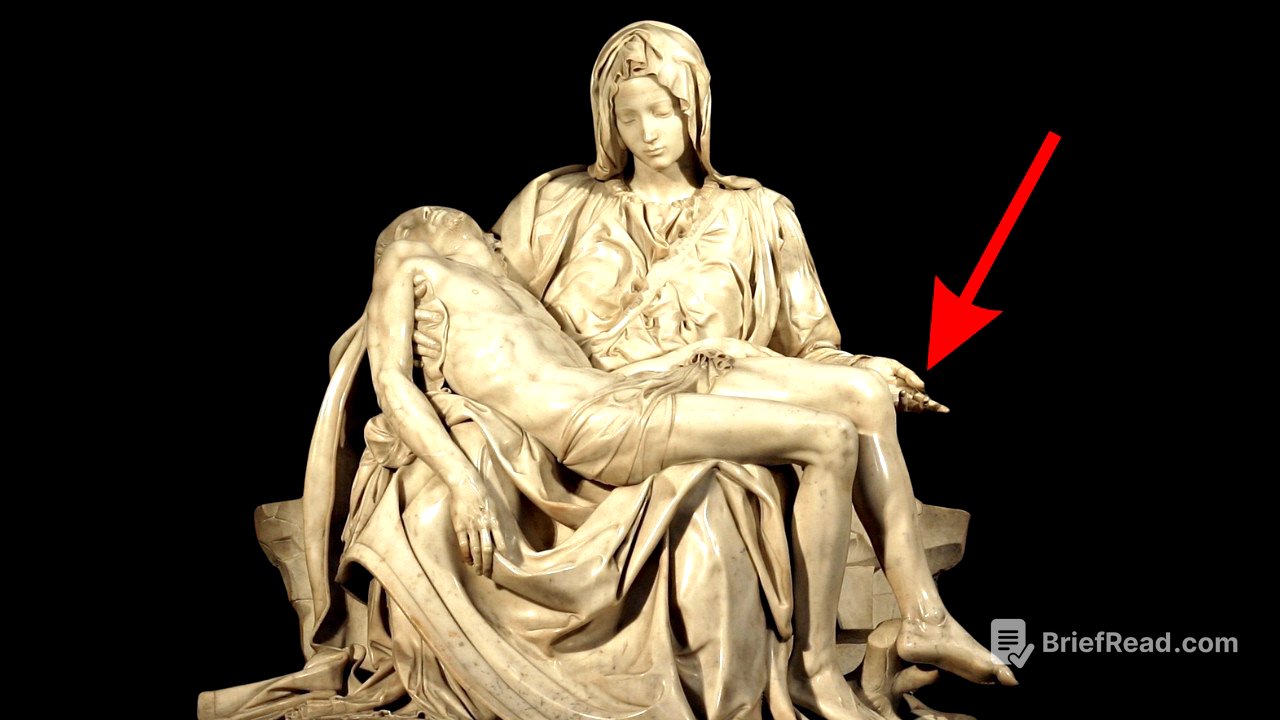
- Michelangelo included a hidden letter 'M' in Mary's palm, which could refer to either Mary or himself.
- The proportions of Mary and Christ are altered to create a harmonious visual and support the adult Christ in her lap.
- The only signature Michelangelo ever carved was on the strap of Mary's robe after overhearing a mistaken claim about the sculpture's authorship.
Hidden Details of the Pietà [0:00]
The sculpture depicts the Virgin Mary cradling the dead body of Christ, showcasing remarkable detail in the marble. Michelangelo's mastery is evident through the precise rendering of both figures. There are three specific yet subtle details in the sculpture: the hidden letter 'M' in Mary's hand, the intricately carved strap across her chest, and the intentional proportions of the figures themselves.
Michelangelo's Early Life and Commission [2:50]
Born in 1475, Michelangelo faced opposition from his father regarding his artistic ambitions. However, he pursued his passion, apprenticing with Domenico Ghirlandaio and working under the influential Lorenzo de Medici in Florence. At 21, he moved to Rome and received a commission in 1498 for the Pietà from Cardinal Jean de Bilhères, who wanted a tomb monument that would stand out among the best in Rome. The contract demanded nothing short of the finest work, which Michelangelo accomplished by the age of 24.
Proportions and Composition [4:50]
Michelangelo cleverly designed the sculpture’s proportions to allow Mary, who appears larger than Christ, to cradle him convincingly. Mary’s body is exaggerated in size, facilitated by the folds of her robe that obscure true dimensions, creating a composition that appears balanced and natural to viewers. Michelangelo made conscious decisions regarding the scale to ensure the poses and interactions of the figures were visually harmonious, despite criticisms about the proportions at the time.
The Signature Incident [6:40]
After witnessing a group mistakenly attribute the sculpture to another artist, Michelangelo carved his name, "Michel Angelus Bonarotus Florent Faciebat," into the strap across Mary's chest in a fit of anger. This impulsive act remains the only sign of his authorship in his life’s work, which he later regretted, viewing it as an expression of vanity rather than the artwork's eloquence speaking for itself.
The Attack and Restoration [8:46]
The Pietà was relocated to St. Peter's Basilica in 1699 and made famous as the first sight of visitors entering the church. In 1972, it faced vandalism when Laszlo Toth attacked it, damaging key features. Restoration efforts successfully repaired the sculpture, although remains of the original damage can still be observed by careful scholars. Despite this incident, Michelangelo continued to create significant works throughout his career, never again signing his pieces.




![[ENG SUB] Official Pilot: รักสุดท้าย My Safe Zone The Series | Ch3 Thailand](https://wm-img.halpindev.com/p-briefread_c-10_b-10/urlb/aHR0cDovL2ltZy55b3V0dWJlLmNvbS92aS82YjRVbkRDR1lzSS9ocWRlZmF1bHQuanBn.jpg)