TLDR;
This video explores the Native American Renaissance by contextualizing the long history of indigenous cultures prior to European colonization and highlighting the complexity and diversity within Native American societies. It emphasizes the enduring influence of Native cultures, the impact of colonization, and the resurgence of Native American literature and art from the late 1960s onwards.
- Native America was home to hundreds of distinct nations with unique languages and traditions before European contact.
- The Native American Renaissance marked a period of cultural revival, characterized by significant literary contributions and political activism.
Understanding Indigenous America [0:00]
The video opens with an exploration of indigenous America, noting that prior to European colonization, North America housed numerous distinct indigenous nations. Each nation had unique languages, governments, and cultural traditions, contrasting against the oversimplified image of Native Americans as a single culture. The historical diversity among these indigenous societies is crucial, as modern mappings do not represent their complex geographical and cultural realities.
Societal Structures Before Colonization [4:04]
The video discusses the existence of sophisticated societies among Native Americans before European contact, emphasizing major cities like Cahokia that showcase advanced political organization and monumental architecture. The midwestern mound-building societies exemplified the complexity of indigenous political and social structures, refuting the notion that lack of European-style cities meant a lack of societal complexity.
Indigenous Lands and Geography [9:08]
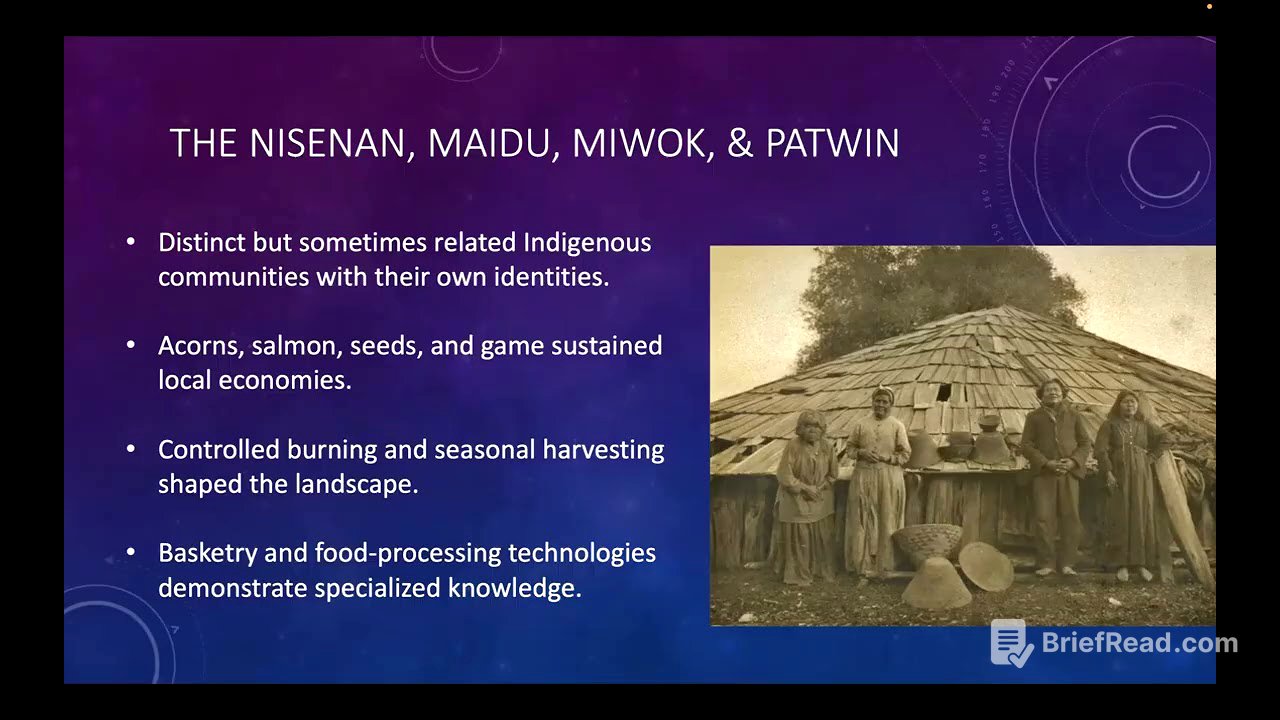
Sacramento is addressed as a former indigenous homeland, where various communities like the Miwok and Patwin thrived long before colonization. The geography of the region significantly shaped indigenous communities, informing their resource management and seasonal practices. The discussion incorporates historical and contemporary indigenous place names, encouraging reflection on whose histories are highlighted in modern maps.
Impact of European Colonization [18:16]
The video examines the devastation caused by European colonization, including disease and displacement, which led to dramatic population declines among Native peoples. The ways in which indigenous nations responded varied, ranging from diplomacy to armed resistance, highlighting their resilience despite the systemic dispossession they faced.
Manifest Destiny and its Consequences [33:18]
The concept of Manifest Destiny is critiqued as it positioned settlers as bringers of progress while portraying indigenous peoples as barriers. An example discussed is John Gas's painting, "American Progress,” which symbolizes the violent narrative of Westward expansion as a narrative of improvement. Additionally, the tragic Trail of Tears exemplifies the injustices faced by Native Americans during Indian removal policies.
California Gold Rush and Its Aftermath [43:28]
The California Gold Rush brought violence and devastation to indigenous communities, leading to land dispossession, massacres, and cultural disruption. It highlights how many state-promoted laws and policies enabled racial violence toward Native Californians during this period.
Treaties and the Reservation System [51:41]
Federal treaties made with Native American tribes were often unratified or ignored, leading to significant frustrations within communities. The establishment of the reservation system restricted traditional lifestyles and disrupted economies, imposing federal control over tribal nations. Further, the Dawes Act fragmented tribal lands and promoted individual land ownership, severely undermining tribal sovereignty.
Indigenous Agency and Activism [1:06:34]
The video discusses how Native Americans have continually asserted their agency through activism and cultural revitalization, notably through movements such as the American Indian Movement (AIM). Indigenous activism came to the forefront during the 1960s and 1970s, demanding sovereignty, recognition of treaty rights, and the preservation of cultural identities.
Native American Renaissance [1:17:25]
The Native American Renaissance signifies a renewed national interest in Indigenous literature starting in the late 1960s, with works reflecting cultural identity, sovereignty, and personal narratives. Authors like Scott Momaday and poets like Joy Harjo emerged, using their platforms to express contemporary Native experiences while drawing from oral traditions.
Counterculture Response to Native American Identity [1:28:11]
The lecture examines how the broader counterculture movement in the 1960s appropriated and simultaneously celebrated Native American culture. While some admiration was genuine, it often misguidedly romanticized Indigenous practices and resulted in cultural appropriation rather than appreciation.
Historical Activism and Land Occupation [1:40:00]
Activists notably occupied Alcatraz Island in 1969 as a protest against governmental treatment of Native Americans, proposing the establishment of a center for Indigenous culture and education. This action catalyzed further activism, including significant demonstrations that addressed police brutality and land rights during the 1970s.
The Role of Women in Indigenous Activism [1:50:35]
Indigenous women are highlighted for their crucial roles in activism, often facing a dual struggle against both colonialism and sexism. Their involvement in political organizing challenged mainstream feminism by emphasizing issues of sovereignty and cultural survival.
Contemporary Indigenous Culture and Activism [2:03:20]
The video concludes by recognizing ongoing efforts in the cultural revival of Indigenous traditions, exploring governance, language revitalization, and intertwining identities within contemporary Native American culture. The discussion emphasizes that indigenous history continues beyond colonial encounters, affirming the active political and cultural lives of Native nations today.
Exploring Indigenous Art [2:13:15]
Indigenous art traditions are examined, revealing that these creations serve multiple purposes beyond traditional roles. The video discusses contemporary shifts in Indigenous art, where artists began to challenge expectations and incorporate modern forms and themes distinct to their cultural identities.
Conclusion: Ongoing Cultural Renaissance [2:23:50]
The lecture wraps up by reinforcing that the Native American Renaissance illustrates both preservation of cultural traditions and artistic innovation. It insists that Indigenous histories are ongoing narratives shaped by political struggles and cultural continuity, urging viewers to consider who controls the narrative of Native American experiences in modern society.