TLDR;
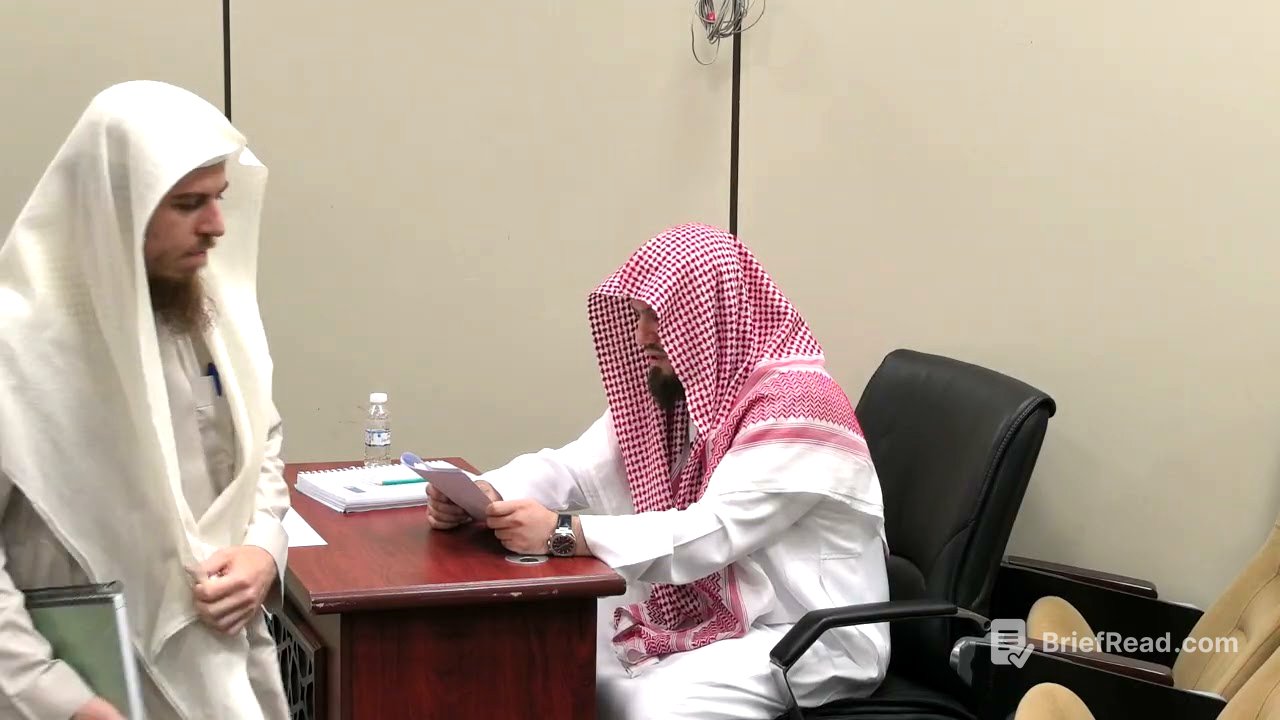
This YouTube video captures the master's thesis defense of a student named Selwan Dili Mehmtai. The thesis, titled "The doctrinal issues in which Imam al-Qurtubi narrated the disagreement among scholars in the book al-Tadhkira," is examined by a panel of esteemed professors specializing in Islamic studies. The defense includes an overview of the thesis by the student, followed by detailed feedback, critiques, and questions from the committee members. The discussion covers various aspects of the thesis, including its methodology, sources, and conclusions, with a focus on ensuring accuracy, clarity, and adherence to academic standards.
- The thesis explores doctrinal issues in "al-Tadhkira" by Imam al-Qurtubi.
- The defense committee provides detailed feedback on methodology, sources, and conclusions.
- Accuracy, clarity, and adherence to academic standards are emphasized.
Introduction and Thesis Overview [0:00]
The session begins with an introduction of the committee members: Dr. Abdullah bin Saleh Al-Barrak, Dr. Abdul Malik bin Marshoud Al-Otaibi, and Mr. Hamoud Al-Salama. The student, Selwan Dili Mehmtai, is then given the opportunity to present a concise overview of his master's thesis. Selwan starts with an Islamic prayer. He explains that the thesis addresses doctrinal issues in Imam al-Qurtubi's book, "al-Tadhkira," aiming to collect and study these issues, clarify the correct views, and highlight the efforts of Sunni scholars in addressing matters of the afterlife. He outlines his descriptive methodology, which involves induction, deduction, and analysis. The thesis is structured into an introduction, a preliminary section, three chapters, and a conclusion, covering doctrinal issues related to life, the intermediate realm (Barzakh), and events after the Resurrection.
Importance and Methodology [5:16]
Selwan explains the importance of his topic, emphasizing its connection to belief in the Day of Judgment, which is a fundamental aspect of Islamic faith. He highlights the significance of Imam al-Qurtubi's "al-Tadhkira" as a comprehensive work in this field. Selwan describes his methodology as descriptive, based on induction, deduction, and analysis. He outlines the structure of his research, which includes an introduction, a preface, three chapters, and a conclusion. The introduction covers the research problem, its significance, objectives, questions, scope, terminology, previous studies, and methodology. The preface includes a brief biography of Imam al-Qurtubi, an introduction to "al-Tadhkira," and the Imam's approach in the book. The three chapters cover doctrinal issues related to life, the intermediate realm, and events after the Resurrection.
Dr. Abdullah Al-Barrak's Critique [12:55]
Dr. Abdullah Al-Barrak acknowledges the importance of the thesis topic, which deals with the Day of Judgment and matters of the afterlife. He commends the student for his comprehension of the subject matter and his effort to add value to each issue studied. However, he notes several areas for improvement. He points out the lack of attention to accurately ضبط (regulate) texts and their forms, including both Hadith and scholarly quotes. He suggests that the student should have focused more on analyzing different opinions rather than including excessive explanations and نقل ( نقل). Dr. Al-Barrak also mentions that the student sometimes attributes statements to scholars without precise accuracy.
Specific Issues and Recommendations [16:06]
Dr. Al-Barrak raises concerns about the student's understanding of certain doctrinal issues, such as women visiting graves. He suggests that the student includes the original wording in the footnotes. He also questions the relevance of including all opinions on intercession ( الشفاعة), as it goes beyond what Al-Qurtubi mentioned. Dr. Al-Barrak criticizes the reliance on commercial editions of books, particularly those by Ibn al-Qayyim, and advises the student to refer to verified editions. He also points out inconsistencies in the student's الحديثية (Hadith-related) analysis, noting that the student's judgments on the authenticity of Hadith are sometimes based on تقليد (imitation) and lead to problematic عقدي (doctrinal) conclusions.
Further Critique and Questions [21:00]
Dr. Al-Barrak criticizes the student's تخريج (referencing) methodology, noting the lack of detail such as chapter, book, part, and page numbers. He also advises against relying on secondary sources for تراجم (biographies). Dr. Al-Barrak asks why the title was not تشكيل (vocalized) and points out an error in the date of Ibn Taymiyyah's death. He suggests adding quotation marks around the title of "al-Tadhkira." Dr. Al-Barrak advises the student to include the names of Al-Qurtubi's teachers and students, as well as praise for him from other scholars, in the biography. He also suggests providing statistics on Al-Qurtubi's مصادر (sources), such as the number of times he نقل ( نقل) from Sahih al-Bukhari and Sahih Muslim.
Methodological and Source Concerns [25:09]
Dr. Al-Barrak asks the student to explain his statement about " التساهل في نقد المتون والأسانيد" (leniency in critiquing texts and chains of narration). He questions whether Al-Qurtubi's نقل ( نقل) from Ibn Furak's "مشكل الحديث" (Problematic Hadith) means that Al-Qurtubi relied on this book. Dr. Al-Barrak criticizes the student's use of the term " التجهيل" (making ignorant) to describe Al-Qurtubi's attribution of statements to " العلماء" (scholars) and " مشايخنا" (our teachers). He argues that this is unfair, as Al-Qurtubi is a respected scholar. Dr. Al-Barrak also points out that the student's statement about " كشف علوم الآخرة" (Unveiling the Sciences of the Hereafter) being " المنسوب للغزالي" (attributed to Al-Ghazali) is incorrect, as the book is indeed by Al-Ghazali.
Specific Hadith and Doctrinal Issues [32:09]
Dr. Al-Barrak discusses the issue of women visiting graves, noting the different opinions on the matter. He points out that the student should have clarified the meaning of " الشواب" (young women). Dr. Al-Barrak advises the student to use the known term " أئمة الدعوة في نجد" (Imams of the Da'wah in Najd) instead of " أئمة الدعوة والتحقيق" (Imams of Da'wah and Verification). He then focuses on the Hadith about لعن عليه الصلاه والسلام زوارات القبور (cursing women who visit graves), questioning the student's تضعيف (weakening) of the Hadith. Dr. Al-Barrak argues that the student's approach to حديثية (Hadith-related) analysis is تقليدي (imitative) and that he should not have based his عقدي (doctrinal) conclusions on his judgments of the Hadith.
Hadith Analysis and Methodological Corrections [38:23]
Dr. Al-Barrak provides detailed feedback on the student's analysis of specific Hadith, particularly regarding the جهالة (unknown status) of narrators. He cites ابن رجب (Ibn Rajab) and الذهبي (al-Dhahabi) to argue that the student's approach to تضعيف (weakening) Hadith is too strict and does not align with the methodology of earlier scholars. Dr. Al-Barrak advises the student to adjust his approach to judging Hadith and to review whether any scholars have previously تضعيف (weakened) the Hadith based on the جهالة (unknown status) of a narrator.
Doctrinal Conclusions and Recommendations [42:34]
Dr. Al-Barrak discusses the student's doctrinal conclusion regarding the permissibility of women visiting graves. He argues that the student should have addressed the arguments against this view and that his ترجيح (preference) for the view is مخال ( مخالف) to the views of many scholars. Dr. Al-Barrak also questions the student's تضعيف (weakening) of the اثر (narration) about Ibn Umar's وصية (will) to read the Quran at graves. He argues that the student should have instead said that Ibn Umar's فعل (action) is not agreed upon by other الصحابة (companions).
Further Scrutiny of Doctrinal Points [48:20]
Dr. Al-Barrak continues his critique, focusing on the student's ترجيح (preference) for the view that the ثواب (reward) of reciting the Quran does not reach the deceased. He suggests that the student should have mentioned Ibn Uthaymeen's view that اهداء (dedicating) ثواب (reward) is not from the هدي (guidance) of the السلف (predecessors). Dr. Al-Barrak advises the student to focus on Al-Qurtubi's كلام (words) regarding the المهدي (Mahdi) and to remove irrelevant material. He also points out that the student's use of a نظم (poem) is inappropriate and that his explanation of الروحاء (al-Ruha') is inaccurate.
Final Points and Corrections [51:56]
Dr. Al-Barrak addresses several more specific points, including the student's statement about ياجوج وماجوج (Gog and Magog) being from China, his attribution of a statement to " العلماء" (scholars) without specifying who they are, and his reliance on commercial editions of books. He emphasizes the importance of using محققة (verified) editions and points out an error in the student's ترجمة (biography) of ابن مسرة (Ibn Masarrah). Dr. Al-Barrak also questions the relevance of including certain information in the thesis, such as the تكحيل العينين (applying kohl to the eyes) and the شفاعة (intercession) for those who die in Medina. He concludes by noting that the student's فهرسة (indexing) of التراجم (biographies) is incorrect and that his ترتيب (arrangement) of المصادر (sources) needs to be revised.
Concluding Remarks and Transition [1:03:32]
Dr. Al-Barrak concludes his critique, emphasizing that his ملحوظات (notes) are not meant to diminish the student's جهد (effort) but to improve the thesis. He expresses his appreciation for the student's حرص (eagerness) to استيعاب (comprehend) his research. Dr. Hamoud Al-Salama thanks Dr. Al-Barrak for his valuable feedback and clarifies that Dr. Al-Barrak was not criticizing the الرجوع (referring) to Al-Albani but rather emphasizing that طالب العلم (students of knowledge) should not اكتفي (suffice) with الرجوع (referring) only to Al-Albani.
Dr. Abdul Malik Al-Otaibi's Assessment [1:06:25]
Dr. Abdul Malik Al-Otaibi begins by expressing his pleasure in participating in the مناقشة (discussion) of the thesis and thanking Dr. Hamoud for the opportunity. He also welcomes the student and the attendees. Dr. Al-Otaibi notes the أهمية (importance) of the topic and the حسن اختيار (good choice) of the subject. He also commends the student for the كثرة (abundance) of مراجعة (references), which exceeded 500. Dr. Al-Otaibi also praises the student's جمع (collection) of material, his حرص (eagerness) on توثيق (documentation), and the قلة (fewness) of الأخطاء الطباعية (typographical errors).
Specific Feedback and Suggestions [1:08:11]
Dr. Al-Otaibi points out that the student made بيان أسباب الخلاف (explaining the reasons for disagreement) among scholars one of the أهداف البحث (objectives of the research) but did not address this in a فصل (chapter). He suggests that the student should have included a fourth فصل (chapter) to address this. Dr. Al-Otaibi also notes that the ترجمة (biography) of Al-Qurtubi is موجزة (concise) to the point of being مخلا (deficient). He states that a ترجمة (biography) should include the name, birth, teachers, students, works, وظائف (positions), أقوال العلماء فيه (scholarly opinions about him), and الوفاة (death).
Methodological and Stylistic Improvements [1:09:54]
Dr. Al-Otaibi advises the student to وحد (unify) his منهج (methodology) in using " ينظر" (see) and " انظر" (look). He also notes that the student sometimes places the رقم الحاشية (footnote number) in parentheses and sometimes does not. Dr. Al-Otaibi suggests that the student should have mentioned whether Al-Qurtubi's مصنفات (works) are مطبوعة (printed) or مخطوطة (manuscript). He also points out that the student begins sentences with " و" (and), which is incorrect. Dr. Al-Otaibi emphasizes the importance of mentioning the موارد الكتاب (sources of the book) to determine its value.
Scholarly Integrity and Source Evaluation [1:11:58]
Dr. Al-Otaibi argues that the student's statement about " الغموض في عزو الأقوال" (ambiguity in attributing statements) is a جناية (crime) against Imam Al-Qurtubi, as Al-Qurtubi stated in his مقدمة (introduction) that he نقل ( نقل) from كتب الأئمة (books of the Imams). He also notes that the student's حواشي (footnotes) are اثقلت (burdened) with مشكلة (problems) and that he should have عزوتها (attributed) the آيات (verses) in the صلب (body) of the text. Dr. Al-Otaibi advises the student to رتب (arrange) the المراجع (references) according to الوفيات (dates of death).
Specific Examples and Corrections [1:13:31]
Dr. Al-Otaibi points out that the student learned about النسخ (abrogation) from شرح النووي على مسلم (al-Nawawi's commentary on Muslim), which is a مشروح الحديث (commentary on Hadith) and المصطلح (terminology). He states that the student should have referred to كتب الأصول (books of اصول). Dr. Al-Otaibi also notes that the student sometimes mentions the المولد (birth) and تغفل (neglects) the الوفاة (death) and that he should وحد (unify) his منهج (methodology) in تلقيبات الأئمة (titling the Imams). Dr. Al-Otaibi states that the student's statement about " ما يجوز وما لا يجوز" (what is permissible and what is not permissible) is اجنبي (foreign) to the المبحث (topic).
Methodological Refinements and Source Accuracy [1:14:38]
Dr. Al-Otaibi advises the student that, in التحرير (editing) مذاهب الأئمة (the doctrines of the Imams), he should refer to معتمدات المذاهب (reliable sources of the doctrines). He also questions whether ابن حبان (Ibn Hibban) should be يقدم (presented) before الترمذي (al-Tirmidhi) and whether البيهقي (al-Bayhaqi) should be يقدم (presented) before الإمام أحمد (Imam Ahmad). Dr. Al-Otaibi notes that the student تترجم (biographies) for أم عطية (Umm Atiyya) and then says " نقلا عن سيرة أعلام النبلاء" ( نقل from Siyar A'lam al-Nubala), which is unnecessary.
Textual Analysis and Stylistic Consistency [1:16:25]
Dr. Al-Otaibi points out that the student's statement about " تباين فهمهم واختلافهم في طرق والتي تدل" (the difference in their understanding and their اختلاف in the ways that indicate) should be وثق (documented). He also notes that the student's صياغات (formulations) such as " واستدل أصحاب هذا القول بما يلي الدليل الأول استدلوا" (and the اصحاب of this قول استدل with the following الدليل الأول استدلوا) are unnecessary. Dr. Al-Otaibi states that the student's statement about " كما قال البعض" (as some said) is معيب (flawed) and that he should not تعريف بعض وكل (define some and all).
Content and Contextual Relevance [1:17:58]
Dr. Al-Otaibi notes that the student's نسبة قول لابن باز (attribution of a statement to Ibn Baz) is to a مصدر وسيط (intermediate source) with the وجود الأصل (existence of the original). He also points out that the student's نقل ( نقل) from شيخ الإسلام (Shaykh al-Islam) is in a صورة (form) that does not تتحدث (speak) about it. Dr. Al-Otaibi states that the student should تعتني (take care) to رسم (draw) the آيات (verses) with the الرسم العثماني (Uthmani script).
Specific Hadith and Scholarly Positions [1:19:34]
Dr. Al-Otaibi advises the student to find the نص صريح (explicit text) for Al-Albani's statement and notes that Al-Albani has اقوال (statements) in الفقه (jurisprudence) that لم يسبق اليها (were not preceded by them). He also points out that the student's التخريج (referencing) from البخاري (al-Bukhari) and مسلم (Muslim) should have a توثيق معهود (customary documentation). Dr. Al-Otaibi states that the student's statement about " وانني لم اقف على احد من العلماء اجاب عن هذا الحديث سوى الحافظ بن حجر" (and I did not find anyone from the العلماء who answered this Hadith except al-Hafiz ibn Hajar) should only be made after عنائم في الاستقراء (troubles in الاستقراء).
Scholarly Affiliations and Methodological Consistency [1:20:57]
Dr. Al-Otaibi questions whether محمد بن أحمد السفاريني (Muhammad ibn Ahmad al-Safarini) is سلفي (Salafi) and advises the student to تعافى (recover) from this. He also notes that the student should always place the الكتاب (book), then the اسم المؤلف (author's name), then the الجزء (part), and then the الصفحة (page). Dr. Al-Otaibi states that the student's statement about " والذي يبدو ان الصحيح" (and what seems to be الصحيح) is not مستساغ (acceptable) in the الها.
Textual Accuracy and Content Relevance [1:22:54]
Dr. Al-Otaibi points out that the student's statement about " وكما استدل أصحاب هذا القول ببعض أوصاف الدجال التي تحدث النبي عنها والتي وجدت فيه بصوره مطابق مطابقه وان حاله تخالف حال البشر الأسوياء في الشكل والمضمون" (and as the أصحاب of this قول استدل with some أوصاف of the الدجال that the النبي spoke about and that were found in it in a form that مطابقه مطابقه and that its حال تخالف the حال of البشر الأسوياء in الشكل and المضمون) should be وثق (documented). He also notes that the student's الراجح (most correct) in this المسألة (issue) is that the الصياد (hunter) لا التعدية (not the التعدية) تكون بالباء (is with the ba') تكون بمن (is with the min).
Qur'anic Interpretation and Content Focus [1:24:01]
Dr. Al-Otaibi advises the student that, when he تستدل (infers) that عيسى (Jesus) is من أشراط الساعة (from the signs of the Hour), he should have come to the الآية (verse) that فيها القراءة السبعية (has the seven readings) that فيها فتح العين واللام (has the opening of the عين and the لام) and that he should نسبه (attribute) it to the الكتب الفرشية (books of فرشية) in the القراءات (readings). He also states that the student should not have ذكر (mentioned) that ياجوج ماجوج (Gog and Magog) are أهل الصين (people of China) and that he should have stated whether بن سعدي (Ibn Saadi) رجوعه (returned) from this.
Final Corrections and Recommendations [1:26:25]
Dr. Al-Otaibi advises the student that, in حاشية رقم أربعة (footnote number four), he should have said " ويقول ابن عاشور" (and Ibn Ashur says) and that this is مكانه (its place) عند الرد على من قال بخلاف ذلك (when responding to those who said otherwise). He also notes that the student صدر (issued) a حديث موضوع (fabricated Hadith) in the اول التخريج (first تخريج) and that he should تخرج (reference) and then تحكم (judge). Dr. Al-Otaibi points out that the student شكل (vocalized) the الحديث (Hadith) and that he should وحد (unify) his منهج (methodology).
Concluding Remarks and Thesis Evaluation [1:32:43]
Dr. Al-Otaibi advises the student to read the اول فقرة (first paragraph) in the نتائج البحث (results of the research) and states that the نتائج البحث (results of the research) should تفيد (benefit) the الشبيبة (youth). He also notes that the student's منهج (methodology) in كتاب التذكرة (the book of al-Tadhkira) and مقصده (its purpose) is not from the المصنفات الفقهية المعتمدة (reliable jurisprudential works) and that it was الف ( ألف) بباب الترغيب والترهيب وإحياء القلوب والموعظة (with the door of ترغيب and ترهيب and إحياء القلوب and الموعظة). Dr. Al-Otaibi states that the student's statement about " الإمام القرطبي مالكي المذهب من غير تعصب مع ميله إلى الأشعرية" (Imam al-Qurtubi is Maliki in المذهب without تعصب with his ميل to the الأشعرية) is a نتيجة (result) but that it is not in the البحث (research).
Thesis Approval and Closing [1:36:04]
Dr. Al-Otaibi concludes his remarks, stating that they are مكملين (completing) the ملاحظة (notes) of الشيخ عبد الله البراك (Sheikh Abdullah al-Barrak). Dr. Hamoud Al-Salama thanks Dr. Abdul Malik for his ملحوظات القيمة (valuable notes) and states that the الطالب (student) will يستفيد (benefit) from them. The committee then مداولة (deliberates) and decides that the الرسالة (thesis) is مستوفية لشروط البحث العلمي والأكاديمي (meeting the conditions of scientific and academic research). The committee توصي (recommends) that the الطالب (student) be منح (granted) the درجة الماجستير (master's degree).