TLDR;
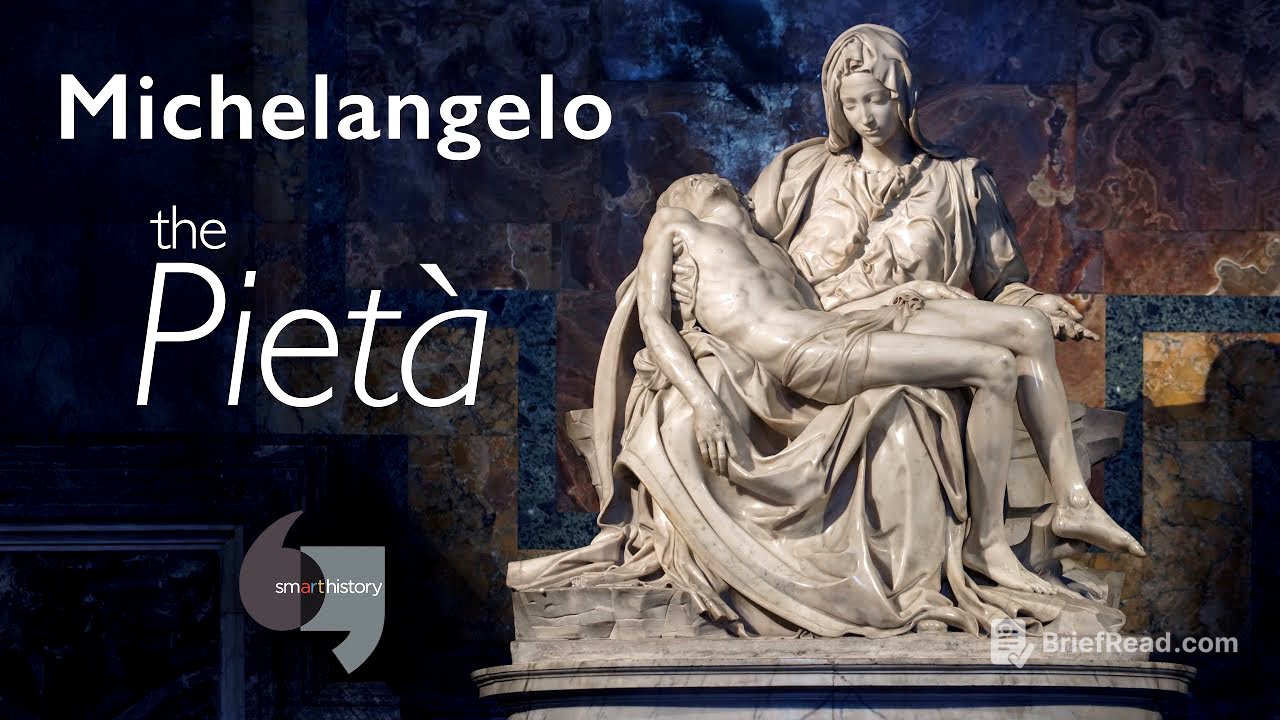
This video explores Michelangelo's famous sculpture, the Pietà, located in the Basilica of Saint Peter's in Vatican City. The discussion delves into the sculpture's historical context, its ideal beauty, and the significant artistic techniques used by Michelangelo. Key points include:
- The Pietà was commissioned by a French cardinal and represents Christ’s body being cradled by his mother, Mary.
- Michelangelo's approach emphasizes idealized beauty and unity between the figures, showcasing his exceptional skill in marble carving.
The Context of the Pietà [0:05]
Dr. Steven Zucker and Dr. Beth Harris introduce Michelangelo's Pietà in the Basilica of Saint Peter's, emphasizing that the current church structure was built after the original church was demolished. The initial display of the sculpture was in a circular space illuminated from above, contrasting with its current display behind bulletproof glass.
Michelangelo's Artistic Style and Intent [0:51]
Dr. Harris explains that the Pietà, favored by French and German sculptors during the period, reflects the High Renaissance focus on ideal beauty. Michelangelo's representation of Mary is notably youthful, leading to criticism at the time about her age relative to Christ. He justified this as a representation of purity.
Sculptural Techniques and Details [1:59]
The detailed craftsmanship is highlighted as Christ's body rests on Mary's lap, with her arm supporting him, creating a sense of limpness. Michelangelo's ability to make marble appear flesh-like is remarked upon, alongside the sculptural balance where Mary and Christ form a stable pyramid, crucial for Renaissance art.
Symbolism and Emotional Impact [3:24]
The sculpture reflects the bond between Mary and Christ, suggesting mourning while simultaneously presenting him to the audience as the path to salvation. The deep carvings create shadows that contrast with the polished surfaces, enhancing the emotional depth of the piece.
Michelangelo’s Signature and Legacy [4:51]
The Pietà is unique as Michelangelo's only signed work, allegedly after he overheard someone attributing the piece to another artist. This act symbolizes his ambition and desire to secure his place in art history. The Virgin Mary's sweet expression is considered an exemplar of the ideals of the High Renaissance.