TLDR;
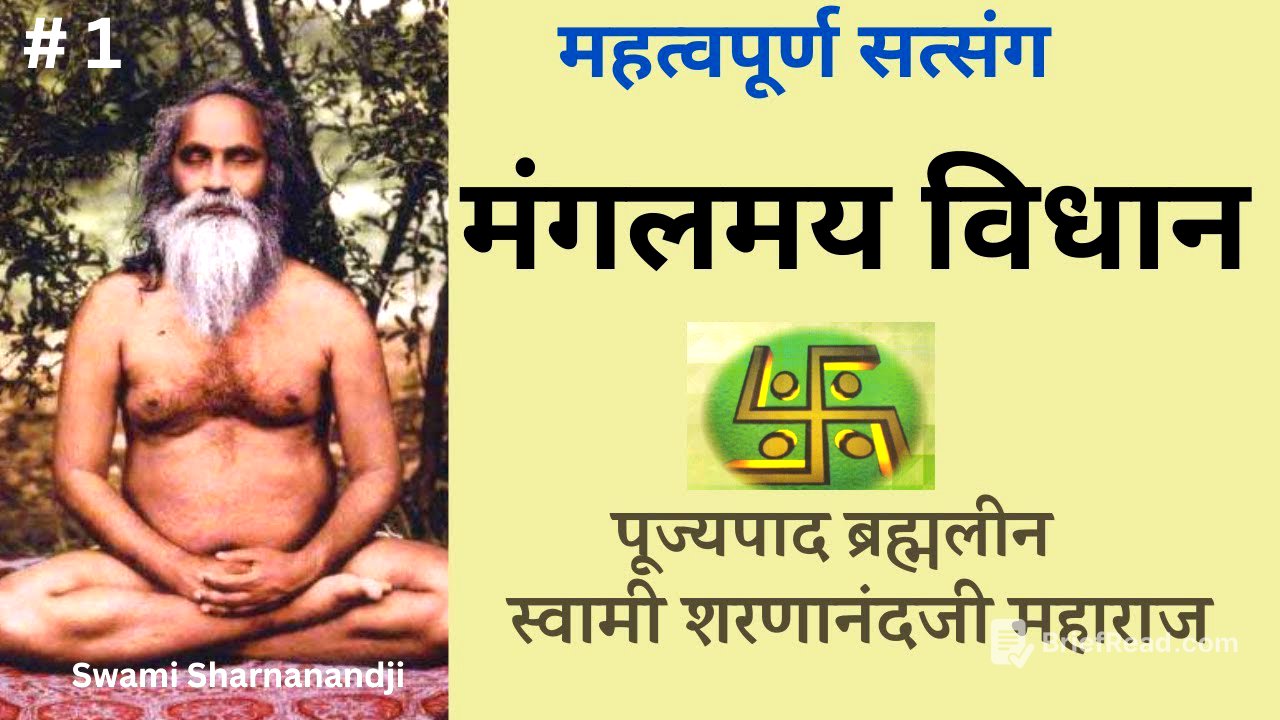
This video explores the concept of "Vidhan," a divine law or cosmic order that governs all existence, emphasizing its inherent benevolence and the importance of aligning with it for a fulfilling life. It highlights the significance of understanding the interplay between action ("doing") and consequence ("happening"), advocating for mindful actions and acceptance of outcomes. The video also touches on the illusion of separateness, the role of suffering, and the path to liberation through self-awareness and surrender to the divine will.
- Vidhan is inherently benevolent and essential for all existence.
- Understanding the interplay between action and consequence is crucial.
- Aligning with Vidhan leads to a fulfilling and liberated life.
Introduction [0:02]
Swami Sharnanand Ji Maharaj explains that everything that occurs is rooted in a fundamental "Vidhan," which is always auspicious for everyone. Only those who are careful in their actions and content with the outcomes can grasp this mystery. It's essential to understand the distinction between doing, happening, and being.
The Nature of Doing and Happening [0:43]
The act of "doing" begins with dependence, where individuals identify with external objects, conditions, or situations, leading to a sense of limitation and the arising of desires. These desires create attachments and inclinations, ultimately resulting in the depletion of energy and the need for withdrawal. However, the auspicious "Vidhan" provides strength during withdrawal, enabling individuals to re-engage in activity with renewed vigor.
The Source of Strength and Wisdom [1:54]
The strength that arises during withdrawal is not a result of past actions but is granted by "Vidhan." This "Vidhan" also provides individuals with the wisdom to use their abilities wisely. This wisdom is the auspicious "Vidhan" of the infinite, under which all of creation operates. Humans have the freedom to use their abilities in accordance with this wisdom or to misuse them, though misusing them leads to negative consequences.
The Consequences of Misusing Freedom [3:12]
Even when humans misuse their freedom, they continue to receive the capacity to act, which doesn't mean that they are encouraged to act wrongly. This freedom is unique to humans. Disregarding "Vidhan" leads to bondage, inertia, and lack. However, even in helplessness, one can find refuge in the all-powerful.
The Role of Suffering and Development [5:00]
The misuse of abilities is a disservice. Even when abilities are misused, they continue to be granted. Though "Vidhan" may bind individuals in illness and sorrow, it is done with immense compassion. This compassion becomes clear when the suffering individual is affected by the effects of the suffering. The experience of suffering, though undesirable, is created solely by the auspicious "Vidhan." The cycle of happiness and sorrow is familiar, but disregarding "Vidhan" makes the departure of happiness and the arrival of sorrow unpleasant. Those who respect "Vidhan" understand that the departure of happiness and the arrival of sorrow are essential for all-encompassing development.
The Paradox of Strength and Weakness [6:24]
Development occurs both when one is capable and when one is incapable, which is a peculiar aspect of "Vidhan." If the misuse of abilities did not result in illness and sorrow, immense chaos would ensue. If the depletion of energy did not occur at the end of activity, humans would remain bound to activity indefinitely. Death, separation, destruction, and helplessness guide humans toward eternal, infinite, divine life.
The Importance of Acknowledging Limitations [7:43]
The pain of dependence gives rise to the desire for independence, and lack gives rise to the desire for completeness. The pain of the present contains the achievement of the future. Only those who consider the misuse of power to be life do not have faith in "Vidhan." While everyone hopes for protection from the strong, they themselves misuse their power against the weak, resulting in the strong becoming weak and the weak becoming strong.
The Benevolence of Weakness [8:46]
Those who do not have the power to create cannot destroy, but they invite weakness through the misuse of power, which is a mistake. The auspicious "Vidhan" does not want to see anyone weak, but when humans misuse their given freedom, they must be weakened to protect them from the consequences of their misuse. This is only understood by those who respect "Vidhan."
The Path to Perfection [9:27]
What is happening is beneficial for everyone, but one must consider what they are doing. Abandoning non-action leads to duty, and abandoning relationships that oppose wisdom leads to detachment. Surrender is attained by abandoning beliefs that oppose wisdom. Respecting "Vidhan" leads to duty, detachment, and surrender. Duty is useful for the world, detachment for oneself, and surrender for God.
The Uniqueness of Individuals and the Role of Rest [10:48]
Reality is such that all-encompassing development occurs when any aspect of it is fully embraced. Duty leads to detachment and surrender, detachment leads to duty and surrender, and surrender leads to duty and detachment. No two humans have the same interests, abilities, or strengths, but everyone has the same fundamental need. Despite many differences, the fulfillment of this need is possible. Laborious efforts are not equally possible for everyone due to individual differences, so laborious efforts are related to the wise use of one's circumstances. Entering the true life that transcends all circumstances is only achieved through rest.
The Essence of Vidhan: Compassion and Unity [12:20]
"Vidhan" is full of compassion, generosity, and intimacy. As the glory of "Vidhan" becomes clear, unwavering faith and trust in the creator grow. This mystery becomes clear when humans respect the knowledge received from "Vidhan" and become carefree and fearless. Individual differences are a wonderful miracle of "Vidhan" because they establish unity between individuals and society, body and world, and groups.
The Interconnectedness of All Things [13:51]
Individual differences complement each other, which is a valid aspect of "Vidhan." The unity of one form underlies all differences, and that unity becomes useful to each other through differences. This mystery becomes clear when humans accept that what they have received is for others, not for themselves. The true life is only achieved through rest.
The Nature of Unity and Diversity [14:45]
When what is received is not for oneself, there is a wonderful equality in inequality. Seeing unity in diversity increases joy, and experiencing unity in unity only eliminates sorrow. Eliminating sorrow is only one aspect of the true need. Along with eliminating sorrow, there is also a need for infinite, eternal, conscious, and ever-new joy.
The Importance of Surrender [15:37]
Detachment leads to the elimination of sorrow, peace, and independence, but ego remains alive by taking refuge in independence. Surrender transforms ego into a deep love for refuge, making life useful for refuge. Duty is expressed by abandoning actions that oppose wisdom, making life useful for the world. Wisdom is a symbol of the auspicious "Vidhan" of the infinite.
The Role of Effort and Grace [16:49]
Respecting "Vidhan" automatically ends relationships and beliefs that oppose wisdom, leading to the expression of duty, detachment, and surrender without any effort. Human effort is only required in respecting the wisdom received. Abandoning known untruth, associating with truth, and expressing means for all-encompassing development automatically occur through the auspicious "Vidhan."
The Power of Collective Energies [17:51]
Even if humans do not respectfully welcome what is happening, what is not done by the individual is created by collective energies. Collective energies are under the auspicious "Vidhan." Power is expressed through light, and "Vidhan" is required to use it. The wise use of abilities is important in human life, which automatically occurs when they are not misused.
The Consequences of Misusing Power [18:31]
Misusing abilities is destroying oneself. Power does not act on its own but acts under the refuge of "Vidhan." If power acted on its own, no strong person could oppress the weak. The use of power is done by another, and "Vidhan" is the light in which power is used. Those who try to develop themselves by destroying others may experience success in the beginning but ultimately destroy themselves.
The Limits of Freedom and the Nature of Vidhan [19:30]
No human has the right to use abilities, objects, or skills obtained in opposition to "Vidhan," meaning one should not misuse their given freedom. No one can conquer "Vidhan" because immense power is under "Vidhan," and "Vidhan" does not harm anyone because it is created with benevolent intentions. "Vidhan" is the expression of the one who is the refuge and illuminator of all.
The Discovery of Vidhan [20:09]
"Vidhan" is not the creation of any individual but a discovery. Discovery is of what already exists. Humans can only discover "Vidhan" when they are free from attachment. To be free from attachment, there must be constant change in every creation. Experiencing constant change automatically creates a desire for the supreme.
The Significance of Change [20:47]
If there were no constant change in created objects, there would be no desire for the self-illuminating life that transcends illuminated objects. There is benefit for everyone in what is happening. There is a big difference between doing and happening. Attachment to doing is imprinted on the doer, but not on happening. Attachment to what is done binds humans in dependence and inertia, which is the root of destruction.
The Role of Attachment and Detachment [21:25]
Activity done in accordance with "Vidhan" frees the doer from attachment to doing, while activity done by being bound in temptation and fear creates new attachments in the doer. Respecting "Vidhan" eliminates temptation and fear because the objects, abilities, and skills received are not personal, meaning one must embrace detachment. Being detached automatically leads to desirelessness, which is the root of development.
The Source of Blessings and the Path to Strength [22:19]
What any human has received has been received from the one who is their best friend and benefactor and is created by the auspicious "Vidhan." Misusing what has been received automatically leads to weakness, and wisely using the strength received automatically leads to increasing strength. Humans have the freedom to wisely use or misuse what has been received, but misusing it will inevitably lead to weakness.
The Importance of Mindfulness and Acceptance [23:14]
It is essential to be careful in doing, but the mystery that what is happening is auspicious will only become clear when one is peaceful in happening and allows what is happening to affect them. Being distressed by the weakness that has come gives rise to the inspiration to wisely use strength, which is the result of the effect of happening.
The Auspiciousness of Happening [23:50]
From an external perspective, the destruction of the body seems inauspicious, but the inspiration to dissolve body consciousness and the achievement of a new, beautiful body are proven by this happening. Fully embracing what is happening leads to entering what transcends what has been received, and then no dependence, inertia, lack, or dullness remains.
The Nature of Doing and Happening Revisited [24:33]
The inspiration to be careful in doing comes from the result of what is happening. One must embrace the effect of what is happening and remain content and peaceful in it. The ego of the individual is not involved in what is happening, so there is no pride of doership in happening. Happening is related to "Vidhan," and doing arises from the individual.
The Fruits of Understanding Vidhan [25:29]
What happens is auspicious. Theists and devotees have attained divine love by considering what is happening to be the play of God. Thinkers have been inspired by its effect to discover eternal life, and dutiful humans have been inspired by its result to wisely use strength. What is happening is auspicious for everyone.
The Illusion of Separateness [26:05]
The division of body and world is not possible, so the owner of both body and world is one, not two. Considering the body to be one's own and not considering the entire world to be one's own is a disregard for "Vidhan." This disregard has resulted in conflict between individuals, groups, countries, and religions, which is the root of destruction.
The Importance of Recognizing Reality [26:48]
Considering oneself to be identical to the body is a mistake, which occurs when humans do not respect reality. Reality and "Vidhan" are two sides of the same coin because clarifying what is and is not is reality, which is lawful. When nothing is personal, misusing objects, being interested in collecting them, and not using them with benevolent intentions is inertia.
The Consequences of Inertia [27:31]
Humans bound in inertia turn away from conscious life, so disregarding "Vidhan" is the root of destruction. What has been received is a gift from someone. Claiming ownership of the object and forgetting the giver is a disregard for "Vidhan." If one says they have not seen the giver, then what is not one's own must belong to another.
The Nature of Ownership and Detachment [27:59]
The one whose object it is has given it to humans in such a way that it seems to be their own, but wisdom clarifies that the object is not their own. Considering the paradox of what is one's own and what is not, it becomes clear that one has the right to use the objects received for wise use and that the object is not one's own for the sake of being detached.
The Path to Unity and Purity [28:45]
Wisely using objects establishes unity between individuals and society, and being detached expresses purity in humans. The giver has given the right to use and has taught the lesson of abandoning attachment. Respecting the auspicious "Vidhan" that leads to unity and purity is essential for all humans. Unity eliminates all conflicts, and beauty exists in purity.
The Importance of Self-Awareness [29:36]
Disregarding "Vidhan" creates conflict and ugliness, so disregarding "Vidhan" is a big mistake. It is accepted by everyone that humans are familiar with their dependence. The knowledge by which humans become familiar with their dependence is received from the auspicious "Vidhan." Until humans are eager to be free from dependence, they do not respect the knowledge received.
The Cycle of Dependence and Freedom [30:23]
Disregarding knowledge is disregarding "Vidhan," and disregarding "Vidhan" is destroying oneself. Following one's own knowledge respectfully automatically leads to the ability to respect "Vidhan" and the understanding of "Vidhan." The understanding of "Vidhan" is only achieved by being free from attachment. The ability to be free from attachment automatically comes when dependence becomes unbearable.
The Role of Suffering in Detachment [30:57]
Respecting "Vidhan" leads to being free from attachment, and being free from attachment leads to the understanding of "Vidhan." Humans bound in attachment can neither know "Vidhan" nor respect it. To end attachment, happiness departs even when one does not want it to. Being sad when happiness departs is disregarding "Vidhan."
The Importance of Non-Attachment [31:30]
Not wisely using happiness generously but being attached to happiness is an act that opposes "Vidhan." What is happening automatically is "Vidhan," meaning the dynamism that is free from the pride of duty and desire is dependent on "Vidhan." The pain of unfulfilled desire and the experience of dependence in fulfilling desire are for the sake of achieving desirelessness.
The Significance of Human Life [32:10]
Although the circumstances of fulfilling and not fulfilling desire exist in other life forms, humans consider not fulfilling desire to be their misfortune and fulfilling desire to be their good fortune because they do not know the importance of "Vidhan." If fulfilling and not fulfilling desire were good and bad fortune, then other life forms would also receive them. Misfortune in human life only comes from disregarding "Vidhan" due to carelessness.
The Path to True Fortune [32:49]
True fortune arises when humans respect "Vidhan" and become carefree and fearless. "Vidhan" is the light of the one who illuminates all. He has given humans the responsibility of following "Vidhan." In other life forms, "Vidhan" is made to be followed. The freedom given to humans has not been given to any other creature.
The Purpose of Human Existence [33:22]
Those who consider experiencing happiness and sorrow to be life cannot respect "Vidhan." In human life, one must not experience happiness and sorrow but wisely use them. The inspiration to wisely use happiness and sorrow is lawful because what one does not have an eternal relationship with cannot be life. Happiness and sorrow are means, not ends.
The Importance of Enthusiasm [34:05]
Not wisely using the means is disregarding "Vidhan." Humans must be enthusiastically ready to respect "Vidhan." Respecting "Vidhan" makes every circumstance have the same meaning, meaning equality is clearly seen in inequality, which is the root of development. Just as hunger and thirst are the same for everyone and there is unity in satisfaction, everyone is the same in achieving peace, independence, and love.
The Unity in Diversity of Means [34:44]
Food and means are not the same for two individuals. There is inequality in some way. The interests, abilities, and skills of two individuals are not the same, but everyone has the same goal. If this lawful fact is respected, unity can remain despite the difference in food and means. Accepting the unity of the goal and the difference in abilities, interests, etc., is "Vidhan."
The Path to Harmony and Liberation [35:29]
The unity of the goal teaches humans the lesson of the unity of love, and the difference in circumstances commands the difference in means. The unity of love ends mutual conflict, and the difference in means makes humans independent from the goal. Wisely using difference and unity can make all humans accomplished. Difference and unity are two sides of the same coin.
The Importance of Balance [36:06]
Both difference and unity are required for all-encompassing development. Accepting the difference in love based on difference gives birth to mutual conflict, which is the root of destruction. Not accepting the unity of love despite the unity of the goal is nurturing limitation and difference, which is the root of decline.
The Nature of Natural Desires [36:47]
The awakening of the demand for reality is a lawful fact, and being bound in unnatural desires is disregarding "Vidhan." Natural is not what ends in lack. Does the result of activity in accordance with desires not take the form of lack? If it does, then desires are unnatural, not natural.
The Illusion of Desires [37:27]
Disregarding the wisdom of "Vidhan" makes desires seem natural due to body consciousness. When all desires are not fulfilled, is considering desires to be natural not disregarding "Vidhan?" The experience of the natural demand of humans that underlies all desires only occurs when this "Vidhan" is enthusiastically respected that the greed for happiness born of fulfilling desires is not true life.
The Role of Unfulfilled Desires [38:08]
The "Vidhan" of unfulfilled desire is for the sake of ending the greed for happiness. The pain born of unfulfilled desire is a means for destroying the greed for happiness born of fulfilling desire. Clearly knowing this mystery makes development inherent in unfulfilled desire. Fulfilling desire is only curiosity, which begins and ends in lack and is dependent in the middle.
The True Demand of Humans [38:53]
Fulfilling desire cannot be the true demand of humans but is a means for experiencing happiness and sorrow. Embracing generosity when experiencing happiness and embracing renunciation when experiencing sorrow is respecting "Vidhan." Forgetting generosity in happiness is binding oneself in attachment to happiness, and not embracing renunciation in sorrow is being afraid of sorrow.
The Root of Decline [39:35]
The slavery of happiness and the fear of sorrow only remain alive until humans do not respect "Vidhan," which is the root of decline. Humans keep limitation alive based on the experience of happiness and sorrow. According to "Vidhan," happiness departs and sorrow comes. Both do not remain at the same time, but the speed and subtlety of the departure and arrival of happiness and sorrow are so intense that the pleasant memory of the past remains while experiencing sorrow in the present, and the sorrowful memory of the past remains while experiencing happiness in the present.
The Importance of Living in the Present [40:31]
Memory proves the distance of what it is of. Although sorrow may seem to be sorrowful and happiness may seem to be happy, they do not remain together at the same time. If importance is not given to the memory of happiness when sorrow comes, the effect of sorrow can end the attachment to happiness. Humans hope for happiness based on pleasant memories during times of sorrow.
The Path to Freedom from Suffering [41:19]
This mistake only occurs when humans try to establish permanence in a dynamic life. If sorrowful memory does not remain during times of happiness, the reality of happiness can be easily understood, which eliminates the temptation of happiness born of dependence forever, which is the root of development. If importance is not given to pleasant memories in sorrow, the effect of sorrow frees the sorrowful from sorrow and makes them one with the life that contains nothing but peace, independence, and love, which is the true demand of humans.
The Significance of Vidhan in Human Life [42:12]
The "Vidhan" by which happiness departs and sorrow comes is auspicious. If one asks why the auspicious "Vidhan" is not naturally dear to humans, seriously considering it makes it clear that "Vidhan" is only dear to those who consider themselves to be seekers. Those who have not experienced that human life is a life full of means, meaning humans are created to be devoted to means, cannot find the auspicious "Vidhan" to be naturally dear.
The Nature of Human Existence [42:59]
Humans are a collection of demands and responsibilities. Humans are not the name of any created object. The decision of what the demand is is only possible when life is not lived in happiness and sorrow. Happiness is enjoyed, and sorrow is forced to be endured. Happiness may be pleasing, but sorrow is not pleasing to anyone.
The Consequences of Disregarding Vidhan [43:53]
Not keeping in mind that the enjoyer of happiness will have to endure sorrow, humans consider life to be in the dependence born of fulfilling and not fulfilling desire. They cannot keep that belief safe, which is not possible. Considering what is not possible to be life is disregarding "Vidhan." The result is that humans forget that they are seekers, which is the root of destruction.
The Path of the Seeker [44:37]
When humans consider themselves to be seekers, they find that what they have received is nothing but means. Seekers must wisely use the means they have received and not be attached to them. Then, what should happen automatically starts to happen, and the result is that what should be received is automatically received without asking.
The True Meaning of Achievement [45:33]
Achievement does not mean what cannot keep unity, eternal relationship, and intimacy safe. What does not have unity and an eternal relationship but has attachment does not come in the meaning of achievement. It is what has been received. There is a "Vidhan" for wisely using what has been received. Being attached to it is disregarding "Vidhan."
The Essence of True Achievement [46:08]
In the meaning of achievement, there is only peace, independence, and love, by which human life becomes useful for everyone. Being one with it has only one means: respecting "Vidhan." This mystery only becomes clear when humans accept themselves as seekers. If human life had no demand and no responsibility, then considering humans to be seekers would be a mistake.
The Inherent Demand for Knowledge [46:34]
No human experiences that they have no demand and no responsibility. Is there any human in whom the awakening of curiosity does not occur from the pain born of doubt? It is a wonderful "Vidhan" that humans doubt what is seen directly by the senses and intellect and then want to know its reality. They also inquire about themselves: what am I?
The Quest for Self-Discovery [47:26]
The inquiry of what am I is a gift from "Vidhan." Until curiosity remains asleep, humans have attachment and desire. The experience of a life free from attachment and desire may not be had, but the bad consequences of attachment and desire are not desired by any human. What is not desired is not life.
The Responsibility of Humans [48:03]
Humans have the responsibility of abandoning attachment and desire, which automatically expresses purity and supreme peace from the auspicious "Vidhan." Humans have the responsibility of abandoning attachment and desire. The achievement of purity and peace automatically makes humans detached from them, and then the question of what am I is automatically solved.
The Fulfillment of Demand [48:50]
It is an auspicious "Vidhan" that demand is fulfilled when humans fulfill responsibility. The ability to fulfill responsibility is received from "Vidhan." "Vidhan" is auspicious. Having faith, trust, and belief in "Vidhan" makes humans careful in doing and content in happening.
The Fruits of Caution and Contentment [49:22]
Caution is the mother of duty, and contentment is capable of destroying sorrow and anger. Duty makes humans useful for the world, and being free from sorrow and anger makes them useful for themselves. The creator of the "Vidhan" by which humans become useful for themselves and the world is beautiful.
The Inseparability of Vidhan and the Creator [49:56]
If one says that "Vidhan" exists but the creator does not, it would be like saying that light and heat exist but the sun does not. What is seen by the intellect is accepted, and what illuminates the intellect is rejected. Even accepting it is the same for everyone because it is the glory of the one who created humans who can reject him.
The Path to Divine Connection [50:39]
Respecting "Vidhan" makes life useful for oneself and the world, and having unwavering faith in the creator makes humans useful for the creator. This mystery is only known by those who have fully experienced their demand. I am sorrowful, I am happy is the experience of all creatures.
The Essence of Liberation [51:15]
The wisdom received from the "Vidhan" that inspires humans to be free from the slavery of happiness and the fear of sorrow makes humans embrace detachment, desirelessness, and non-attachment and experience that they have no trace of the slavery of happiness, meaning dependence, and that sorrow cannot reach them. If this glory were human's own, why would they have bound themselves in the slavery of happiness and the fear of sorrow for so long?
The Nature of True Achievement Revisited [52:05]
Would any independent person bind themselves in dependence, sorrow, and lack willingly? If development automatically occurs to be free from the slavery of happiness and the fear of sorrow, is what is not achieved by development? Achievement is of what always is. The entire creation is constantly running towards what always is.
The Path of the Seeker and the Devotee [52:35]
The seeker is in search of what always is, and the devotee is devoted to the love of what always is. The seeker becomes one with their search, and love does not allow distance, difference, and distinction to remain. Both the seeker and the devotee become one with true life by wisely using their interests, abilities, and skills.
The Nature of Knowledge and Ownership [53:12]
What is known can be taken in the meaning of this. It is a mistake to call it I. What is experienced by the intellect is this. Humans have the right to use this. This is not the personal property of any human. The entire creation comes in the meaning of this. The question automatically arises in the seeker: the understanding of I beyond this is not possible with the cooperation of this.
The Limits of Intellect and the Nature of Faith [53:58]
When humans cannot know I with the intellect, how can they decide that "Vidhan" exists but the creator does not? Humans have the freedom to have faith or not have faith from "Vidhan," but humans do not have the right to decide that the creator does not exist. Humans bound in the slavery of the intellect believe in "Vidhan" and refuse to believe in the creator.
The Freedom to Reject the Creator [54:43]
It is a peculiar "Vidhan" that humans receive the freedom to reject the creator from "Vidhan." Humans have not fully understood this with the cooperation of the intellect, and the intellect cannot reach the realm of I. How reasonable is it to decide that "Vidhan" exists but the creator does not? What is known with the cooperation of the intellect is known incompletely.
The Role of Curiosity and Inquiry [55:12]
The pain of doubt and the awakening of curiosity only occur in incomplete knowledge. The intellect only supports the awakening of curiosity. When the awakening of curiosity detaches humans from