TLDR;
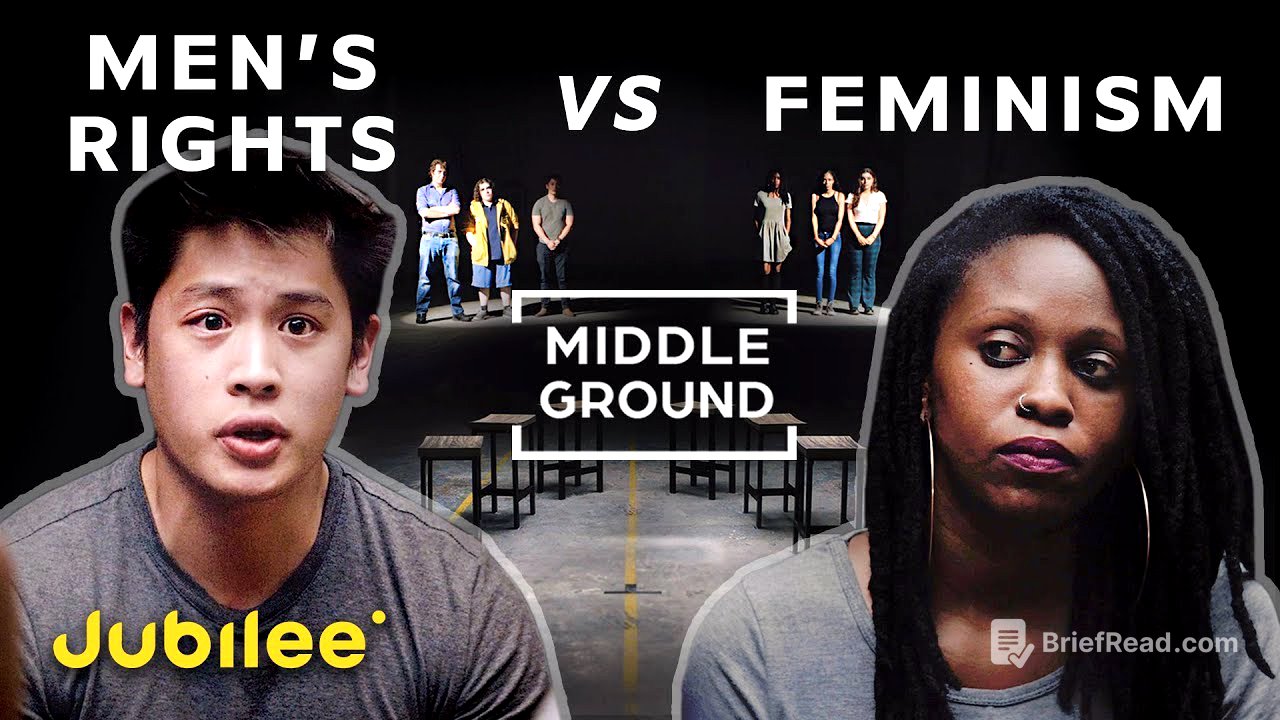
This episode of Jubilee's Middle Ground brings together feminists and men's rights advocates to discuss their perspectives on gender equality, toxic masculinity, and the challenges each group faces. The conversation explores fundamental disagreements about the existence of systemic discrimination against women, the definition and impact of toxic masculinity, and the validity of men's rights activism. Participants share personal experiences and discuss potential areas of common ground, such as biases in the court system, but also reveal deep ideological divides that hinder mutual understanding and empathy.
- Participants from both sides share their personal experiences and perspectives.
- The discussion highlights fundamental disagreements about gender equality and the validity of men's rights activism.
- The conversation explores potential areas of common ground, such as biases in the court system.
Introductions and Initial Definitions [0:26]
The host introduces the concept of Middle Ground, emphasizing the importance of dialogue and understanding in the face of disagreement. Participants are asked to define feminism and men's rights, revealing differing perspectives. Feminism is described as fairness, but also critiqued as misguided and flawed, even associated with Marxism by one participant. Men's rights are viewed with suspicion, with some associating the phrase with aggression, while others define it as advocating for the human rights of men. The participants express their hopes for the conversation, aiming for insight, understanding, and agreement where possible.
Beliefs on Gender Differences and Equality [2:17]
Participants discuss whether they believe men and women are different but equal. While acknowledging biological differences, feminists emphasize the historical and ongoing systemic discrimination against women, citing the wage gap and limited rights. Men's rights advocates agree on biological differences and legal equality but dispute the existence of systemic discrimination against women, dismissing the wage gap as a debunked concept. One participant compares the legal status of women to that of children, arguing for different treatment based on perceived needs for protection. The discussion touches on traditional gender roles, with some arguing that men and women complement each other and that attempts to equalize them are detrimental to child-rearing and overall well-being.
Toxic Masculinity [5:40]
The conversation shifts to the concept of toxic masculinity, with feminists describing it as the harmful idea of what masculinity should be, often involving violence, power, and control. They share personal experiences of how toxic masculinity manifests in everyday life, such as young boys being told not to cry and men feeling entitled to women's attention. Men's rights advocates question the definition of toxic masculinity, asking whether it is inherent to men or a product of upbringing and environment. One participant shares his personal experience of being raised by a single mother and feeling the need to be told to "act like a man," while another argues that showing emotions is a sign of weakness, particularly in front of women.
Advantages of Women [9:34]
The discussion explores the idea that women have more advantages than men today. Men's rights advocates argue that affirmative action and a strong advocacy for equal representation in the workplace have led to women being favored in hiring decisions. They claim that men are being excluded from certain positions and that women have an easier time finding relationships. Feminists counter that women still face significant challenges, such as having to consider their safety when going out and experiencing entitlement from men. The conversation touches on issues such as the tampon tax and the dismissal of women's health concerns.
Men's Rights at Risk and the Need for Allies [17:01]
The participants discuss the ways in which men's rights are at risk, with men's rights advocates citing disparities in health conditions, the criminal justice system, family courts, and the educational system. Feminists argue that men's rights activism is often a response to women seeking equality and that it does not focus on actual men's rights issues. The conversation explores the idea of men and women being allies, with feminists calling on men to speak to other men about toxic behavior. Men's rights advocates express skepticism about repeating feminist talking points and suggest that a return to traditional values might be beneficial.
Understanding and Empathy [20:23]
The discussion turns to the importance of understanding and empathy between the two sides. Feminists share personal stories of harm they have experienced from men, expressing frustration when their experiences are dismissed or invalidated. Men's rights advocates emphasize the need to avoid bias based on emotional testimony and argue that the feminist ideology is built on a fallacy that causes real consequences for men. One participant expresses empathy for women but states that society is not patriarchal, it's not traditional. Another participant feels empathy for personal experiences, but cannot sympathize with the ideological position.